A bare-metal command line for every peripheral on the board
Situation
The day after. DRAM worked over FEL, so I had 2 GiB and a CPU that does exactly what I tell it. What I didn’t have was any idea whether the rest of the board was alive under my code: eMMC, the SDIO Wi-Fi, Bluetooth, the Ethernet PHY, the IR receiver. The vendor image talks to most of it through blobs.
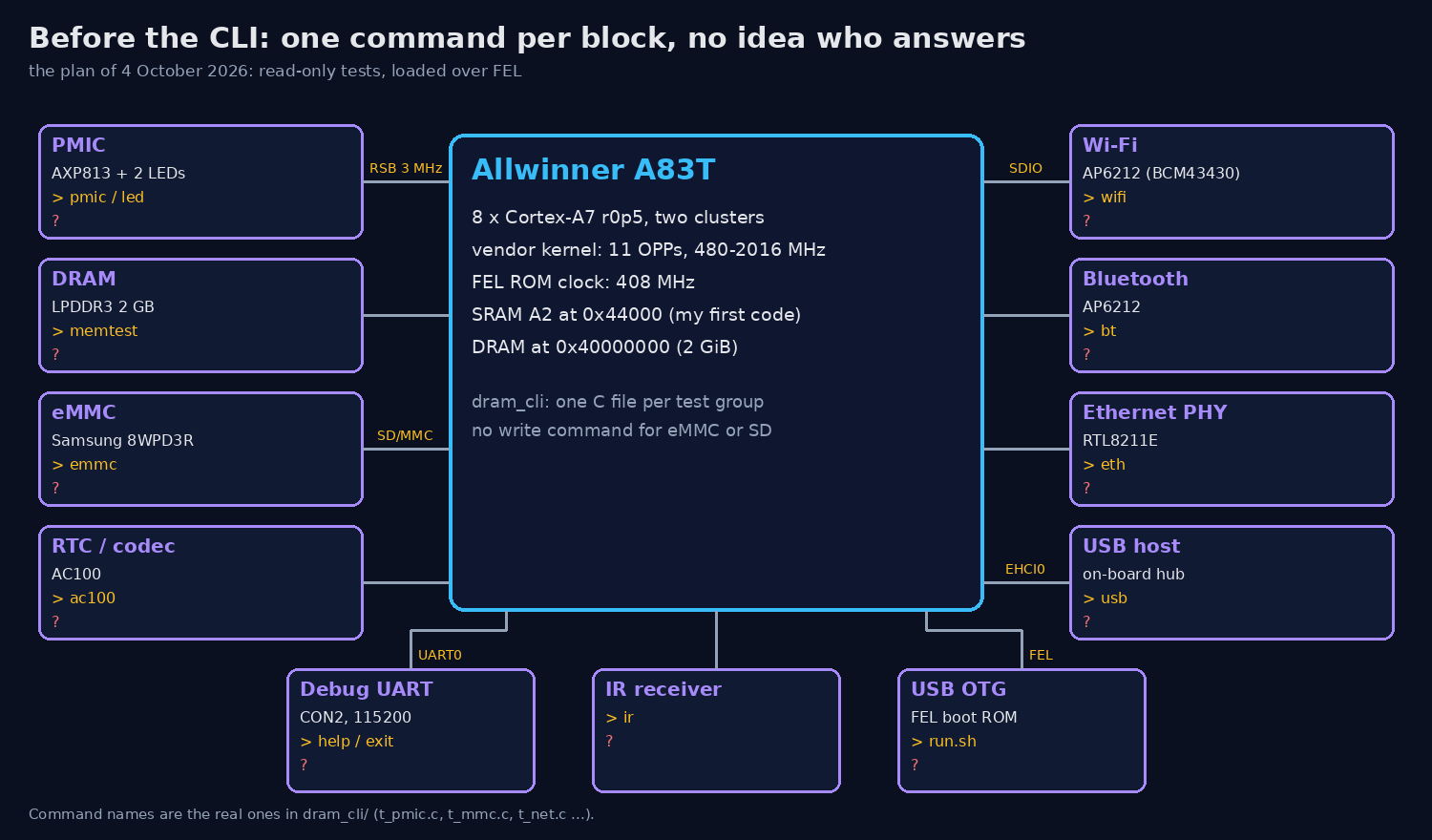 The plan for the CLI: one command per block, and at that point a question mark on every one of them.
Task
One program on UART0 (CON2) with a command per peripheral, read-only for storage, that I can load,
poke, and exit back to FEL for the next build. No U-Boot, no OS.
Action
It’s loaded the same way as the DRAM blink: ddr_init.bin first, then cli.bin at 0x40000000.
There’s no write command for eMMC or SD, on purpose.
$ make                      # cli.bin, about 29 KiB
$ sh run.sh                 # board in FEL: DRAM init, load, start
$ python3 cli.py /dev/ttyUSB0 help info pmic emmc
$ python3 cli.py /dev/ttyUSB0 exit
Getting it to run taught me a few rules the hard way. Anything written before .bss is cleared
must not live in .bss: my exit once restored a stack pointer of 0. FEL writes the new image behind
the cache, so invalidate the I-cache before turning it on. With the MMU off, unaligned loads fault,
hence -mno-unaligned-access. The SD/MMC module clock has to run before the controller reset can
finish, or it never does. The first temperature sample reads 0 until a conversion ends, so throw it
away. And every polling loop has to reach its timeout test on every path, because the one path that
skipped it was a hang.
One issue from that session is still open. My suspect: I had a second serial terminal on the same port
while cli.py ran, and two readers on one port split the bytes between them.
Result
| Command | Result on my board |
|---|---|
info |
Cortex-A7 r0p5, 408 MHz (ROM clock) |
memtest |
64 MiB, 0 errors, 16 MB/s with caches off |
pmic |
AXP813 IC 0x51, ACIN + VBUS present, every rail read |
emmc |
Samsung 8WPD3R, 7456 MiB, MBR, boot0 checksum OK |
temp |
3 sensors, about 39 to 44 °C |
eth |
RTL8211E, PHY ID 001c:c915, link down (no cable) |
wifi |
SDIO CMD5 answers: Broadcom 02d0 / BCM43430 a9a6 |
bt |
HCI reset ok, BT 4.1, Broadcom, subversion 2209 |
usb |
EHCI0 port enabled, high-speed device (on-board hub) |
ir |
12-bit fixed-code remote, 6 codes decoded |
ac100 |
RTC running, still at 1970 (never set) |
i2c |
TWI0 to 2 scan: nothing on CON1 (nothing plugged in) |
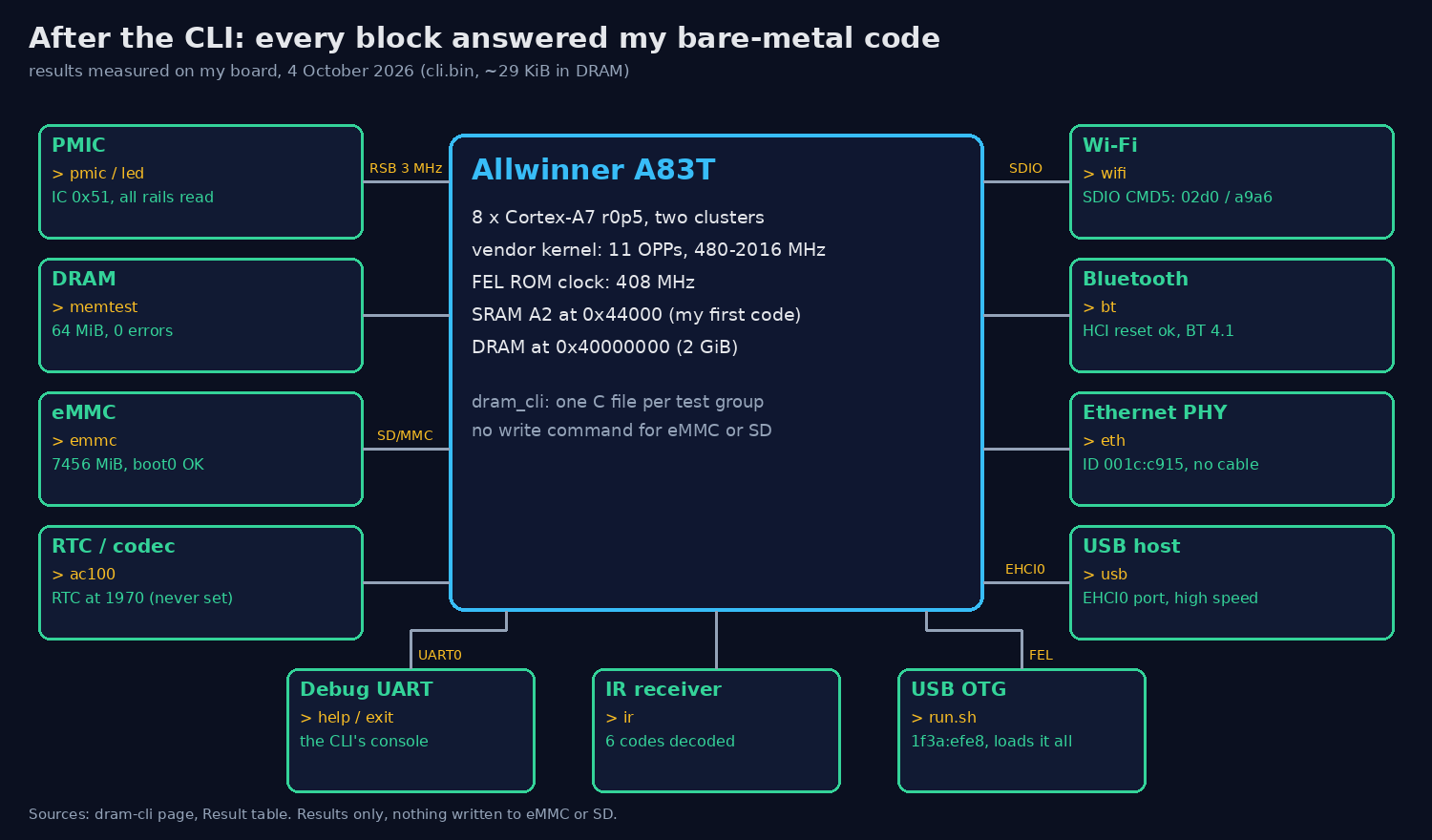 Same diagram afterwards: every block answered, from the AXP813 (IC 0x51) to the IR receiver (6 codes).
Also there: timer (Timer1 at 24 MHz; the ARM generic timer isn’t counting, the ROM leaves it off),
led/key, pin/header (all 40 pins of CON1 with function and level), sd (no card in the slot).
What I’d do next
Close that open issue for real, with only one program on the port. And use this as the test bed when the mainline image finally boots: every number in the table above is something Linux should agree with.