Thanh LeLê Quang Thành
Embedded / firmware engineer at Amazon. At home, most evenings, a dev board and a UART cable.
I like getting a board to boot my way: from the boot ROM up, with my own code, and usually without Linux. This site is where I write down what broke and what I measured, so the next time I hit the same wall I don't start from zero.
Around the boards there are robots (mostly in simulation so far), AI models running on the board itself, and a C++ control library I check against simulated plants before it ever drives a motor.
| Day job | Embedded / firmware engineer |
| Employer | Amazon |
| Boards on the bench | 12 |
| Board stories (STAR) | 63 |
| Robots | 5 |
| AI on the board | 13 stories |
| Writing here since | 2017 |
Where it started
§1My undergraduate thesis was a small humanoid robot on SG90 servos. I drew it in SolidWorks, worked out the DH table and the inverse kinematics, and planned its walking in simulation before running it on the controller.
One wrong angle in a matrix and the leg goes somewhere you didn't expect. I've liked working at that level ever since: close to the hardware, where a number is either right or the thing falls over.
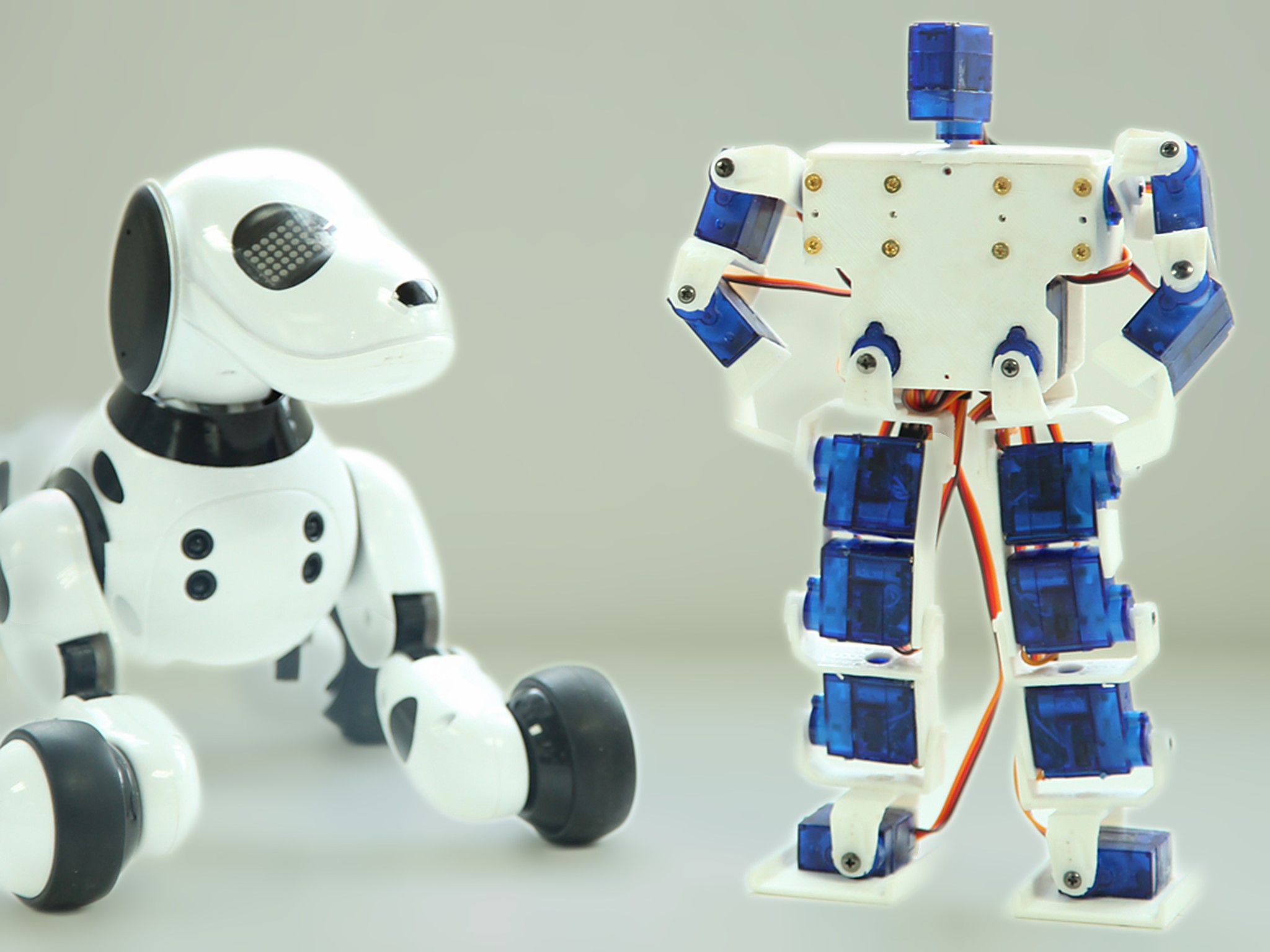 Thesis robot, version 2: 3D-printed again, same size and SG90 servos
The two I spent the most time on are the ROCK 3A and the NanoPi 2 Fire. Then there are the old boards I like pushing past what their vendors shipped. Each card is the one number that board is known for on this site.
Radxa ROCK 3A
FreeRTOS on core 3 at 154 ms after power-on, my own Debian 13 on the other three; the NPU with no Linux; a RISC-V MCU that watches the webcam with all four A55s off; LEDs that follow the music; Android 14.
S5P44181.5 % CPUNanoPi 2 Fire
A 2016 quad Cortex-A9 with no NPU: webcam to HDMI on FreeRTOS, then face detection.
Snapdragon 800Android 15DragonBoard 8074
A 2013 dev kit that shipped with Android 4.3, now on kernel 6.6 with HDMI and local AI.
BCM283543.5 msRaspberry Pi 1 (2012)
No Linux: a face detector on the 12 QPUs, 2.37 s down to 43.5 ms per picture.
Older posts are still here too: my Yocto port of the ROCK 3A, the ESP8266 boot sequence and flash map, a Pi that pretends to be a Bluetooth keyboard and mouse, and Linux networking notes on where a packet actually goes inside the kernel.
Beyond the boards
§3 · robots, AI on the board, control, MCUsRobots, in MuJoCo first
A dinosaur on my own frame, my thesis humanoid, a Microduck, DYNAMIXEL servos and a Hokuyo lidar. The dino walks 30 of 30 runs on perturbed robots, in simulation.
Edge AI13 storiesAI on the board itself
Face detection on an NPU with no Linux, on a 2016 Cortex-A9 and on a 2012 Pi's QPUs; an offline Vietnamese voice assistant; an LLM on a 2013 phone chip.
C++170.77 sA control library, in simulation
PID, LQR, MPC, ADRC, sliding mode and estimators, each checked against a plant. Back from windup in 0.77 s instead of 108.
ESP32-S330.3 fpsMCU demo apps
USB device demos and a USB webcam on the ESP32-S3: 640×480 scaled to 320×240 at 30.3 frames a second.
What's next
§4 · started, not finished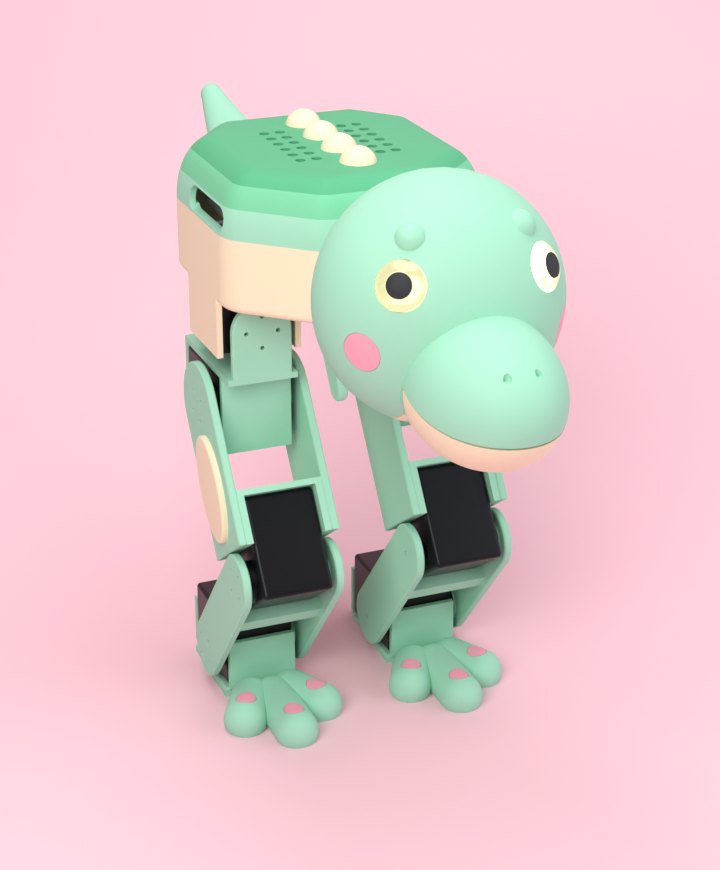
A two-legged dinosaur
On a frame I drew myself: 13 DYNAMIXEL servos, LCD eyes, a passive TPU tail. So far it stands, walks (40.7 mm/s) and roars only in MuJoCo. Maybe a kit later. (Render of one variant.)
A Microduck
The small duck robot from Pollen Robotics and Hugging Face that learns to walk by reinforcement learning. Official policies run in simulation; no servos bought yet.
Parts as code
The 3D-printed parts for both robots, drawn in CadQuery, with a script that checks every size and hole before I export the STL.
Pi 5 off QEMU
FreeRTOS borrowing core 3 of a running Linux passes all its checks in QEMU. Next it has to run on the real board.