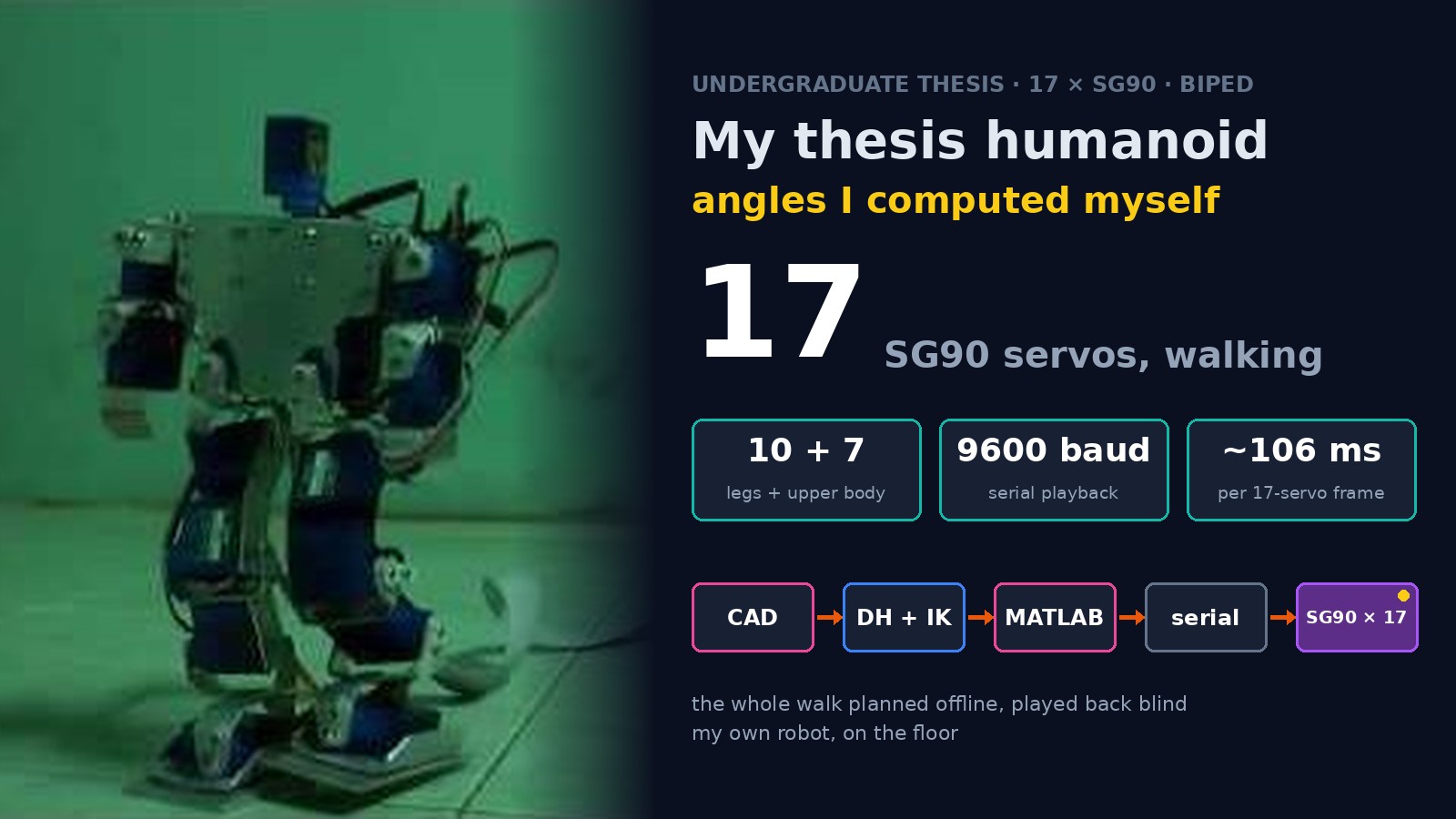
 17 SG90s walking on the floor from angles I computed myself.
Situation
This is the robot I built for my undergraduate thesis: a small biped with 17 blue SG90 hobby servos (10 in the legs, 7 in the upper body), aluminium brackets holding them together, and a ribbon cable trailing behind it on the floor. SG90s are the tiny plastic-gear servos everyone has in a drawer. They are weak, so the whole robot had to stay small and light, because every gram on the upper body is something the hips and knees have to hold up.
Task
Make it walk from angles I worked out myself, not from a canned servo sequence: a model of the body, the kinematics of the legs, a planned path for the feet and hips, and only then the real servos.
Action
I modelled the body in SolidWorks first, so I knew where every servo sat and how long every link was.
From the model came the Denavit-Hartenberg table for the legs and the transform matrices. Boring, and one wrong sign here breaks everything after it.
Forward kinematics tells you where the foot is for a set of joint angles. Walking needs the opposite: I want the foot here, which angles do I send? So I solved the inverse kinematics and planned the path for the feet and the hips.
Then I ran the trajectories in a simulation with the controller in the loop, so the mistakes showed up on screen instead of on the floor. The whole walk was planned offline in MATLAB, turned into servo pulses, and uploaded frame by frame over a 9600-baud serial link to a microcontroller that played them back at a fixed delay.
Result
The angles went to the SG90s and the robot walked on the floor; that is the first video on this page. I uploaded the step-by-step videos in March 2019.
What I’d do next
Because the walk was played back blind, with no feedback from the servos or an IMU, it only worked on a flat floor; and at 9600 baud a frame for all 17 servos takes about 106 ms, so it could never react fast. Years later I picked the same problem up again in simulation with my own kinematics library; that story is on the humanoid hub.