Walking in MuJoCo: two feet in one place, and the one feedback that paid
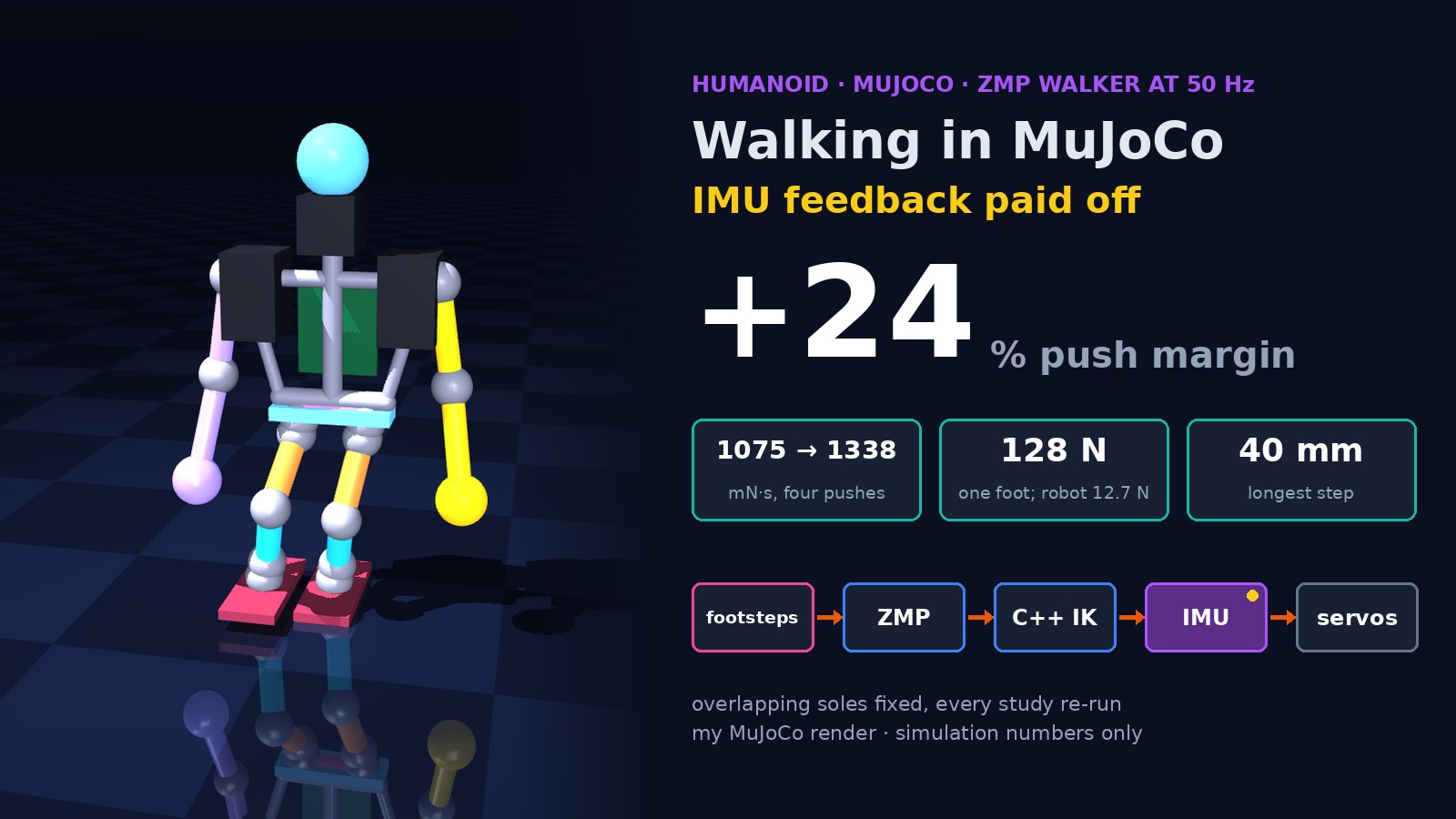 In MuJoCo, IMU feedback lifts the push margin from 1075 to 1338 mN·s (+24 %).
Situation
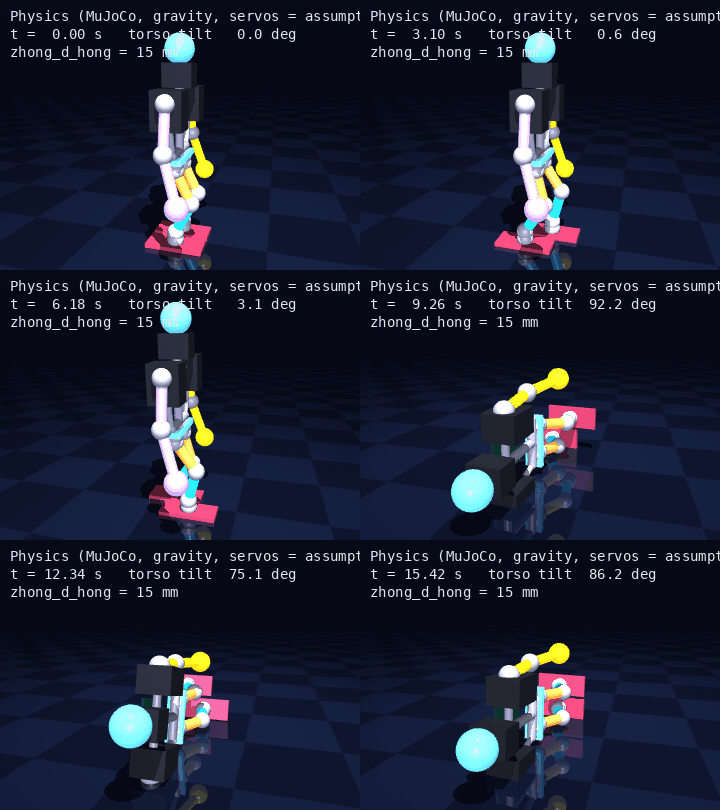
Once the IK hit its targets (previous story), I put the robot in MuJoCo with gravity and position servos. The thesis gait, with its default 15 mm hip sway, went over sideways.
I own DYNAMIXEL MX-28 and AX-12A servos, so I modelled those per joint: MX-28 at 77 g and 2.5 N·m stall, AX-12A at 54.6 g and 1.5 N·m, a plastic body around 1.3 kg. The masses are guesses. The first study told me I needed at least eight MX-28 in the legs because the hips peaked at 2.1 N·m. That turned out to be wrong, see below.
Task
Replace the offline gait with an online walker: a footstep plan gives a ZMP reference, a ZMP preview controller (Kajita 2003) turns it into a centre-of-mass path, the pelvis is placed so the whole-body CoM follows it, the C++ IK gives ten joint angles, and the IMU’s roll and pitch bend the stance ankle back upright. 50 ticks a second, same code for MuJoCo and for the real servo bus. Then try four upgrades (IMU feedback, LIPM preview, the online loop, capture steps) and keep only what survives the same push test.
Action
The open-loop LIPM walk fell at 5.1 s even though its ZMP reference looked right. So I logged the centre of pressure and the load on each foot. At t = 1.2 s one foot carried 128 N. The whole robot weighs 12.7 N.
The soles were 50 mm wide and their centres 40 mm apart: the two feet overlapped and MuJoCo was
pushing them apart with ten times the robot’s weight. I cut the soles to 34 mm and tightened the
contact settings (cone="elliptic" impratio="10" noslip_iterations="4"). Same script after:
t 1.26 roll -0.9 zmp_ref y -16.0 COP y -16.1 load L 12.6 N R 0.0 N left foot y -20.0
joint p 0 i 0 att 0: fell False nan tilt 1.9 fwd 190.7/195
Load equals weight, the CoP sits on the reference, and open loop walks the full distance. That bug had fed every earlier conclusion, so I re-ran all of them and wrote a correction on the project page instead of quietly editing. Real peak hip torque: 0.29 N·m, not 2.1. No servo saturates, every leg layout with MX-28 stays up, and the hip sway works anywhere from −5 to 10 mm, so the default became 0.
The push test hits the walking robot with a 0.1 s shove in four directions at four different times and records the largest one it survives (worst case). Later I added the servo torque–speed limit (MX-28 55 rpm no-load) and a skeleton torso, and re-ran everything again. These are the final numbers:
| Set-up (as walk_stress.py labels it) | +y | −y | +x | −x | Sum, mN·s |
|---|---|---|---|---|---|
| LIPM open loop, 0.8 s single support | 137.5 | 137.5 | 337.5 | 437.5 | 1050 |
| LIPM open loop, 0.5 s single support | 150 | 150 | 375 | 400 | 1075 |
| + IMU attitude | 225 | 225 | 425 | 462.5 | 1337.5 |
| + quick step | 137.5 | 175 | 387.5 | 375 | 1075 |
| + capture-point placement | 162.5 | 162.5 | 350 | 375 | 1050 |
Capture-point foot placement made every test worse. The log shows why: the position servos pull the body back towards the plan after a push, so the capture-point error swings back past zero within 0.25 s (+22 mm, then −28 mm after a 0.35 N·s forward push). A foot that follows it steps the wrong way. A deadband and a “never step back” latch reduced the damage but never turned it into a gain. Both are still in the code, switched off, for the real robot, whose servos are softer than my model.
Result
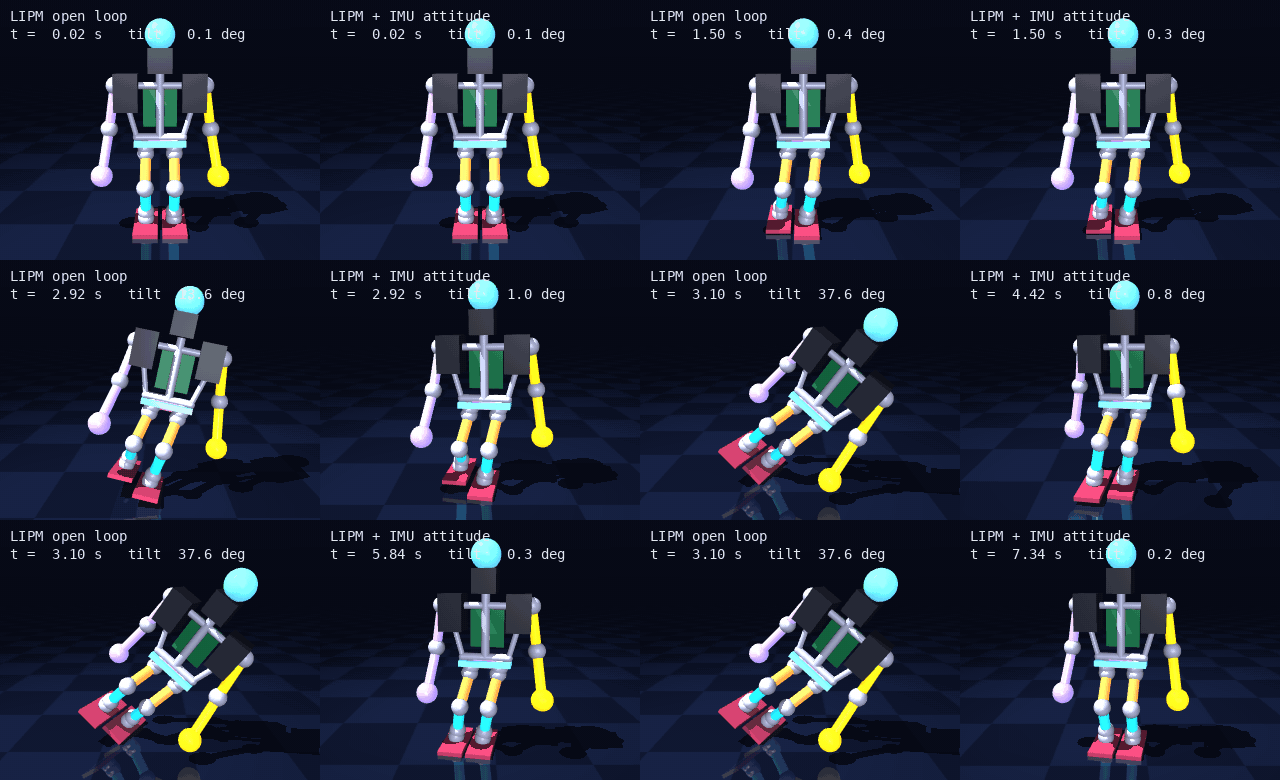
In MuJoCo, IMU attitude feedback is the one upgrade that pays: the push margin goes from 1075 to 1338 mN·s (+24 %), and sideways, the direction this narrow-footed robot falls, from 150 to 225 in each direction. A 0.5 s single-support phase takes the same pushes as 0.8 s and walks 1.6 times faster.
The servo speed limit is what caps it. Steps up to 40 mm walk (234 to 256 of 260 mm); 50 mm and longer fall in every set-up because the swing foot would have to move faster than 55 rpm allows. Before I added the limit, 70 mm walked. That number belonged to the model, not to the servo. One tick costs about 6 to 10 ms of Python out of the 20 ms budget.
What I’d do next
The margins move by ±50 to 100 mN·s for small model changes (the skeleton torso alone moved open loop from 1113 to 1075), so I only compare set-ups measured on the same model. The real numbers will come from weighing the parts and measuring the servo stiffness on a bench, and from putting an actual IMU on the robot. Until then the 1338 is a simulation number.