Hokuyo URG-04LX lidar (2D, 240°)
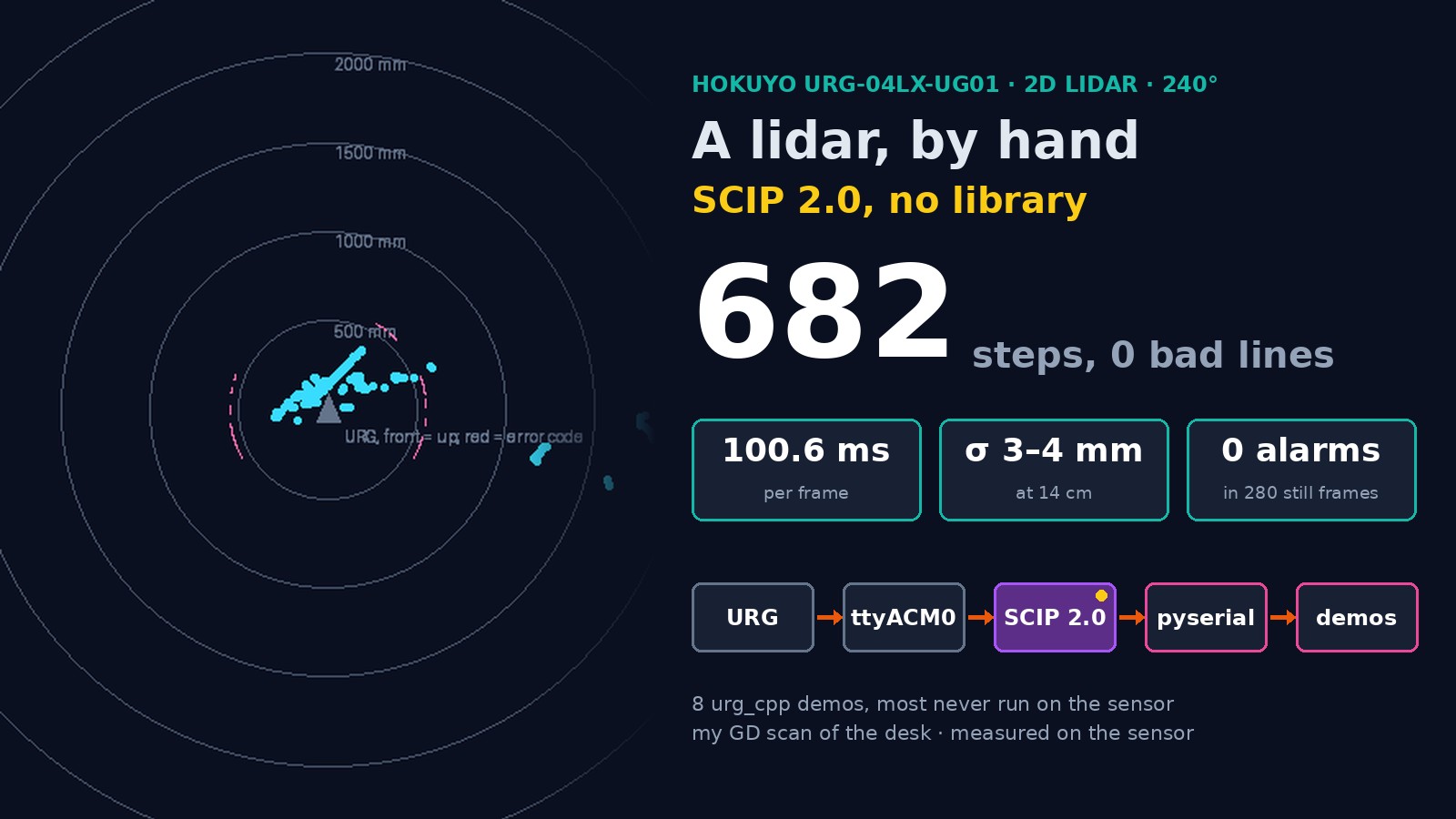 682 steps per scan, 0 bad checksum lines, a frame every 100.6 ms.
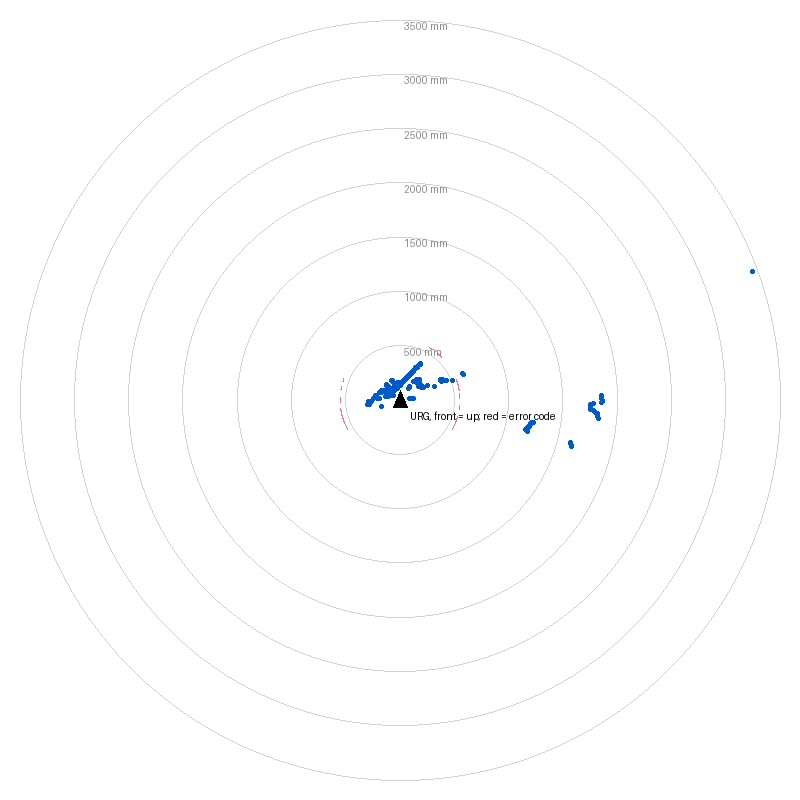
The URG-04LX-UG01 is Hokuyo’s small 2D laser scanner. It spins at 600 rpm, sweeps 240° in 682 steps of 0.3516° (360/1024, exactly), and
measures 20 to 5600 mm. It’s USB powered and shows up on Linux as a plain CDC-ACM serial port,
/dev/ttyACM0, no driver. Mine reports firmware 3.4.03 from December 2012. Hokuyo discontinued it
and says indoor use only.
I had eight little demos for it on top of Hokuyo’s open-source urg_cpp library (a point reader,
an object clusterer, safety zones, a CSV logger, a people counter and a few more). In September
2026 I plugged it in again and wanted two things: see the protocol for myself, without the library,
and find out whether those demos actually worked. Most of them had never run on the sensor.
The stories
| # | Story | Result | Status |
|---|---|---|---|
| 1 | Talking SCIP 2.0 to the URG-04LX by hand A raw client in Python and C++: 6-bit text encoding, a checksum that skips the semicolon, and two stream bugs of my own |
682 steps per scan with 0 bad checksum lines, 100.6 ms per frame, σ 3 to 4 mm at 14 cm (the spec allows ±30 mm) | Done |
| 2 | A safety zone that was always CLEAR, and an intrusion alarm that never stopped Running my eight urg_cpp demos on the sensor for the first time: a step-versus-index bug and mixed pixels |
zone_monitor now flags the object at 113 mm it used to call CLEAR; scan_diff: 0 false alarms in 280 frames (before: every frame) | Done |
Still open
Three checks need someone in front of the sensor: wave a hand or a box through the scan while
scan_diff runs (I only proved it no longer raises false alarms, not that it still catches real
changes), put an object down for dimension_measure, and hold a hand on the sensor’s left to see
whether the zones called LEFT and RIGHT are swapped. I suspect they are, because angles grow
counter-clockwise on the URG line, but I haven’t checked. I also never measured how the error codes
behave on dark, shiny or edge-on surfaces, and I haven’t tried the commands that change the bit
rate or motor speed.