A safety zone that was always CLEAR, and an intrusion alarm that never stopped
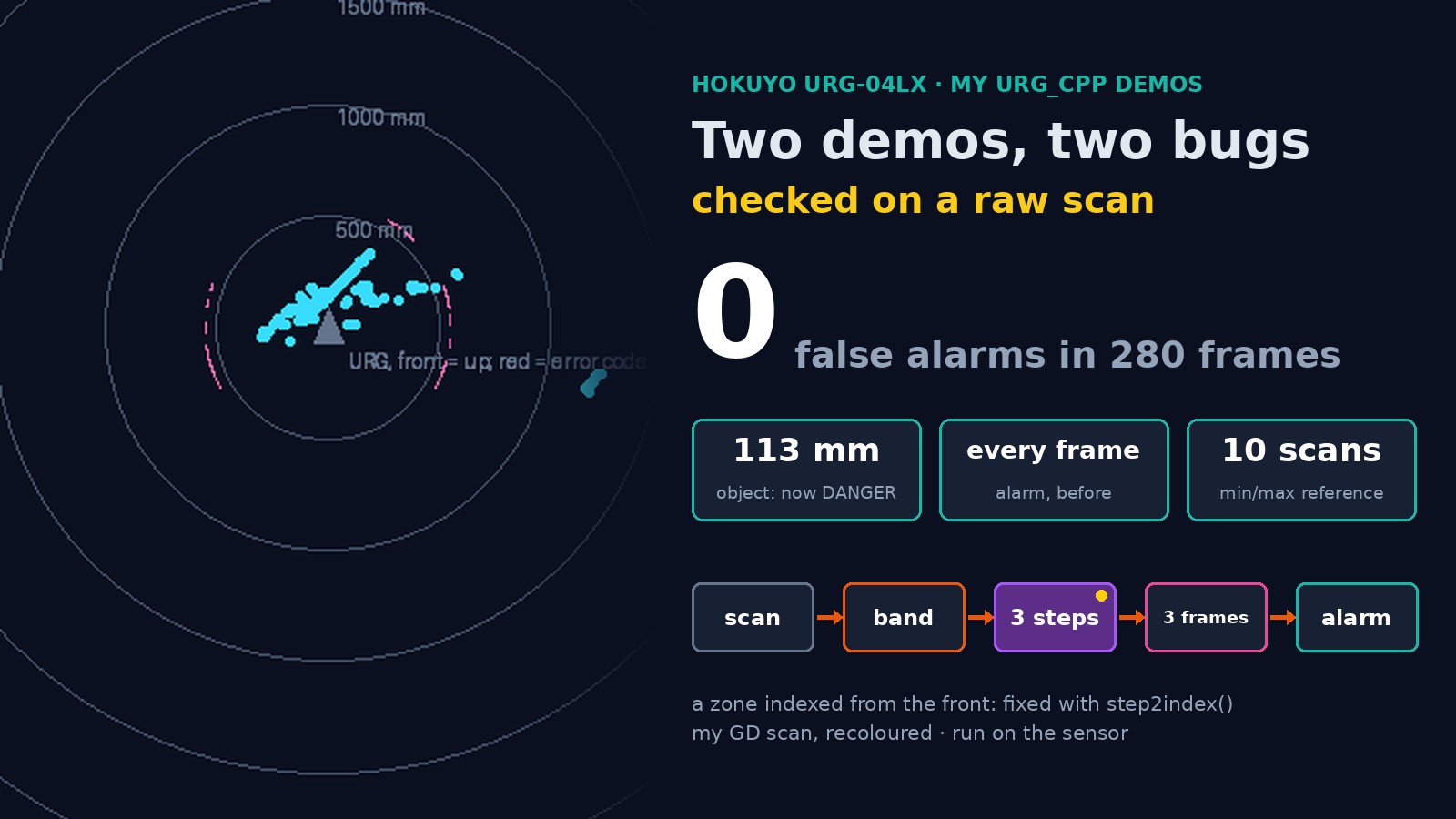 0 false alarms in 280 frames, where the old scan_diff fired on every one.
Situation
Of my eight urg_cpp demos, only two (urg_reader and csv_logger) had ever run on the sensor.
All eight built cleanly, which proves nothing. With the raw SCIP client from the
previous story I finally had
something to compare their output against.
Task
Run the other six on the real sensor, compare what they report with a raw scan of the same desk, and fix what’s wrong.
Action
Four of them loop until Ctrl+C, so I ran them under timeout -s INT 4. All six opened the sensor
and ran. Two looked wrong straight away. scan_diff 200, on a desk where nothing moved, printed a
change on every frame:
Reference OK (726 points). Monitoring changes > 200mm
[CHANGE] 2 points differ | biggest: -84.7° 164mm->565mm (Δ401mm) at (52,-563)
[CHANGE] 3 points differ | biggest: -75.6° 1030mm->1630mm (Δ600mm) at (406,-1579)
That’s the mixed-pixel effect: a beam that hits the edge of an object sometimes returns the object
and sometimes the wall behind it, and the reference was a single scan. And zone_monitor printed
Read error on Ctrl+C because the signal cut into a read and the loop left through its error
branch.
While fixing the Ctrl+C thing in zone_monitor I read check_zone() and found a worse bug. It
loops from deg2step(min) to deg2step(max) and uses that as the array index. But steps are
counted from straight ahead (0 = front), and the array starts at the beginning of the scan range.
I checked it with a few lines of C++ before touching anything:
deg2step(-90)=-256
deg2step(-45)=-128
range -135..+135: size 726 index2deg(0)=-135.00 index2deg(size-1)=119.88 step2index(0)=384
So the −90° to −45° zone mapped to negative indices, got skipped, and always said CLEAR.
dimension_measure had the same bug and only looked at half of its ±45° window. The other demos
use index2rad(i) on array indices and were fine. The fix is step2index().
For scan_diff I first planned a median of several scans as the reference. When I wrote it I
switched to a [min, max] band per step over 10 scans: an edge pixel that flips between two values
is off the median half the time, but if it flipped while the reference was taken, both values are
inside its band. On top of that an alarm needs at least 3 adjacent steps out of band for at least
3 frames in a row. The price, written in the file header: about 300 ms of delay, and nothing
narrower than 3 steps (roughly 18 mm at 1 m) is seen.
Result
Reference OK: 586 of 726 steps usable, widest band 144 mm at -107.2 deg
Alarm when >= 3 adjacent steps are > 200 mm outside the band for >= 3 frames
Done. 280 frames, 5 with raw point changes, 0 alarm(s)
0 alarms in 280 frames (30 s) on a still desk, where the old version fired on every frame. The band alone cut raw differences to 5 of 280 frames, and the adjacency and duration rules removed those.
zone_monitor now agrees with a raw scan in all three zones. The −90..−45° zone has an object at
113 mm (at −62.6°) and says DANGER, where the old build said CLEAR. Ctrl+C prints Stopping. and
nothing else.
What I’d do next
The other direction is untested: does scan_diff still catch a real change? That needs a hand in
the beam. And I want to settle which side “LEFT” really is before anyone trusts these zone names.