DragonBoard 8074
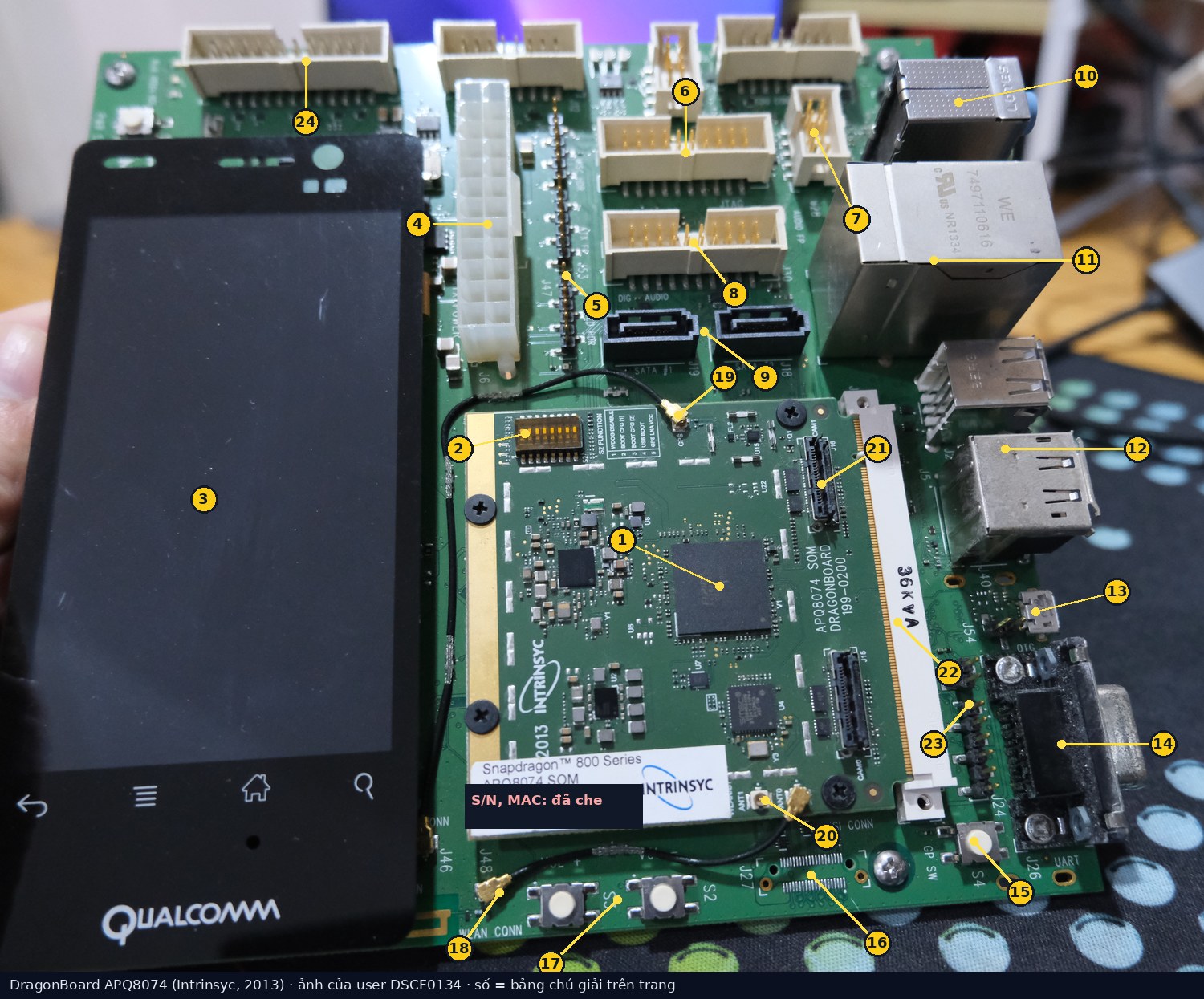
This is Intrinsyc’s DragonBoard 800 development kit from 2013: a Qualcomm APQ8074 (Snapdragon 800, the modem-less twin of the phone chip MSM8974) on a small SOM, plugged into a Mini-ITX carrier with ATX power, SATA, Gigabit Ethernet, USB 3.0, a DB9 UART and JTAG. Four Krait cores up to 2.15 GHz, an Adreno 330, 2 GB of LPDDR3, 16 GB of eMMC, and a qHD touch panel. Same chip family as the Galaxy Note 3.
Mine shipped with Android 4.3 and a 3.4 kernel (not the 4.4.2 the product page promised). I wanted to know how far a 13-year-old phone SoC can go with today’s software. The answer turned out to be: a lot further than I expected, but nearly every block needed a kernel patch, and a couple of them nearly cost me the board.
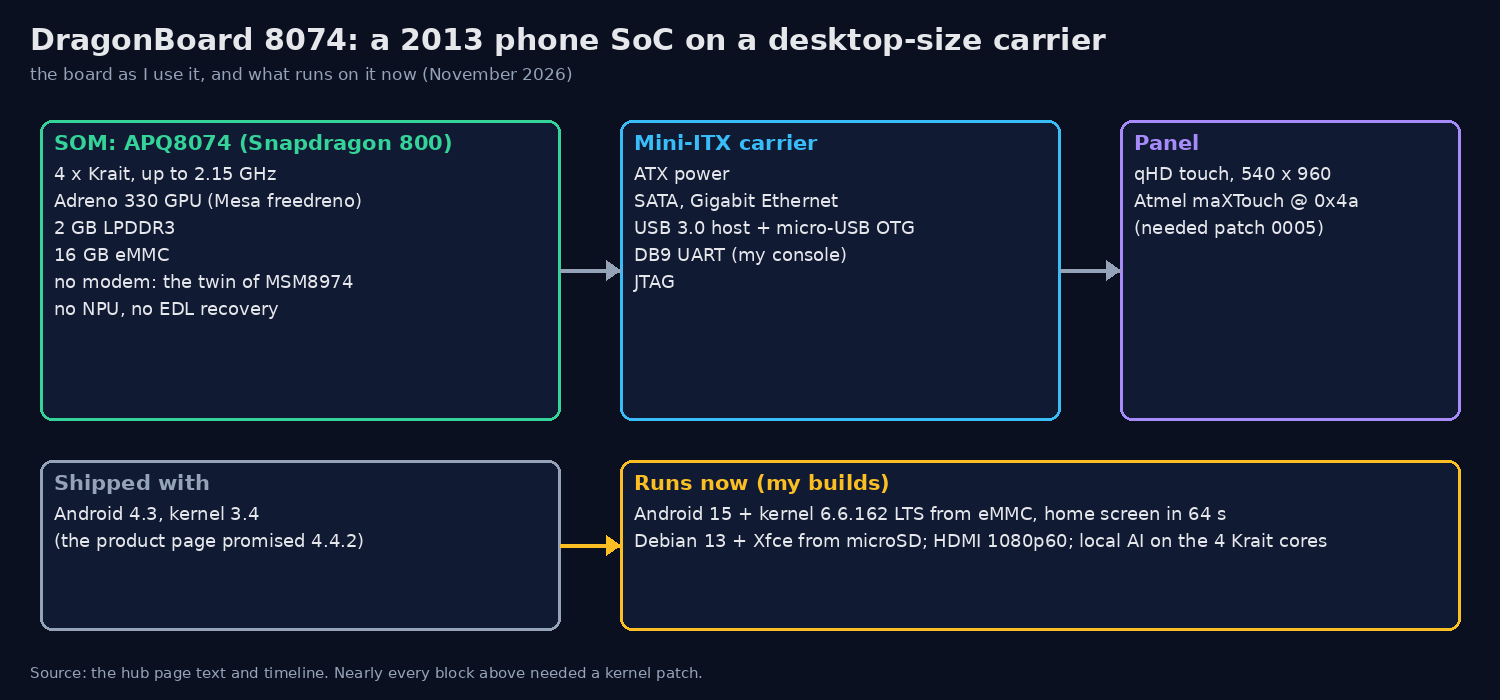 The board in one picture: APQ8074 SOM on a Mini-ITX carrier, the qHD panel, and what runs on it now vs what it shipped with.
What I got it to do
I built Android 15 (android-15.0.0_r36) with kernel 6.6.162 LTS, booted it from RAM first and then from eMMC by itself, all without touching the stock boot chain. Touch, the GPU (Mesa freedreno) and the CPU at 2.15 GHz took the boot to the home screen from 264 s down to 64 s. HDMI needed a ported PLL, and a GPU hang turned out to be the memory shrinker. Debian 13 with Xfce runs from microSD, and USB host, HDMI sound and Bluetooth work too. Later the eMMC got a new partition table (/data from 864 MiB to 10 GiB), and the four Krait cores ran local AI models, helped by an L2 cache driver I wrote. The backlight flicker I traced to the WLED switching frequency.
The write-ups
Each one is Situation / Task / Action / Result, with the numbers I measured on the board.
| # | Story | Result | Status |
|---|---|---|---|
| 1 | Android 15 on a board that shipped with Android 4.3 Building AOSP 15 + kernel 6.6 for the APQ8074, booting it from RAM first, and the long list of things between it and a home screen |
Launcher3 home screen on the panel; boot from eMMC in 66 s | Done |
| 2 | From 264 s to 64 s: touch, a real GPU, and the Krait cores at 2.15 GHz The board ran very slowly. A GPU driver, ported CPU tables and one interrupt firing 59 000 times a second |
Boot to home 264 s to 64 s; CPU 0.80 to 2.15 GHz; a DSI IRQ from 59 000/s to 1/s | Done |
| 3 | HDMI from an unmerged patch, then a GPU hang that wasn't the GPU Porting the MSM8974 HDMI PLL to kernel 6.6, and chasing 'gpu lockup' down to the memory shrinker |
HDMI at 1080p60 on kernel 6.6; GPU hangs from 5 to 10 a minute down to 0 in 41 min | Done |
| 4 | Re-partitioning the eMMC without the command that would have erased it Android said storage was full. /data was 864 MiB. The fix needed a new GPT, and fastboot was the wrong tool |
/data from 864 MiB to 10 GiB, 15 bytes changed per GPT copy | Done |
| 5 | Local AI on a 2013 phone chip, and an L2 cache stuck at 576 MHz No NPU, no GPU compute: LLM, speech and vision on four Krait cores, then a new driver so the L2 follows the CPU |
Qwen2.5-0.5B at 4.15 tok/s; L2 driver lifts 4-thread memory read from 4433 to 7084 MB/s | Done |
Still open
The hardware video codec (Venus) is ported but not running. The offline Vietnamese voice assistant (listen, think, speak, sentence by sentence) works end to end in emulation on my PC, but hasn’t run on the board yet, so it isn’t written up. HDMI still needs enabling by hand after each boot.