From 264 s to 64 s: touch, a real GPU, and the Krait cores at 2.15 GHz
Back to the DragonBoard 8074 hub
Situation
November 2026. Android 15 reached the home screen, but touch didn’t work, HDMI was black,
and the whole thing was very slow: 264 s to boot_completed, and sluggish after that. The CPU sat at
0.80 GHz and the GPU wasn’t used at all.
Task
Touch first. Then make the CPU run at its real maximum and get the GPU doing the drawing.
Action
Touch. The panel’s Atmel maXTouch at 0x4a on BLSP1 I2C1 is in the stock device tree but not in mainline. I copied the node across and enabled the driver:
atmel_mxt_ts 0-004a: Family: 129 Variant: 1 Firmware V2.0.AB Objects: 16
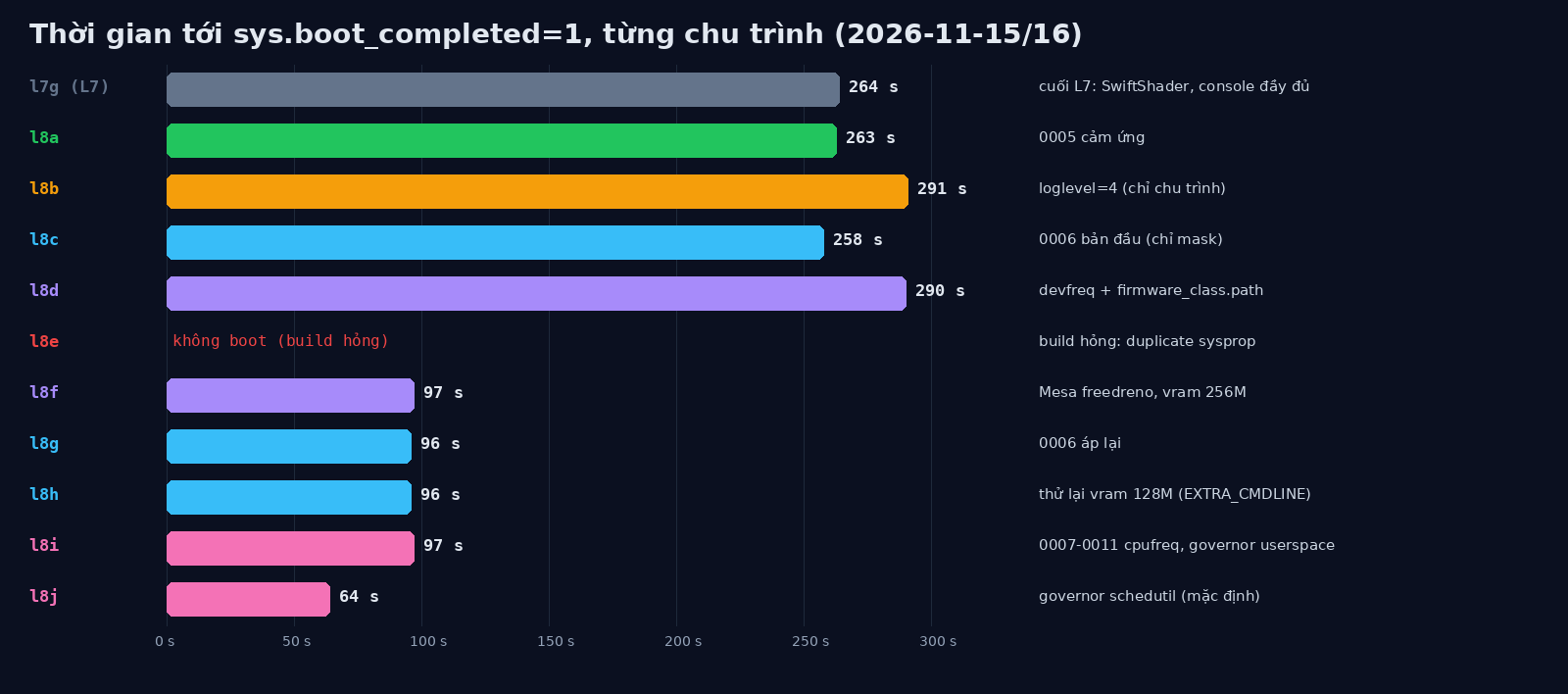
GPU. Mesa freedreno instead of SwiftShader. That one change took the boot from 290 s to 97 s.
CPU. Mainline has no Krait frequency tables for this chip. Five patches port the vendor ones; the fuse reads speed bin 2, PVS 4, PVS version 0, which picks 13 OPPs from 422.4 to 2150.4 MHz. With schedutil, 97 s became 64 s.
The hidden CPU eater. Even then one core was busy doing nothing useful. /proc/interrupts showed
the DSI error interrupt firing about 59 000 times a second (once per video line), and its worker eating
52 to 100 % of a core. A patch brings it down to about once a second. My first version of it only
looked fixed: the screen had gone to sleep, so of course there were no DSI interrupts. I only caught
that by re-measuring with the screen on.
One thing that didn’t help, for the record: changing the console log level alone (291 s).
Result
Boot to boot_completed=1 went from 264 s to 64 s (the chart above, ten cycles). The CPU went from
0.80 to 2.15 GHz: I measured 2.15033 GHz on all 4 cores at 1100 mV and 60 °C. The DSI error IRQ
dropped from about 59 000 a second to about 1. And touch works.
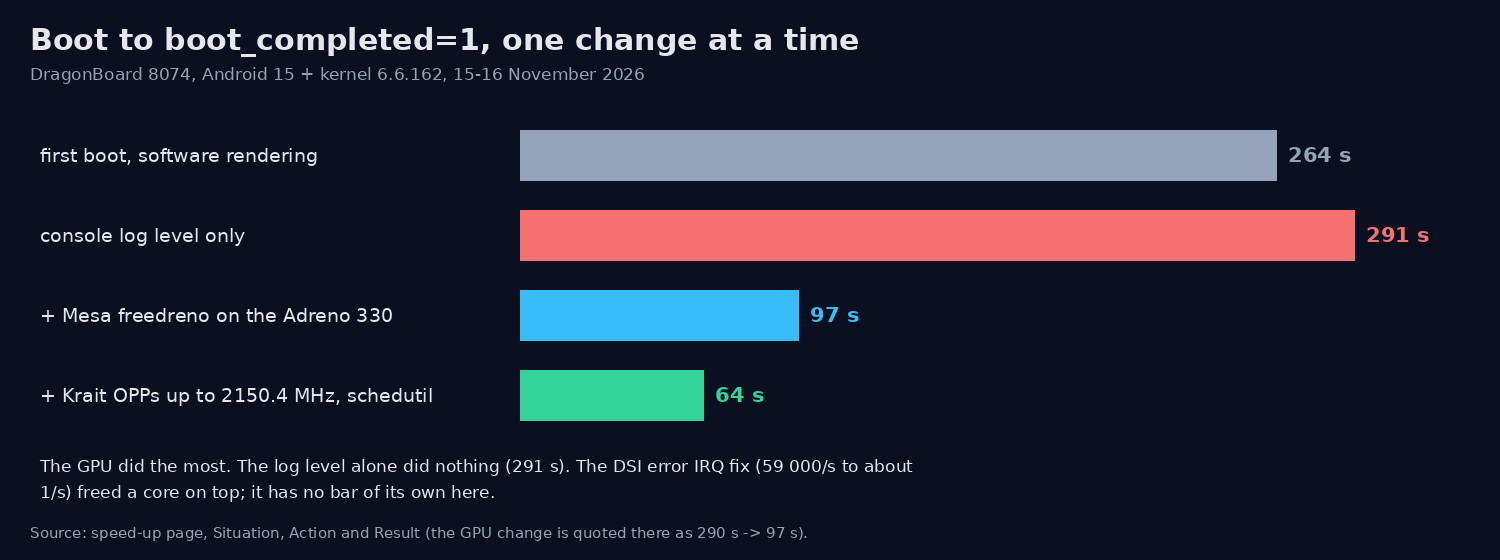 The same story in four bars: the log level did nothing (291 s), the GPU did most (97 s), the Krait clocks did the rest (64 s).
The catch: under a 4-core load without a heatsink it hits the 75 °C trip and throttles between 0.88 and 2.15 GHz.
What I’d do next
A heatsink. And the GPU at 450 MHz: I added the OPP later, but the GPU mostly idles, so I haven’t seen it matter yet.