HDMI from an unmerged patch, then a GPU hang that wasn’t the GPU
Back to the DragonBoard 8074 hub
Situation
November 2026. Touch and the panel worked, HDMI showed nothing. No mainline kernel has the HDMI PLL for MSM8974; it lives only in the vendor 3.4 kernel. A day later, with HDMI working, a new problem: after some minutes of use the screen turned to garbage and then HDMI went black.
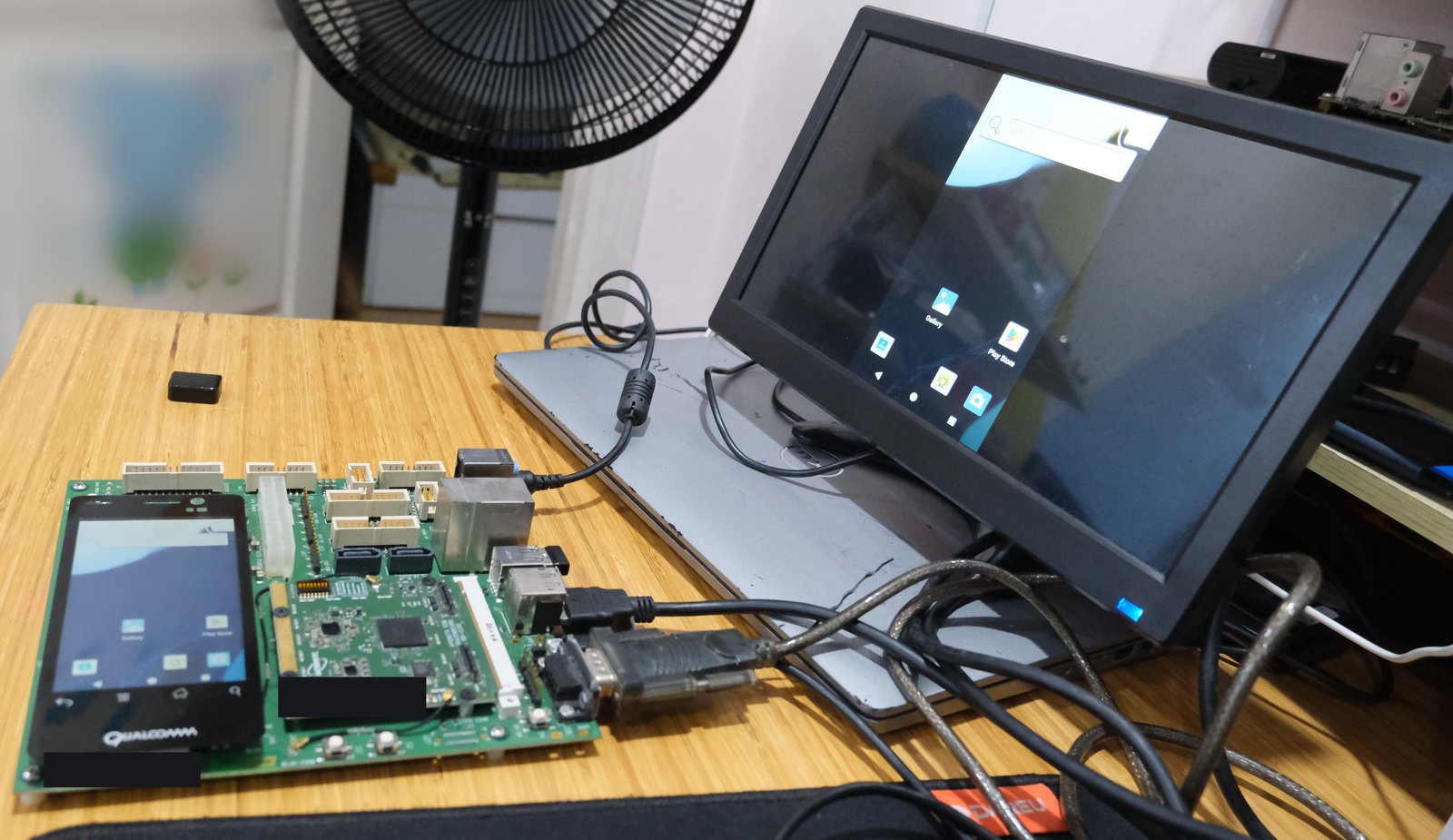 My desk with HDMI working: the panel and the external monitor both showing Android. Labels painted over, the room behind blurred.
Task
Drive HDMI from kernel 6.6. Then make the board survive more than a few minutes of real use.
Action
The PLL. I started from Dmitry Baryshkov’s “drm/msm: add support for HDMI on msm8974” RFC from May
2023, never merged, but tested on this very board, with the PLL code from Brian Masney’s 2019 RFC.
That became a 749-line PLL driver, plus device tree nodes for the SoC and for the board’s connector
and supplies. I didn’t trust the tables blindly: every register value of the 7
pixel rates I kept was checked against the vendor’s clock-mdss-8974.c, 38 writes each.
On the board the kernel side came up at once: PLL registered, 7 rates from 25.2 to 148.5 MHz, the
connector connected, EDID 256 bytes. Still black. Two blockers above the kernel:
- drm_hwcomposer put 6 planes on one CRTC, and the MDP5 v1.2 mixer refused it about 60 times a
second (
too many planes! cnt=6). Fix:vendor.hwc.drm.use_overlay_planes=0. - Android 15 waits for the user to confirm mirroring to a new display. Fix:
cmd display enable-display 2.
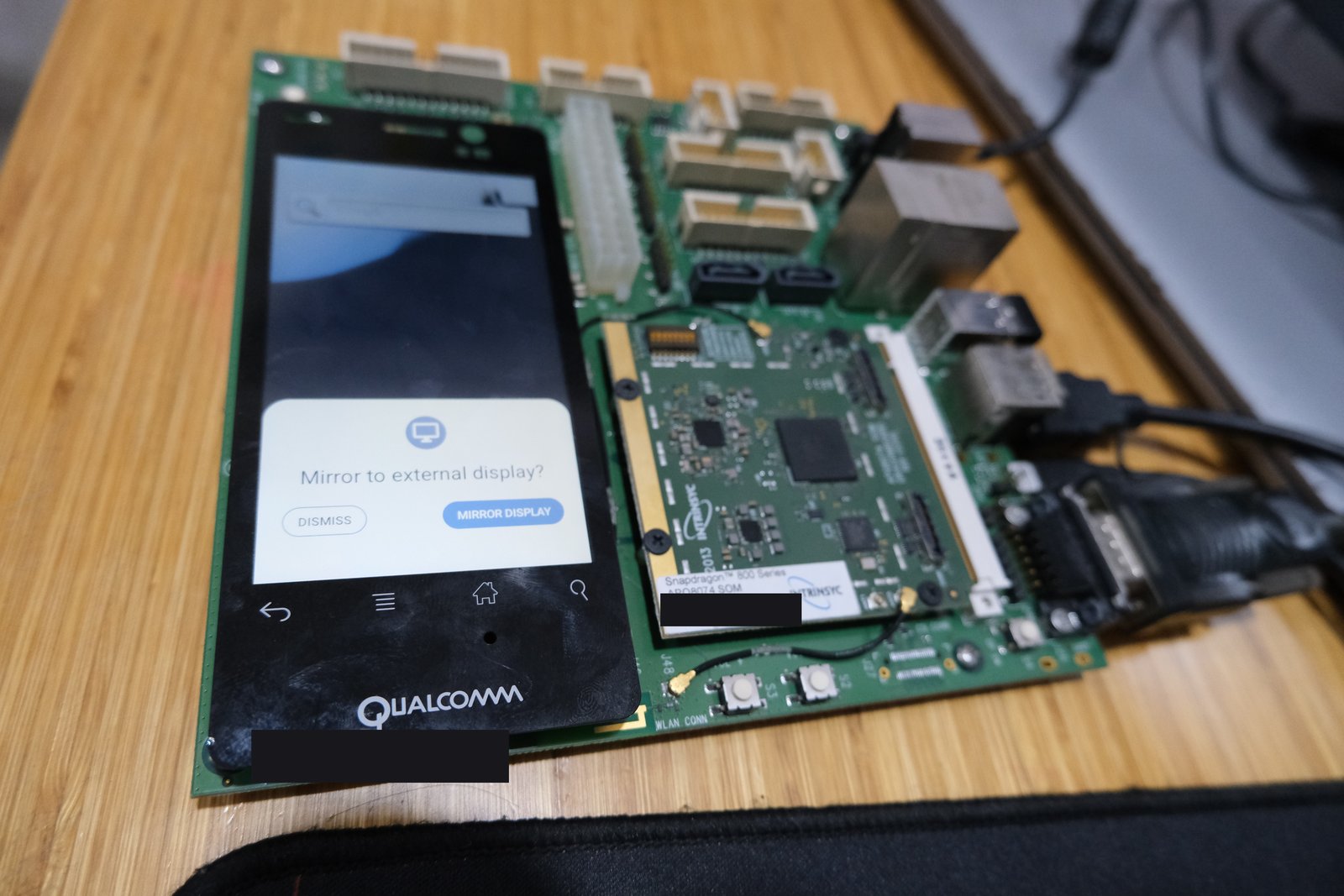 Blocker 2 in the flesh: Android 15 asking on the panel whether to mirror to the new display. Until someone answers, HDMI stays black.
Then hdmi_pll = 148 500 000 Hz (1080p60) and a picture on the monitor.
The hang. The log, every couple of seconds:
msm_mdp fd900100.display-controller: [drm:hangcheck_handler] *ERROR* 3.3.0.1: hangcheck detected gpu lockup rb 0!
msm_mdp fd900100.display-controller: [drm:recover_worker] *ERROR* 3.3.0.1: offending task: RenderThread (com.android.systemui)
My first suspects were my own ports and the GPU clock. Neither: an older known-good kernel hung the same way, and every rate gave 5 to 10 hangs per minute:
max 450000000: 6 hangs in 60 s
max 200000000: 5 hangs in 60 s
max 27000000: 10 hangs in 60 s
I’d briefly believed “cap the GPU at 320 MHz and it stops”. Wrong: the dmesg ring buffer had wrapped, so my hang counter simply stood still. The test above clears dmesg first.
The real cause is in the figure. With no IOMMU, every GPU buffer lives in a 256 MiB VRAM carveout, and its GPU address is set once. With zram on, kswapd runs the msm shrinker, which “evicts” idle buffers. For a carveout buffer that means: drop the contents, free the range, and leave the GPU and the display still pointing at the old address. The next allocation gets the same range, and two buffers share memory.
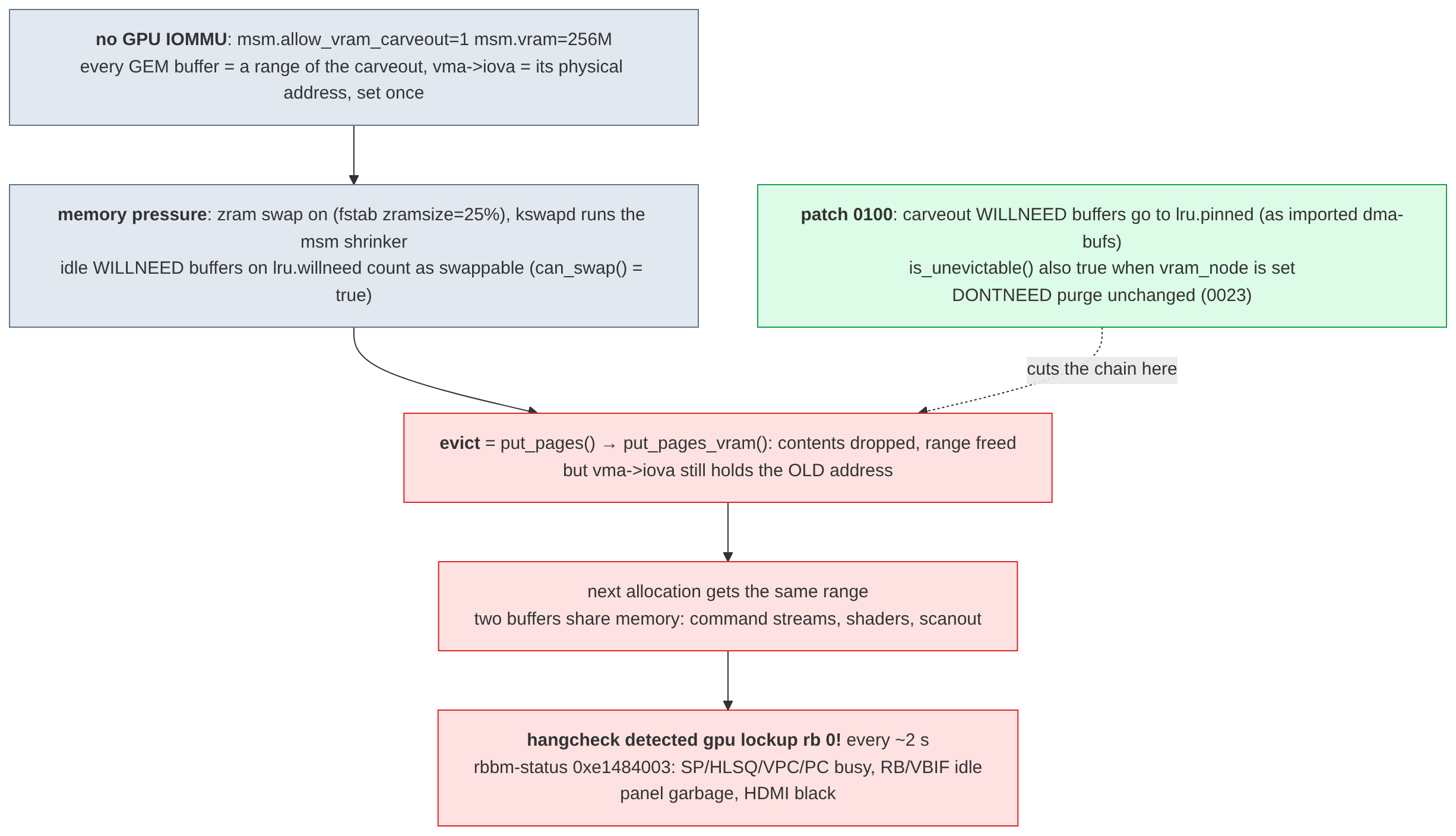
Patch 0100 keeps carveout buffers that are in use off the shrinker’s list. A second small one adds
/sys/kernel/debug/dri/0/vram so I can see the carveout.
Result
HDMI runs from kernel 6.6 at 1080p60 (148.5 MHz pixel clock), and the DSI panel still works next to it. The GPU hangs went from 5 to 10 a minute to none: after patch 0100 I watched 41 minutes with HDMI on and 180 MB in zram, 0 hangs. The carveout used 62 644 KiB of its 262 144.
carveout 0x68100000 size 262144 KiB used 62644 KiB free 199496 KiB largest-free 190368 KiB
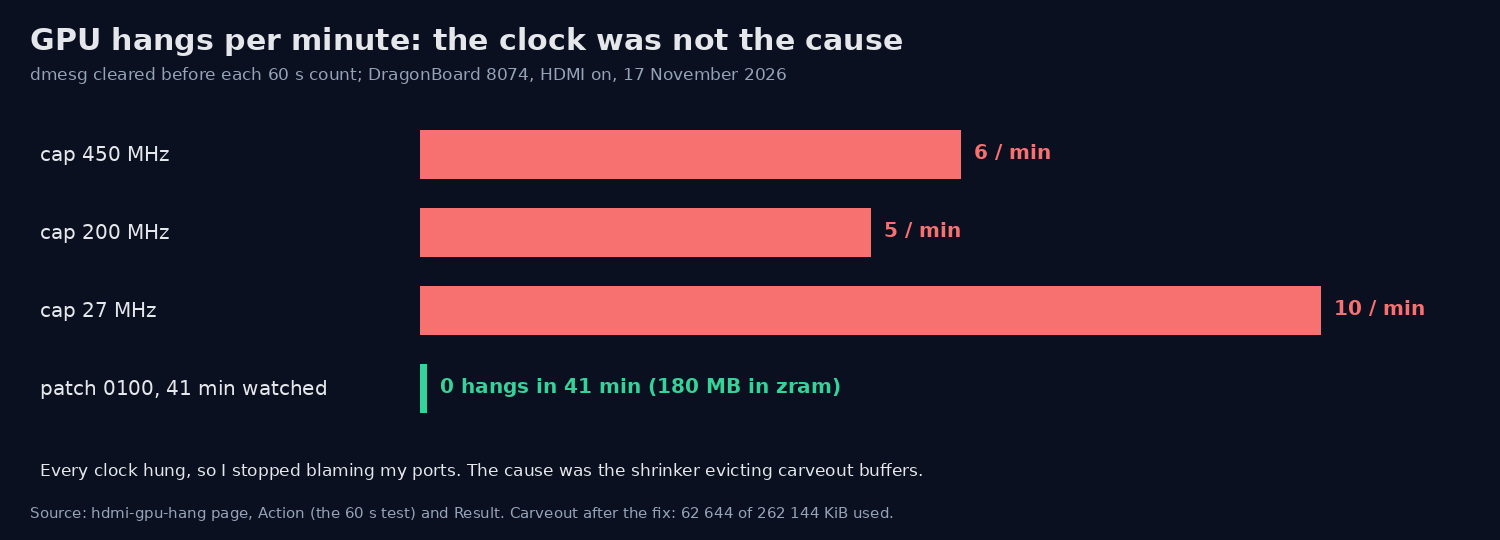 Why I stopped blaming the GPU clock: 6, 5 and 10 hangs a minute at three caps, then 0 in 41 minutes with patch 0100.
What I’d do next
The carveout was a workaround for “no IOMMU”. The same evening I asked myself why there’s no IOMMU at all, and backported Baryshkov’s (also unmerged) MSM8974 IOMMU series: Adreno and MDP5 in their own IOMMU groups, no carveout. In a 17-minute watch that gave 4 hangs, all in the first 2 minutes, none after, and 0 IOMMU faults. Those early hangs are still unexplained. HDMI also still needs enabling by hand after every boot.