XR829 Wi-Fi on mainline Linux 6.8: from 2 to 22 Mbit/s, and the culprit was the console
Back to the D1 Nezha hub · measured 2026-10-01
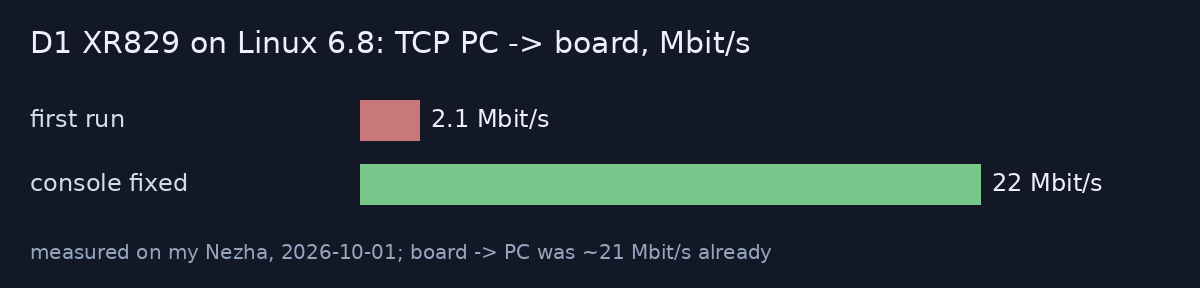
Situation
I’d started Wi-Fi on FreeRTOS: SDIO up, the XR829 firmware downloaded, and both passive and active scans worked. Joining a network was next, and that’s a lot of code to write blind. I wanted a reference first: the same chip, working, on a Linux I control, so I could compare against it. The XR829 driver only exists in Allwinner’s Tina tree, but someone in the community had ported it to Linux 6.8.
Task
Get the XR829 associated with WPA2, DHCP and ping on a mainline kernel, booted through my own chain over FEL (my boot0, OpenSBI, U-Boot), without touching the NAND. Then see what throughput it gets.
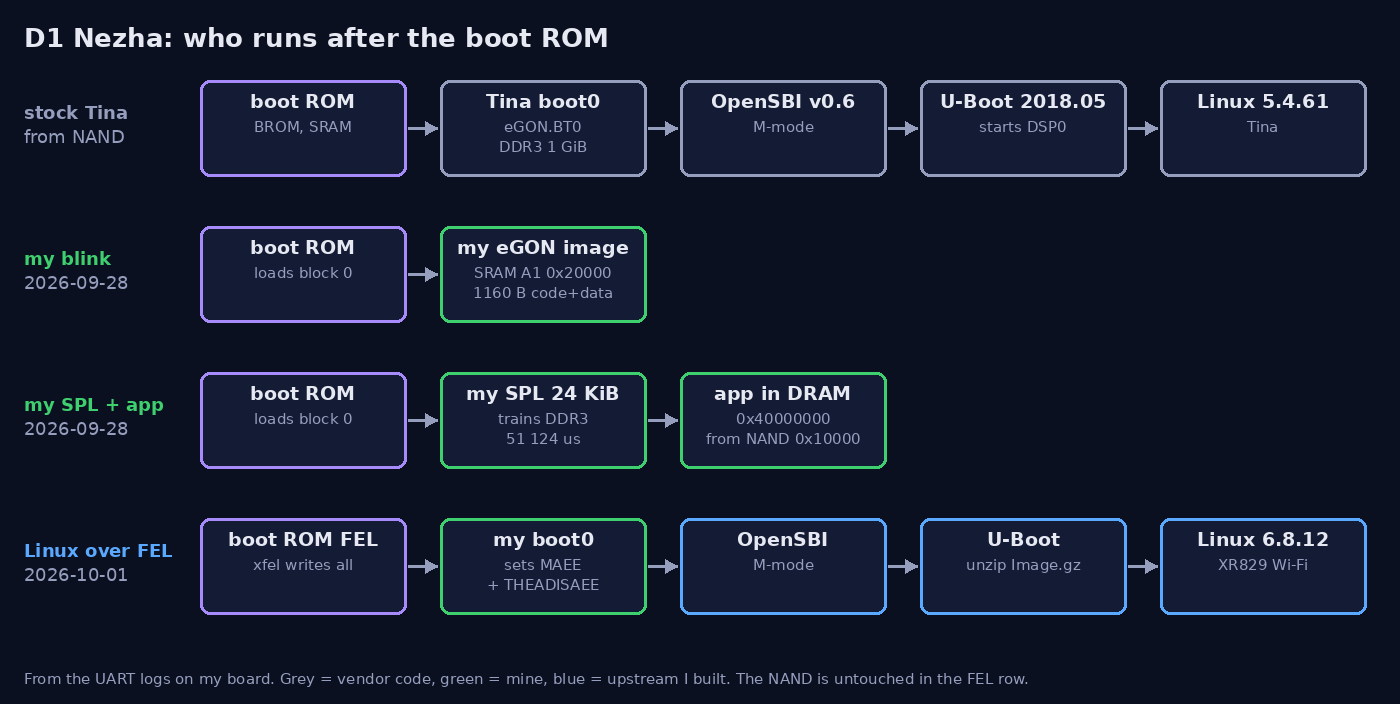 The bottom row is this story: everything written over FEL, my boot0 setting MAEE before OpenSBI, U-Boot unzipping the kernel, Linux 6.8.12 with the XR829. The NAND stays as it is.
Action
Kernel version. I tried the port against 6.18 first. Too far: after fixing the include path there were still 62 cfg80211 errors. 6.8.12, the kernel the port targeted, already has the D1 and the Nezha device tree. The port’s last commit was half done; about 25 changes to make it build, each marked in the source.
Five bugs before a shell had Wi-Fi. First, nothing after “Starting kernel”. With earlycon=sbi
it showed: the mainline DTB has no /memory node (the Nezha’s own U-Boot adds one, the generic U-Boot
doesn’t). The Makefile now adds 1 GiB at 0x40000000 with fdtput, and boots with panic=5 so a
panic resets the board back to my NAND CLI.
Then every /proc entry had an empty name and /proc/keys couldn’t be created. I’d built 6.8 with
GCC 15, a year newer than the kernel. Rebuilt with GCC 13.3: gone. (The cause is my inference; the
fix worked.) U-Boot’s booti refused to decompress at every address, so Image.gz (8 MB instead of
22 MB at 315 KB/s over FEL) gets unzipped by U-Boot’s unzip first.
The fourth one took longest. No wlan0, and every MMC data transfer hung on both controllers while
commands without data worked. 6.8 marks DMA-coherent memory (the SD controller’s descriptors)
non-cacheable with T-Head’s own page-table bits, and those only take effect when M-mode has set
mxstatus.MAEE. My boot0 never did. Setting MAEE (bit 21) and THEADISAEE (bit 22) before OpenSBI:
firmware loads, wlan0 exists.
Last, the AP authenticated us and even started the 4-way handshake, so it had accepted the
association, but cfg80211 was never told. The port called cfg80211_rx_assoc_resp() with an empty
struct. Passing the frame, its length, the request IEs, the BSS and the status (as the 5.15 driver
did) fixed it. WPA2-PSK, DHCP, ping.
Then iperf3. About 21 Mbit/s from the board, about 2 to it. Every encrypted frame also logged
Slowpath: tailroom is not big enough. Req: 8. Was it the radio? The SDIO interrupt? About 7000
interrupts for 3 MB, only 2 missed. UDP from the PC at 20 Mbit/s: 0 % loss. So receive was fine and
only TCP was slow, and TCP needs the board to send ACKs. Power save off: no change (2.37 Mbit/s).
The thing I kept looking past was that WARN line. printk to the serial console is synchronous: a 70-character line at 115200 baud takes about 6 ms. One per frame. With the console quiet: 2.4 -> 20.3 Mbit/s. Made permanent (warning lowered to a debug level, tailroom reserved in the driver), three runs per direction after a clean boot: 22 Mbit/s both ways, steady.
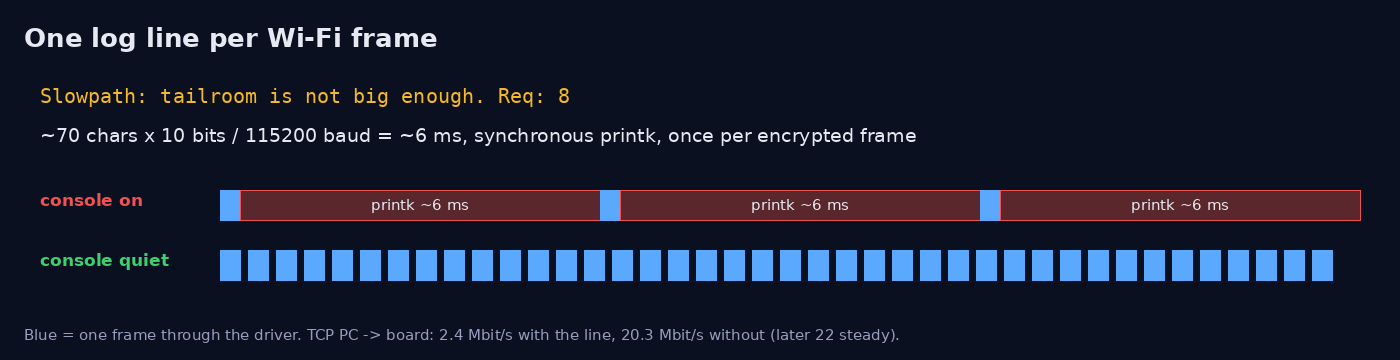 Why one WARN line mattered: at 115200 baud a 70-character line is about 6 ms of synchronous printk, once per frame. Blue is the driver’s actual work.
Result
The XR829 works on mainline Linux 6.8.12: WPA2-PSK, DHCP, ping, TCP, booted over FEL through my own boot0, OpenSBI and U-Boot, with the NAND never touched. TCP PC -> board went 2.1 -> 22 Mbit/s, board -> PC is ~22 Mbit/s.
Now it’s CPU-bound: the single 1 GHz core is ~95 % busy, mostly in the driver’s bottom half, which does one SDIO transaction per frame. The link reports MCS 7 (65 Mbit/s PHY), so the radio has headroom. The lesson I’ll keep: a log line per packet on a 115200 console is a 6 ms sleep per packet.
What I’d do next
Back to the FreeRTOS port with this as the reference: join, association, the WPA2 handshake, then
ARP/DHCP. On Linux, batching SDIO transfers in the driver is the obvious next win, but I couldn’t
profile it: Alpine’s perf pulls in libLLVM and Python (177 MB), which I didn’t want on a FEL-loaded
initramfs.