The webcam that kept dropping, and the LED ring that went dark
Back to the Pi 1 hub · measured 2026-10-26 and 2026-10-27
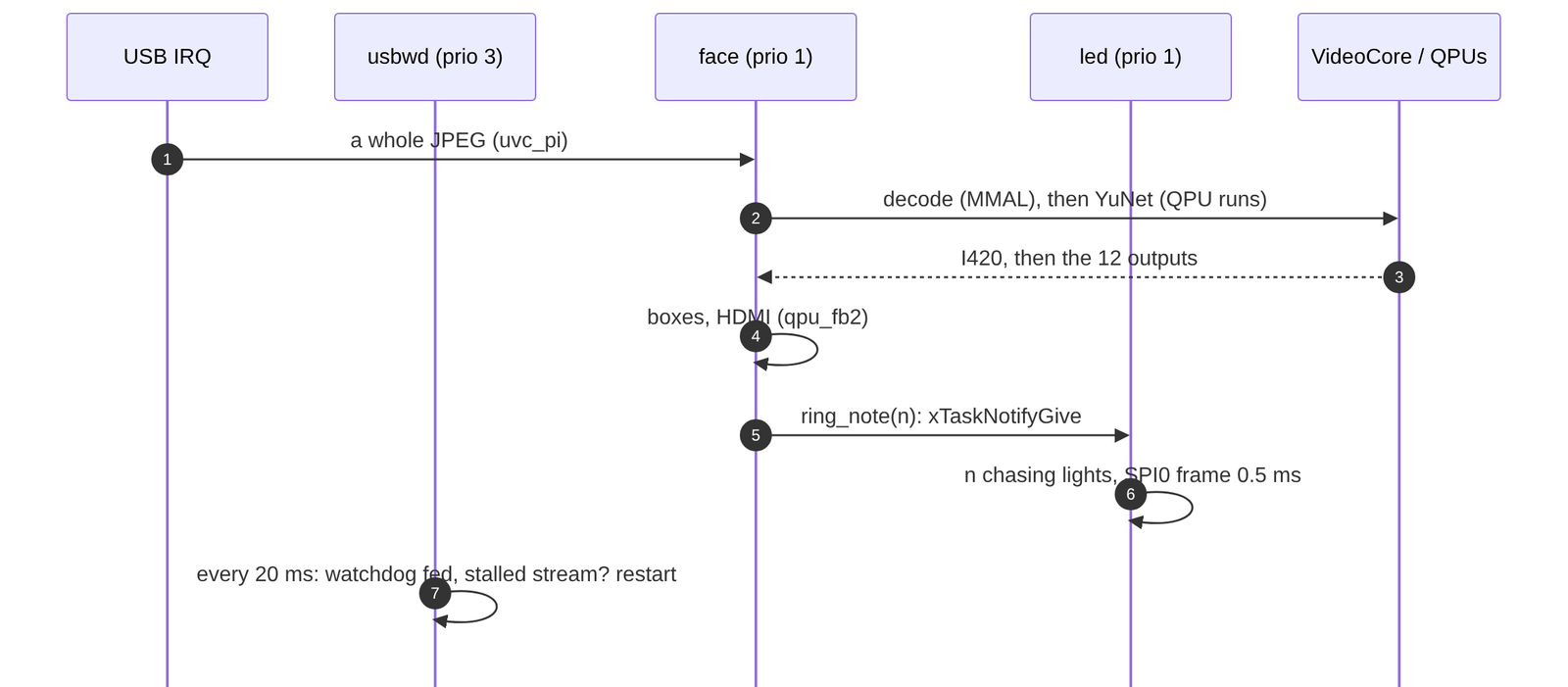
Situation
With the detector on the QPUs the Pi 1 could do a picture in under 50 ms. Live, it didn’t feel like it. The webcam (A4 Tech, isochronous, on the LAN9512 hub) would stop: its light went off and on, the picture froze. And it looked like it happened when a face showed up. I also had a 16-LED WS2812 ring on SPI0 (GPIO10, header pin 19) that should chase one light per face. At some point it just stayed dark.
Task
Make the stream stay up for minutes, find out whether faces really had anything to do with it, and get the ring back.
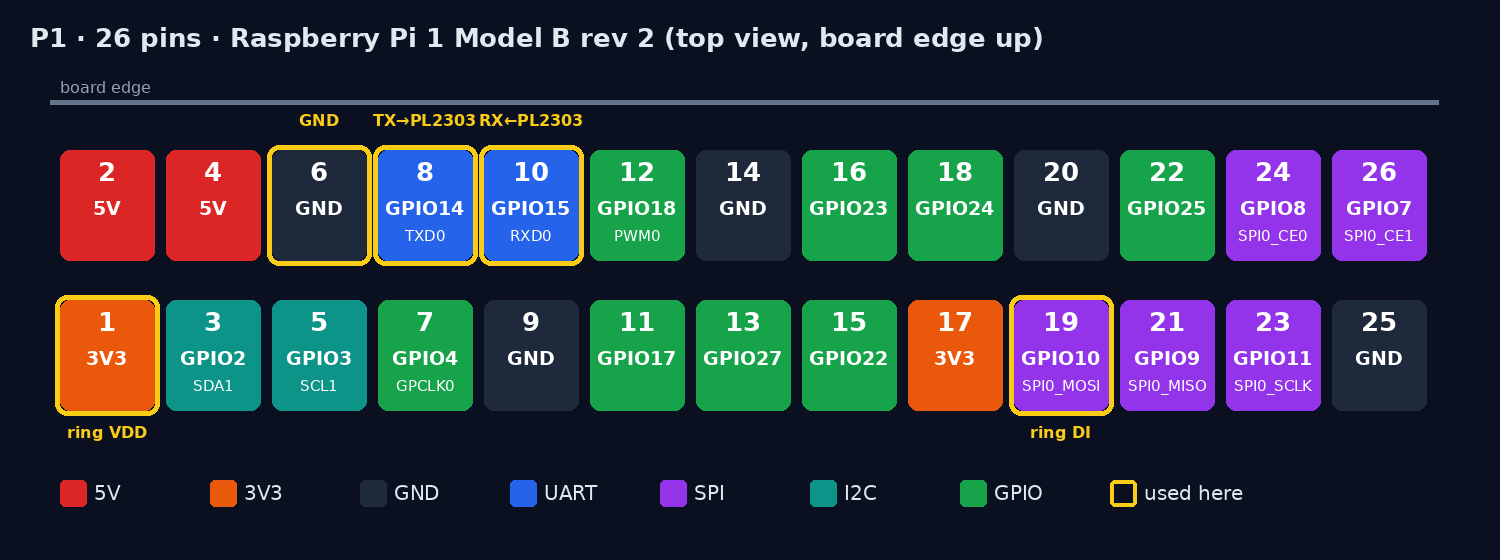 Where the ring hangs: 3.3 V on pin 1, data on pin 19 (SPI0 MOSI, GPIO10), next to the PL2303 on pins 8/10.
Action
The stall, first look. It wasn’t the GPU: the stream stopped after ~95 s with no VCHIQ use at all.
Reading the stuck DWC2 core: DMAReq set, AHBIdle 0, host channel 2 “disabling” forever. An RX FIFO
flush did nothing; a core soft reset (CSftRst) brought AHBIdle back, and a full USB init then
streamed again. So I added a watchdog task that does exactly that when the stream stalls. Over 200 s of
MJPEG: 7 restarts, 69 detector runs, never stuck for good. A band-aid. Each restart costs ~1.15 s,
mostly the hub re-enumerating.
“It drops when a face appears.” That’s what I saw. So I tested the obvious suspect, the ring (which only lights up when there’s a face):
ring off (round 1): restarts 0 -> 12 = 12 in 90 s
ring spin (round 1): restarts 12 -> 20 = 8 in 90 s
ring off (round 2): restarts 20 -> 20 = 0 in 90 s
ring spin (round 2): restarts 20 -> 20 = 0 in 90 s
Not the ring: 12 drops with it off, 8 with it on. And round 2 reads 0 not because it got better, but because the stream had died for good: a restart had failed and my watchdog never tried again (nothing left to watch). That was a real bug; it now retries after 300 ms with no stream. Drops also happened with nobody in view. The faces were a coincidence.
The actual cause. I added a histogram to usb stat: when each isochronous transfer was armed
versus the frame parity bit (OddFrm) the DWC2 uses to decide which microframe a channel runs in.
Armed with the parity of the frame already running, the channel fires at once and errors follow:
 arm parity == OddFrm, data : +0 72967 +1 0 +2 0 +3.. 0
 arm parity == OddFrm, error: +0 0 +1 75356 +2 75355 +3.. 0
Linux’s dwc2 driver arms for the next frame’s parity. I switched to one channel armed that way: 0 errors, but still 11 restarts. The last piece was the alt setting. The camera had picked alt 7, 3072 bytes per microframe (three packets). Capping it at one 1024-byte packet per microframe:
 iso: 972685 transactions, 247698904 bytes, 651305 empty, 0 errors, 0 deferred, 972685 irqs; 0 stream restarts
 uvc: 3565 frames, 0 short, 1 bad payloads; HPRT 0000100F
 face: 2117 runs, last 50 ms, 0 face(s); ...
 mjpeg: last JPEG 70936 B, decode 4 ms, 0 decode errors
(I also tried a lighter recovery, resetting only the core. The hub port was lost after CSftRst, so
the full bring-up stays as the fallback.)
The dark ring. First question: does SPI0 even move the pin?
ring probe
 SPI0 CS 00050080 at start, 00050080 at the end, CLK 40; pin 19 seen high 804, low 847 times while sending
It moves. To separate code from wiring I rebuilt an older image (the one where the ring last worked) in
a git worktree and loaded it: the ring spun. So, code. SPI0 runs at 250 MHz / 40 = 6.25 MHz, 160 ns per
SPI bit, one SPI byte per LED bit. A WS2812 “1” was 0xF8 (800 ns high). Somewhere between the working
version and the new one it had become 0xF0: 640 ns high. Too short for my ring. Back to 0xF8, a red
test frame, and it lit.
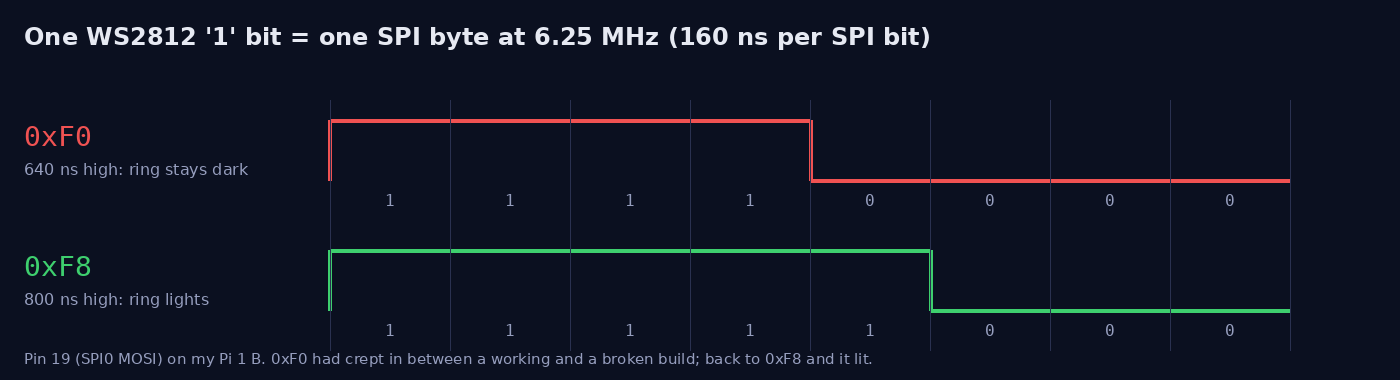 The whole bug in one picture: four high SPI bits are 640 ns, five are 800 ns. My ring wanted the longer one.
While I was in there I gave the ring its own FreeRTOS task: the face task calls ring_note(n), which
wakes the led task with xTaskNotifyGive; it waits for that or 40 ms. A frame on the SPI takes
0.5 ms. The effects come from my NanoPi project (78 of them), the WS2812 encoder from my ROCK 3A code.
Result
The webcam went from ~9 stream restarts a minute to 0 in 121 s: 2117 detector runs, 0 isochronous errors, 0 decode errors. The live rate is now ~17.5 detections a second (it was 12.3 with the restarts).
My “drops when a face appears” theory was wrong: 12 drops with the ring off vs 8 with it on. But
that test found a real bug (no retry after a failed restart). The LED ring was dark with 0xF0
(640 ns) and lit with 0xF8 (800 ns), checked by eye: the old image spun, then the new one lit.
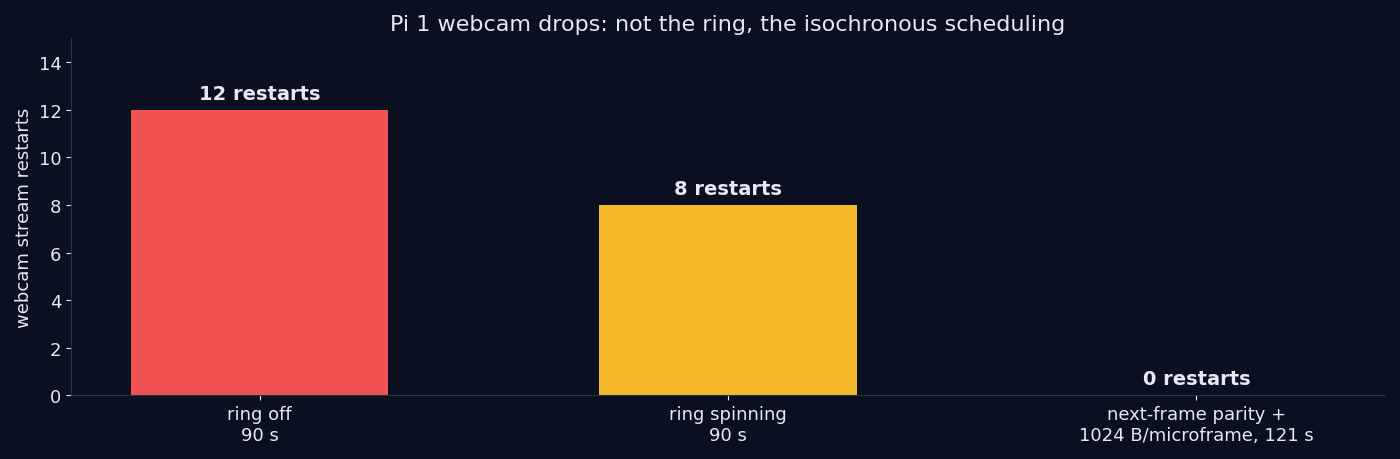 Restarts per run: 12 with the ring off, 8 with it spinning, 0 in 121 s after the parity and packet-size change.
What I’d do next
Watch the auto start at power-on with this kernel; it’s on the card but I haven’t seen a cold boot through to a lit ring yet. And the stream costs one interrupt per microframe (972 685 in those two minutes); batching them is what I’d look at next.