Bare metal from the BootROM, no hands on the board
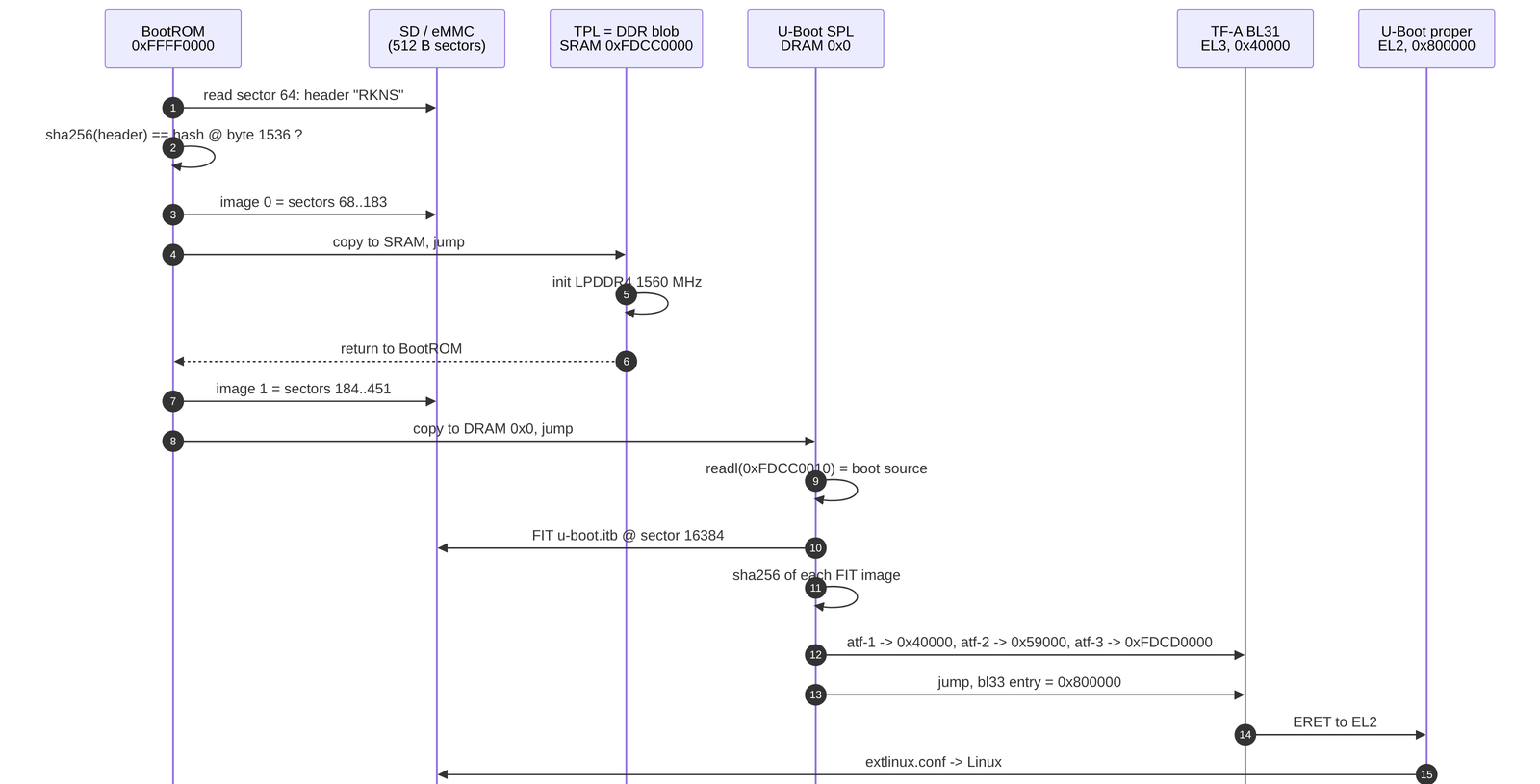
Situation
I wanted to run my own code on the RK3568 with nothing underneath it: no U-Boot, no TF-A, no Linux. The chip has a USB download mode in its mask ROM (Rockchip calls it Maskrom, it’s the same idea as FEL on Allwinner). The catch on my bench: the relay I’d wired for power cycles turned out to do nothing once the board moved to a proper PSU, so every power cycle needed my hand.
Task
Get a tiny program (sram_hello) running from SRAM, printing on UART2 and blinking the LED. Then one
from DRAM (dram_hello), which means the DDR training has to happen first. And make the loop
hands-free: build, download, run, and land back in Maskrom by itself.
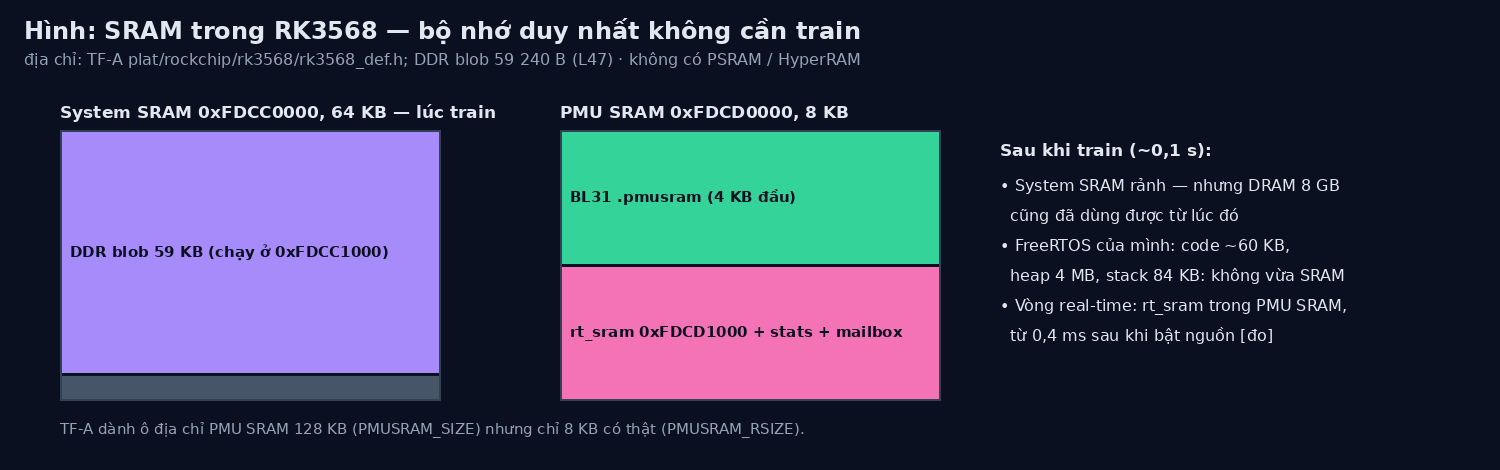
Before DDR training the only memory is on the chip: 64 KB of system SRAM at 0xfdcc0000 (where sram_hello lives, and where the DDR blob runs later) and 8 KB of PMU SRAM. Drawn from TF-A’s rk3568_def.h plus my own measurement of the blob’s size (59 240 B). The pink block is from a later experiment.
Action
I started from U-Boot. At that point my PC only saw the board through USB-C, which is power only,
so Maskrom was out and the first
sram_hello went in through the vendor U-Boot prompt: 329 mw.l writes into SRAM at 0xfdcc6000
and a crc32 to check it. go 0xfdcc6000 crashed with an instruction abort (esr 0x8600000e):
U-Boot’s MMU maps SRAM as non-executable device memory. My workaround was a bit silly but it worked.
I wrote an 88-byte fake Linux Image into DRAM whose only job is blr 0xfdcc6000, and started it
with booti. booti turns the MMU off before jumping, as Linux expects, so SRAM becomes executable.
Then Maskrom. With the A-A cable in, I found I didn’t even need the Maskrom jumper: U-Boot’s
download started a USB gadget my PC never saw, and Ctrl+C on it printed
Enter rockusb failed, fallback to bootrom... and dropped the chip into the BootROM’s USB mode. Fine
by me.
The first Maskrom run of sram_hello was painfully slow: six “500 ms” LED blinks took 328 s. Straight
from the BootROM nobody has programmed CNTFRQ_EL0 and the system counter isn’t running, so my
delay_ms() fell back to a busy loop sized for a fast CPU with caches on. I measured the real rate
(50 000 000 turns took 54.7 s, so 914 turns per ms) and put that in.
For dram_hello I packed Rockchip’s closed DDR blob as the first image (471) and my code as
the second (472). The BootROM runs the blob, it trains the LPDDR4X, returns, then the BootROM copies
my 472 to DRAM address 0x0 and jumps to it at EL3. My code starts the STIMER (so the generic timer
counts at 24 MHz), probes 10 addresses up to 0x1fff00000, and runs a 16 MiB write/read test.
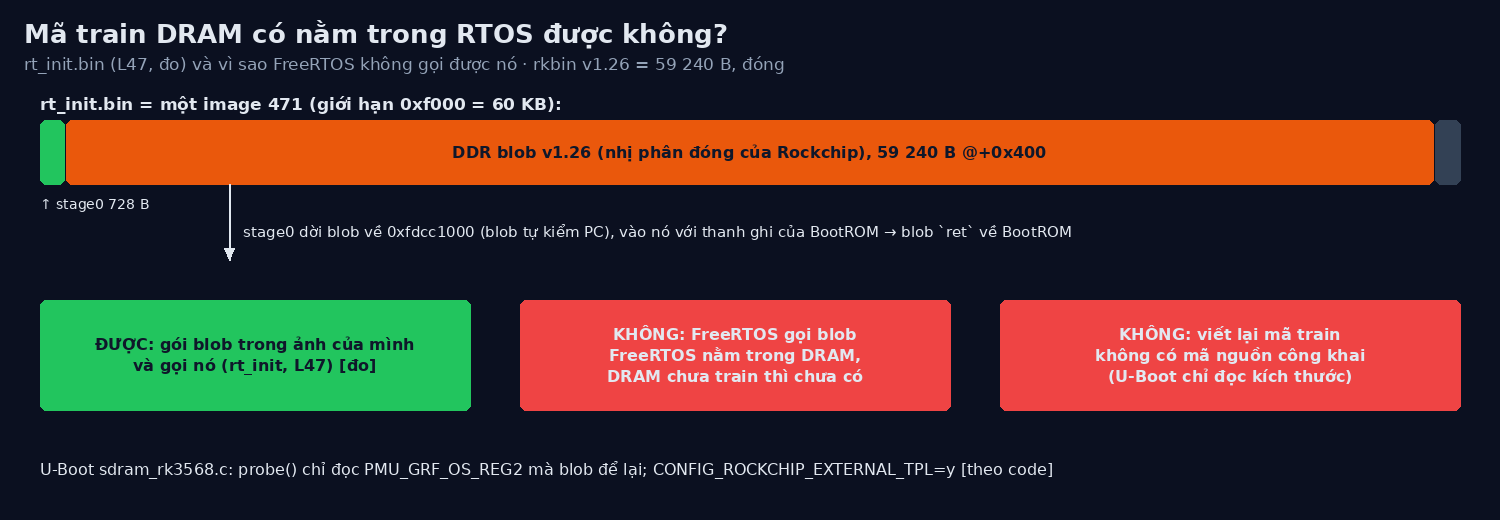
Why dram_hello needs two images: the 471 is Rockchip’s closed DDR blob v1.26 (59 240 B of the 60 KB the BootROM allows), it trains the LPDDR4X and returns to the BootROM. The red boxes are the things I wanted and can’t have: FreeRTOS can’t call the blob (it lives in the DRAM that isn’t trained yet), and there’s no public source to rewrite it from.
The hands-free part is three registers. dram_hello ends with reset_into(): write 0xEF08A53C
into PMU_GRF os_reg0 (0xfdc20200, U-Boot keeps its boot-mode flag there), wait for UART LSR.TEMT
so the last line isn’t cut, then write 0xfdb9 to the CRU global reset. The BootROM reads the flag
after reset and goes straight back to USB download.
~/rock3a$ make -C dram_hello run
    1.06  BW=32 Col=10 Bk=8 CS0 Row=17 CS1 Row=17 CS=2 Die BW=8 Size=8192MB
    1.37  CurrentEL     0x0000000000000003
    2.48  probe 0x00000001fff00000      ok      (10 of 10 ok)
    3.08  write 141557 us = 118 MB/s
    3.08  read  480783 us = 34 MB/s, errors 0
    3.68  dram_hello: reset into Maskrom (boot mode 0xef08a53c)
Bus 003 Device 017: ID 2207:350a Fuzhou Rockchip Electronics Company
The last line is my PC seeing a brand-new Maskrom device. That’s the loop closing.
Result
sram_hello from Maskrom: the 6 blinks went from 328 s to 3.01 s after the busy-loop fix. With
dram_hello all 8 GB answer (2 ranks, trained to 1560 MHz), 0 errors on the 16 MiB test.
Bandwidth with the MMU off is 118 MB/s write, 34 MB/s read. That’s latency, not bandwidth: every access is Device memory, one 8-byte read about every 235 ns.
The dev loop takes about 3 s from rkdeveloptool db to the last UART line, and then the board is
waiting in Maskrom again. make END=normal run leaves it booting the vendor Ubuntu instead (login after
40 s).
What I’d do next
The 34 MB/s bugs me. An identity map with DRAM as Normal cacheable memory and the caches on should give GB/s; I did that later inside FreeRTOS (633 MB/s read at 400 MHz) but never went back to measure it in plain bare metal. A hang still needed my hand at this point; a day later the watchdog took that over too (see the FreeRTOS page).