FreeRTOS on core 3 at 154 ms, Linux on the other three
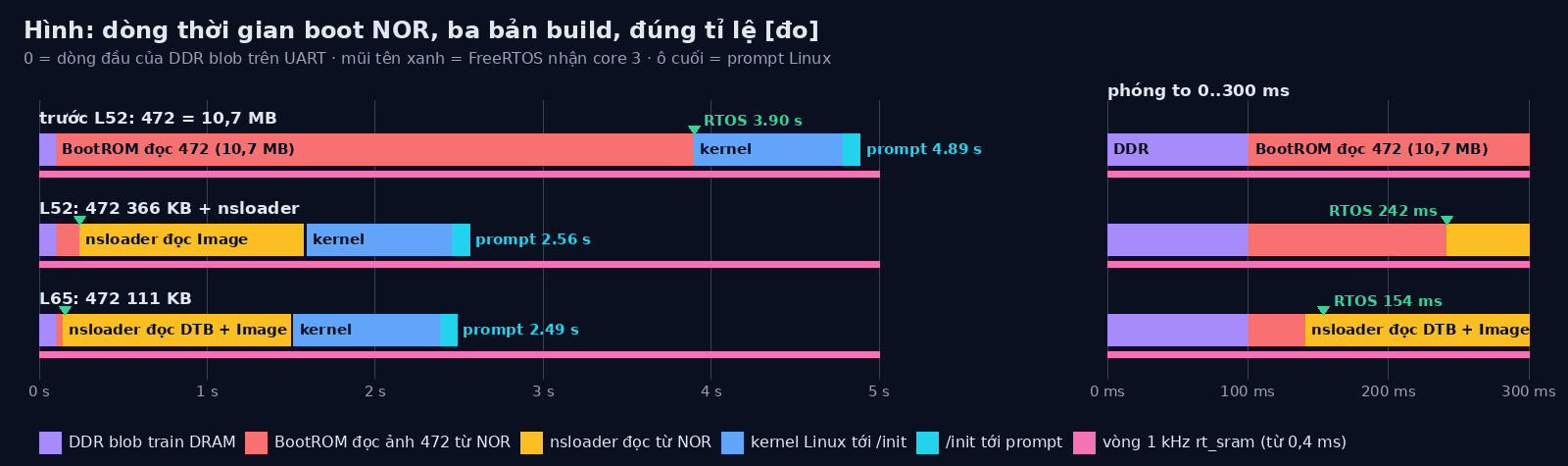
The figure is from my wiki, so the labels are in Vietnamese. Each row is one build; the green arrow is the moment FreeRTOS owns core 3, the pink bar under it is the real-time loop that runs from 0.4 ms.
Situation
I had FreeRTOS on four cores and a mainline Linux, but never both, and never quickly. On a robot the motor loop shouldn’t wait for Linux to finish booting. A normal RK3568 boot needs seconds before anything of mine runs: the DDR blob trains, the BootROM loads the next stage, TF-A, U-Boot, kernel.
Task
A hard real-time loop on core 3 from the very first instructions, even while DRAM is being trained. Then hand core 3 to FreeRTOS and boot Linux on cores 0 to 2 next to it, with no U-Boot. All of it from the 16 MiB SPI NOR, so the board boots by itself, and with the RTOS up as early as I can get it.
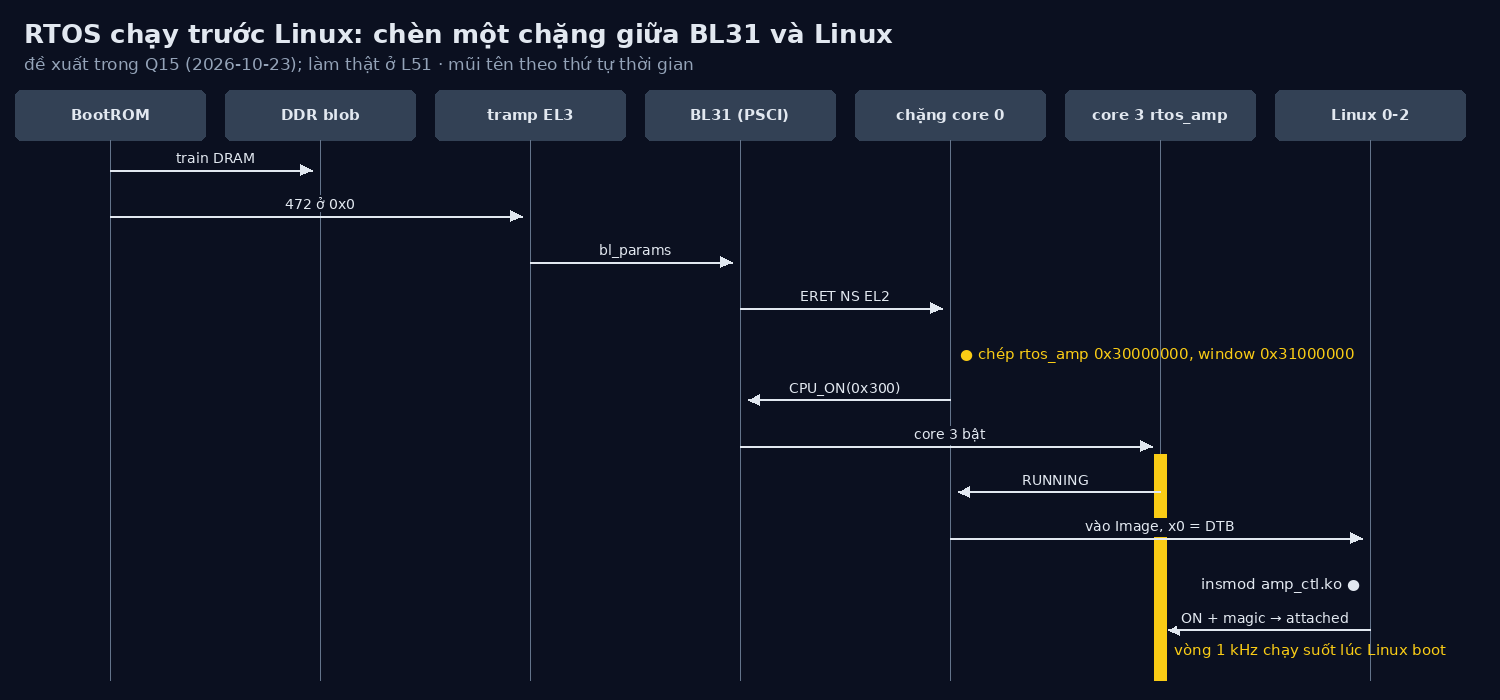
The plan I drew before writing any of it (Vietnamese labels): BootROM, DDR blob, my tramp at EL3, BL31, then core 3 started into rtos_amp while Linux boots on cores 0 to 2 and attaches to it later with amp_ctl.ko.
Action
The loop has to run before DRAM exists. The only RAM free while the DDR blob runs is the second half of the 8 KB
PMU SRAM. My first-stage 471 starts the STIMER, copies a tiny rt_loop there, wakes core 3 through the
BootROM’s mailbox and returns. Core 3 then busy-waits 1 ms deadlines on CNTPCT. The first
measurement said “no period lost”, and it was wrong: the DDR blob resets the STIMER twice (around
5.5 ms and 285 ms), and a loop that only compares against its deadline can’t see a counter that jumped
back. The loop now treats any reading lower than the previous one as a reset and shifts its deadline
by the same jump.
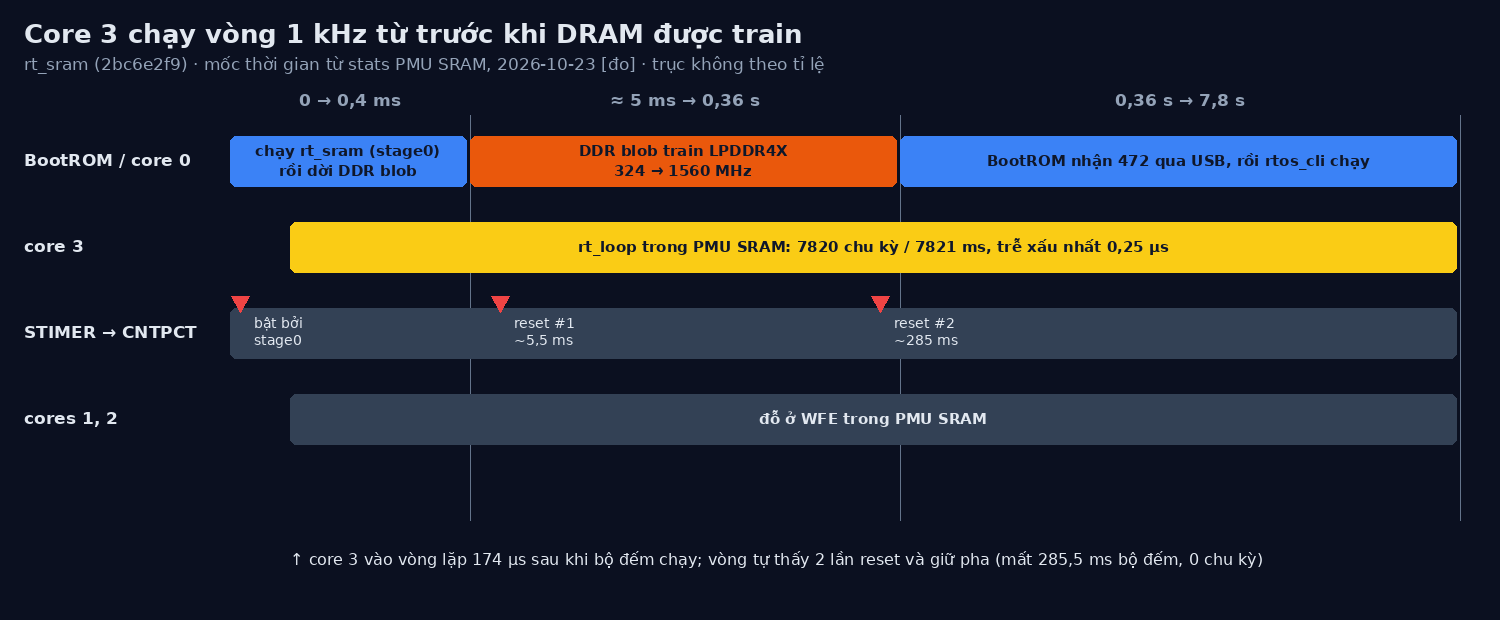
Core 3 in its 1 kHz loop from PMU SRAM, under the whole DDR training and download: 7820 periods in 7821 ms, worst 0.25 µs late. The red marks are the two STIMER resets (~5.5 ms and ~285 ms) that fooled my first version.
Booting from NOR ate a whole afternoon, most of it asking “why is it back in Maskrom”. U-Boot’s mkimage has two
Rockchip header types, rksd and rkspi. rkspi pads every 2 KB to 4 KB for older SoCs. I picked
rkspi because the name said SPI. The RK3568 BootROM silently ignores it and falls back to Maskrom.
Comparing against U-Boot’s own u-boot-rockchip-spi.bin showed it uses rksd, at NOR offset 0x8000.
I also stopped trusting the Rockchip SPL loader for writing the NOR (it once repeated a 32 KB chunk,
and once wedged so hard only a power cut helped) and wrote a spi flash command into my own shell
that erases, programs and reads back every byte.
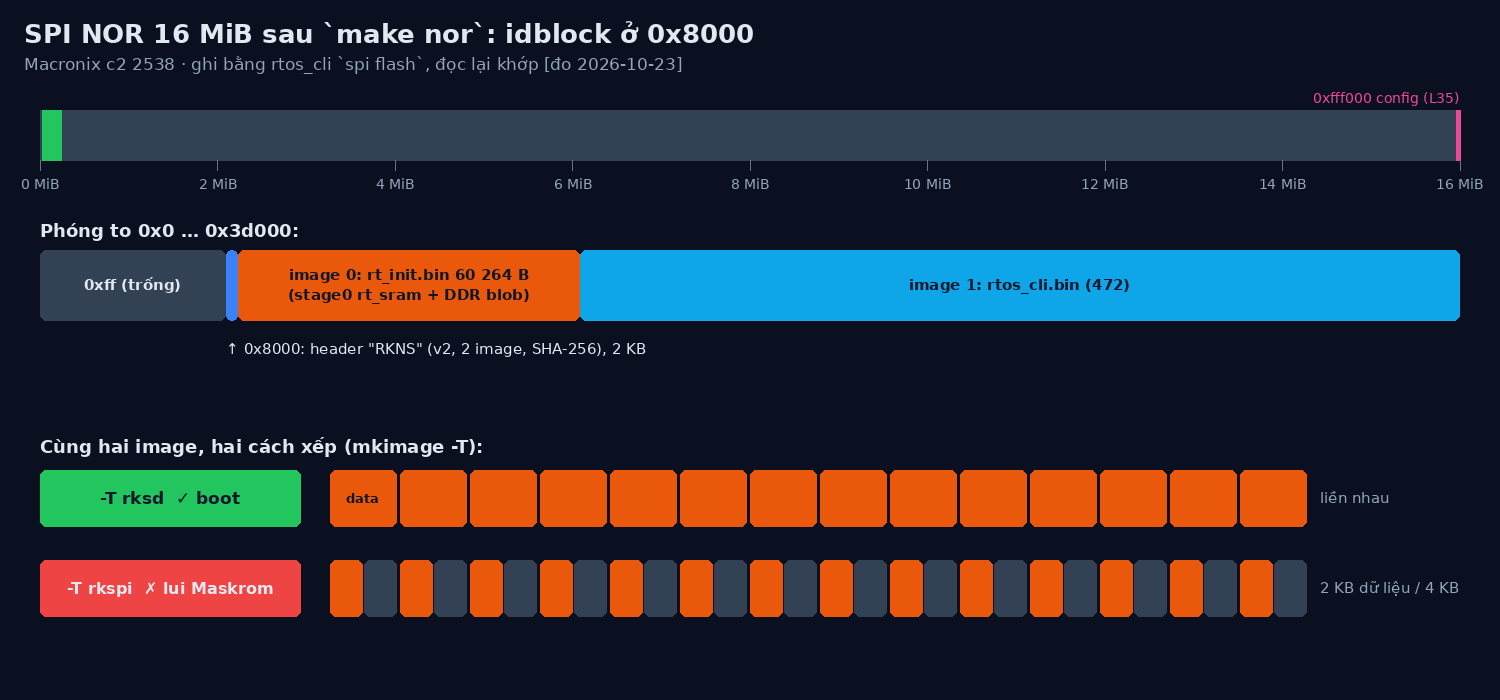
The afternoon’s mistake in one picture: the same two images packed with -T rksd (data back to back, boots) and with -T rkspi (2 KB of data in every 4 KB, the RK3568 BootROM ignores it and falls back to Maskrom). Idblock at NOR offset 0x8000.
For the handover, a small tramp at EL3 places the RTOS at 0x30000000 and fills a mailbox. I patched BL31
in three places, each of which would kill an RTOS that runs before Linux: it reloads the STIMER (the
counter would jump to 0 under a running tick), it leaves Group 1 Non-secure interrupts off until Linux’s
GIC driver turns them on, and its write of the request sat in core 0’s cache for 19 ms because core 3
reads PMU SRAM with its MMU off. With a cache clean after the write, core 3 sees the request 22 µs
later. Linux then boots and amp_ctl just attaches: core 3 already runs '20261023-2156': attached.
The first NOR build gave FreeRTOS core 3 only at 3.9 s. The BootROM reads the whole second image from NOR, one data line at 24 MHz,
about 2.8 MB/s, before running a byte of it. My 472 carried the 6.5 MB kernel, so the RTOS waited for
a kernel it doesn’t need. I split it: the BootROM now reads a small 472 (366 KB), and a 3 KB nsloader
I wrote reads the kernel later with quad-output reads and a CRC-32 on the fly. That alone brought
the RTOS to 0.242 s.
Then 366 KB down to 111 KB. 136 KB of that 472 was all-zero pages (page tables, gaps), and 66 KB was
the DTB, which nsloader can read later. mkimage.py now cuts everything into 64-byte blocks and
writes a table of (src, dst, len) records; src = 0 means “write zeros”. Before writing the NOR I ran a
Python replay of tramp over the 31 records and compared every piece byte for byte, because a bad
record only shows as a board that doesn’t boot.
  0.101  out
  0.141  NOTICE:  BL31: core 3 asked to start the RTOS at 0x30000000
  1.495  nsloader: read 1350 ms (4755 KB/s), CRC ok; Linux
  2.487  linux_min: BusyBox shell (exit = kernel panic, reset the board)
  handover: asked at 153 ms, taken 829 us later, after 154 periods (154 ms since power-on)
Result
| Milestone | First NOR build | Kernel split off | Packed 472 |
|---|---|---|---|
| Image the BootROM reads | ~10.7 MB | 366 125 B | 110 832 B |
| FreeRTOS owns core 3 | 3.897 s | 0.242 s | 0.154 s |
| Linux prompt | 4.888 s | 2.561 s | 2.487 s |
The real-time loop starts 174 µs after my first instruction and keeps its 1 kHz period through DDR training and the whole download: 7820 periods in 7821 ms, worst lateness 0.25 µs, 0 periods late by more than 10 µs. The only gap on core 3 is the switch from the loop to FreeRTOS, 4.3 ms.
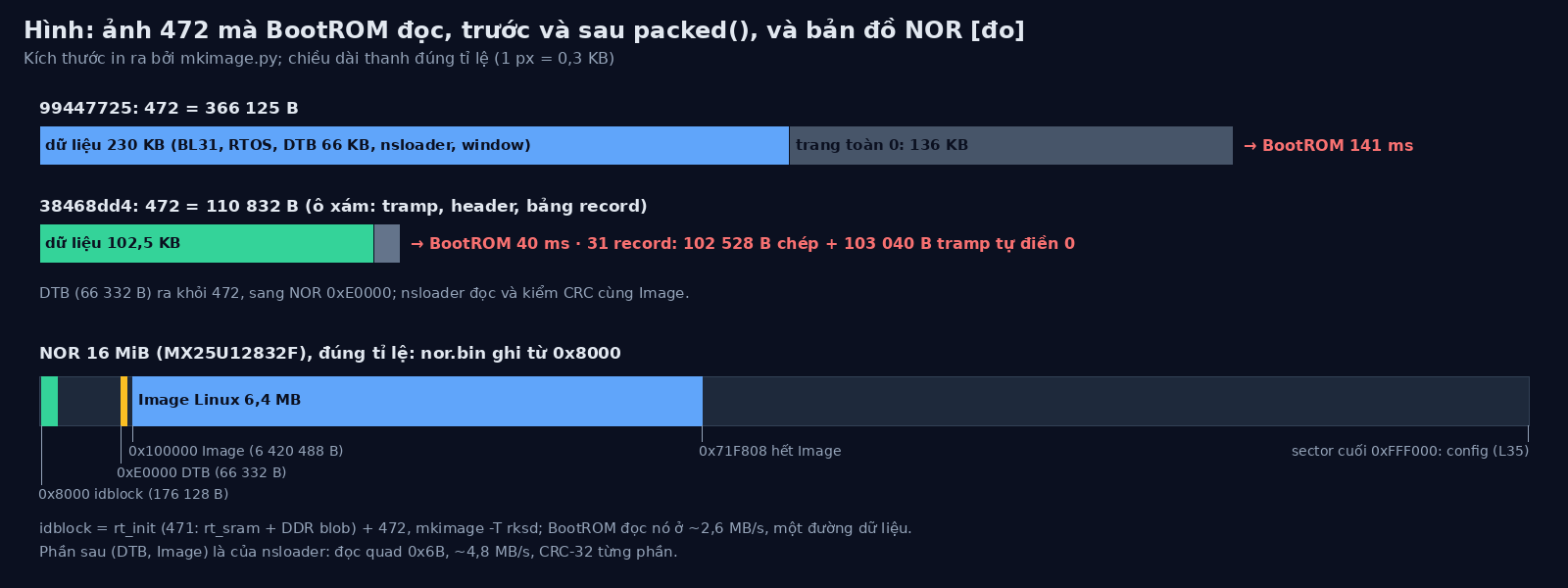
The image the BootROM has to read, before and after packing: 366 125 B with 136 KB of zero pages (BootROM done at 141 ms), then 110 832 B as 31 records (40 ms). Below, the 16 MiB NOR to scale, with the 6.4 MB kernel at 0x100000 that nsloader reads later.
The blue LED tells me who owns core 3 without a terminal: an even 1 Hz is the loop, a double blink is FreeRTOS.
What I’d do next
Of the 154 ms, 101 ms is DDR training in Rockchip’s closed blob, and I don’t see a way around that.
The Linux side is where the time is now: nsloader reads the NOR at 4.8 MB/s, while U-Boot read the
eMMC at 91 to 125 MiB/s in HS200 on the same board. An eMMC driver in nsloader would cut most of
the 1.35 s kernel read. For the RTOS itself I expect almost nothing from eMMC (my guess is 0.15 to
0.17 s, not measured).