First contact: what the stock Nezha really runs, and which vector it really has
Back to the D1 Nezha hub · measured 2026-09-27
Situation
The D1 docs say “C906 RISC-V 1GHz” and “supports RVV”. The ncnn page of the same docs says release builds “will cause illegal instruction errors”. Those two sentences don’t sit well together. Before writing any code for this board I wanted to know what it actually runs and what its vector unit actually is. The board had the stock Tina firmware in NAND, an FTDI TTL-232R-3V3 on the debug UART, and later a USB-C cable on the OTG port.
Task
Measure, on the board, everything I’d otherwise take from the docs: clocks, RAM, flash, the boot chain, the ISA. Then find a way into FEL (the boot ROM’s USB mode) that doesn’t need someone to press a button.
 Where this ended up:
reboot efex from an adb shell, U-Boot waits about 3 s, gives up, boot0 sees the flag and the ROM comes up in FEL as 1f3a:efe8. No hand on the board.
Action
UART. The boot log answered half the list by itself:
 [45]HELLO! BOOT0 is starting!
[00.288]DRAM: 1 GiB
[00.298]CPU=1008 MHz,PLL6=600 Mhz,AHB=200 Mhz, APB1=100Mhz MBus=300Mhz
Then OpenSBI v0.6, U-Boot 2018.05, “DSP0 start ok” (U-Boot starts the HiFi4 before the kernel), and a
5.4.61 kernel built in April 2021 with the C-SKY toolchain. cpufreq has exactly one level, 1008000.
So “1 GHz” means 1008 MHz, and Tina never clocks down. /proc/cpuinfo says isa : rv64imafdcvu. That
v is the trap.
The vector probe. I couldn’t install a cross GCC (no sudo on that PC), but zig worked. I wrote a
small static binary that runs one instruction at a time as raw machine code (encodings computed by
hand) and catches SIGILL with sigsetjmp:
vsetivli t0,4,e32,m1 (RVV1.0 only) SIGILL
csrr vlenb (CSR 0xC22, RVV1.0) OK result=16
and a second probe with no signals at all:
A same-block: vsetvli->4 vl=4 vtype=8
B after printf: vl=4 vtype=8
C after usleep(syscall+sched): vl=4 vtype=8
In RVV 0.7.1, vtype = 0x08 means e32/m1, so vl = 4 gives VLEN = 4 x 32 = 128 bits. In RVV 1.0 the
same encoding would be e16 and give vl = 8. And vsetivli only exists in 1.0. So it’s T-Head’s 0.7.1
(mainline calls it xtheadvector from Linux 6.14 on), not binary compatible with RVV 1.0. Anything
built with -march=rv64gcv will die with illegal instruction here. That explains the ncnn page.
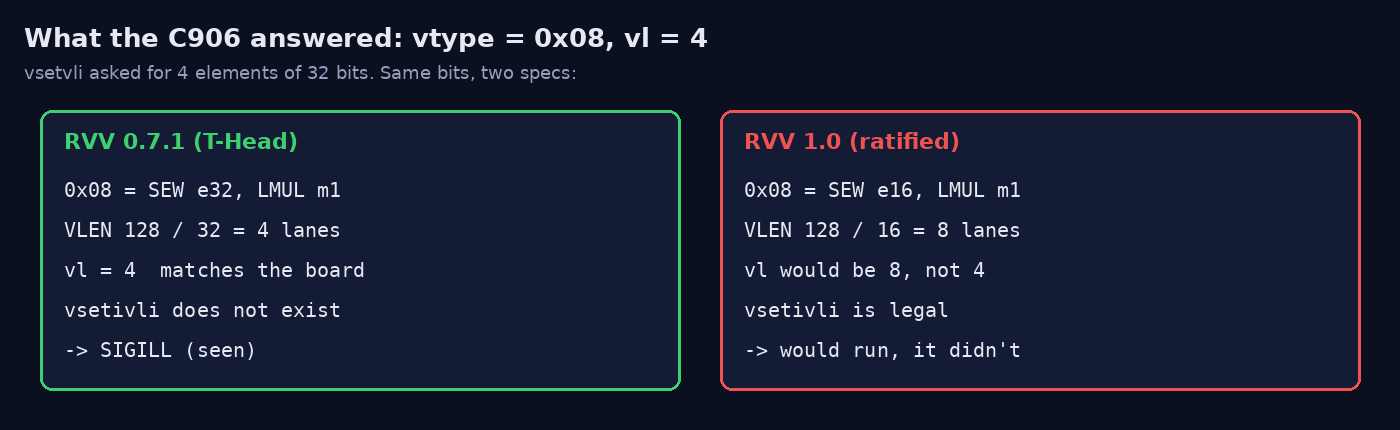 The two readings of the same answer. Only 0.7.1 gives
vl = 4 for e32 at VLEN 128, and only 0.7.1 has no vsetivli.
One odd thing I caught: in the first run, after the SIGILL handler returned, vl read 128 and
vtype 3, not what I’d set. Without signals (the second probe) the registers held across printf,
usleep and rescheduling. My reading: this vendor kernel’s signal path doesn’t preserve vector state.
I haven’t read its signal code, so that’s a guess. Vector code here should redo vsetvli after any
signal.
OTG. The stock firmware shows up as 18d1:d002 “Tina ADB”, and adb shell drops straight into
root, no password. A 16 MiB file: push 4.5 MB/s, pull 5.1 MB/s, md5 matching both ways, on a link that
negotiated 480M. Probably the single core or adbd, not USB.
FEL without the button. reboot efex writes a flag; after the reset U-Boot waits about 3 s for
PhoenixSuit, gives up, resets, and boot0 sees the flag and jumps into the boot ROM’s FEL:
Bus 003 Device 018: ID 1f3a:efe8 Allwinner Technology sunxi SoC OTG connector in FEL/flashing mode
$ xfel version
AWUSBFEX ID=0x00185900(D1/F133) dflag=0x44 dlength=0x08 scratchpad=0x00045000
From there, read-only: xfel spinand finds the MX35LF2GE4AD (268435456 bytes, the chip the kernel had
named), and the first word of NAND is 0x3c80006f (a jal over the header) followed by eGON.BT0,
length 64 KB, checksum 0x31a49730. I recomputed the checksum with the sunxi rule (sum of all 32-bit
words, checksum field replaced by 0x5F0A6C39) and got exactly 0x31a49730. xfel reset brings Tina
back.
A backup trap. dd if=/dev/mtd0 on Tina returns every 2 KB physical page twice, because the sunxi
NAND driver uses 4 KB logical pages. Writing that image back would be wrong. Take the first half of
each 4 KB block, or read with xfel spinand read; both give the same bytes and the checksum matches.
Result
All from the board, not the docs: the CPU runs at 1008 MHz with a single level, 1 GiB of DDR3
(PLL at 1584 MHz), 256 MB of SPI-NAND. The vector unit has VLEN 128, vl = 4 at e32/m1, and
vsetivli raises SIGILL, so it’s RVV 0.7.1, not 1.0.
ADB gives root, 4.5 / 5.1 MB/s push/pull over a 480M link. FEL is reachable from software
(reboot efex), the stock boot0 header checks out byte for byte, and reading the NAND’s first 4 KB
over FEL runs at 125 KB/s. Slow, but it’s the ROM.
What I’d do next
That became the whole plan, really: with FEL reachable from a shell command, I could write my own boot0 and try it without a hand on the board (next story). Still unmeasured from that first day: current draw from the OTG port.