FreeRTOS on the C906: a 27x cache surprise, and an RTOS that never slept
Back to the D1 Nezha hub · measured 2026-09-29 and 2026-10-01
Situation
By then I had a bare-metal CLI on the Nezha (d1_cli: UART, I2C, SD, SDIO, DMA, the vector unit…)
loaded from my own SPL or over FEL. It
runs in M-mode, no SBI firmware under it, built with zig. I wanted an RTOS under that shell, and real
latency numbers for the C906, because I couldn’t find any published.
Why FreeRTOS and not RT-Thread, which has D1 BSPs? Those are RT-Smart: S-mode with the MMU, entered through OpenSBI and U-Boot, and they want GNU GCC. I’d have had to throw away my boot path, my toolchain and my shell. FreeRTOS’s generic RISC-V port runs in M-mode and leaves the timer to me.
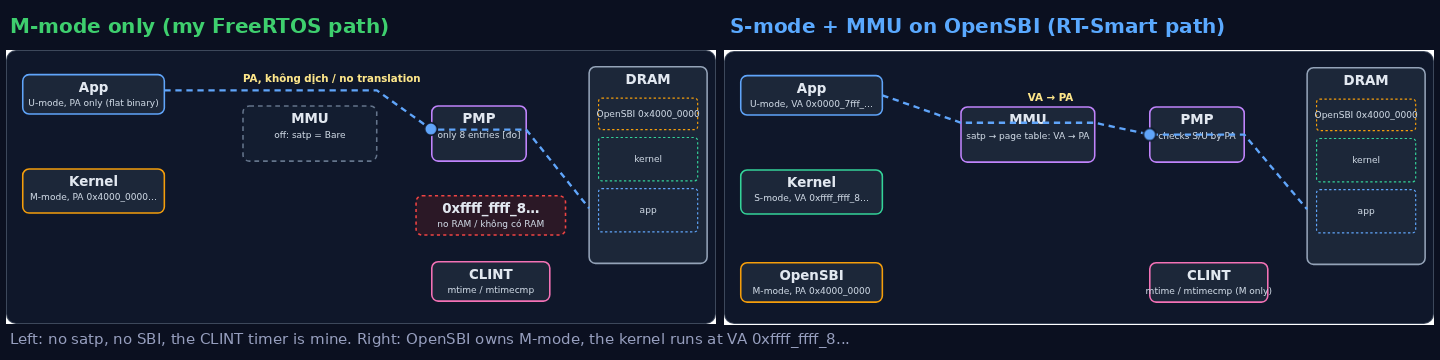 The two roads, from my own notes on the D1 boot chain: left, everything at physical addresses with no MMU and the CLINT mine; right, OpenSBI in M-mode and a kernel at
0xffff_ffff_8... through page tables. (Some Vietnamese labels.)
Task
FreeRTOS V11.2.0 on the C906 with a 1 kHz tick from the CLINT, an interrupt-driven console, all the
d1_cli commands as before, plus commands that measure the kernel itself. Load over FEL, and exit
back to FEL so the edit-run loop needs no hands.
Action
The tick. With portasmHAS_MTIME 1 the port updates mtimecmp with one 64-bit store, which the
C906 CLINT doesn’t take, and there’s no hook to replace it. With 0, the trap code hands the timer
interrupt to a C handler I own. I took 0.
A bug of mine, with damage. The link rule was -o $$@ inside a define used through $(call).
It reached the shell as -o $@, empty, so the linker took the next word as its output:
../d1_cli/app/start.S. It overwrote a committed source file of the other project with an ELF.
git status in d1_cli caught it (file said “ELF 64-bit LSB executable”), git checkout restored
it, and the macro now takes the output file as an explicit argument.
First board run. Tick, UART interrupt, preemption, sleeping in the kernel: all worked the first time. Then the numbers:
d1rt> rt switch
100000 round trips = 200000 task switches in 3953685.958 us
one switch (notify + ecall + save/restore 31 regs + scheduler): 19926 cycles = 19.750 us (~19768 ns)
d1rt> rt jitter 10
wake-up latency (tick compare -> task running): 10000 samples min 14.958 us avg 15.583 us max 17.916 us
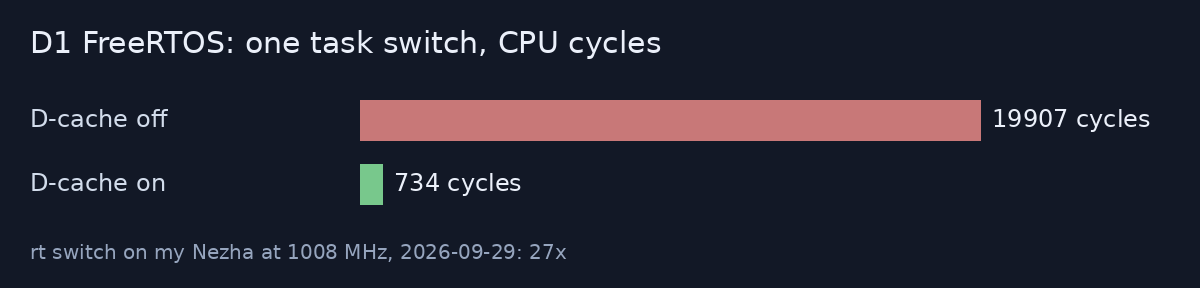
20 000 cycles per task switch. Way too slow. info showed mhcr 0x109: FEL and my SPL leave the
D-cache off. Every stack and list access was a DRAM round trip, and my old d1_cli bench had already
shown uncached DRAM reads about 20x slower than writes. One command to test it:
mhcr 109 -> 10b: D-cache ON (bit1), I-cache on (bit0)
one switch (notify + ecall + save/restore 31 regs + scheduler): 739 cycles = 0.708 us (~733 ns)
wake-up latency (tick compare -> task running): 10000 samples min 0.500 us avg 0.500 us max 0.541 us
And then I broke FEL. The binary I had loaded before had no cache handling, and I’d typed
cache on in it. It exited to FEL with the D-cache still on. xfel write then put the new image into
DRAM behind dirty cache lines, the CPU ran stale bytes, and the board hung with FEL dead. Even the
16 s watchdog didn’t fire. I had to go and press the button on the board by hand. Now main() turns the D-cache on at start and
every way out (exit, fel, a fatal error) cleans it and turns it off first.
The RTOS never slept. Two days later I wrote power-management demos (clock changes, PLL off, power
domains, die temperature). My pm wfi demo said the core had been stopped for most of the second.
mcycle disagreed: it counted 99.9 % of the cycles. So I counted retired instructions instead
(minstret), with every task asleep:
999 ms at 1008 MHz: sleeping retired 517544620 instructions (1007777143 cycles counted), spinning 431965490: 119.81% of the work
While “sleeping” the core retired more instructions than a busy loop. The IDLE task was spinning:
configUSE_IDLE_HOOK was 0, and the only wfi in the whole image was in the fatal-error path. I added
an idle hook with wfi:
999 ms at 1008 MHz: sleeping retired 225457 instructions (1007367730 cycles counted), spinning 377840483: 0.05% of the work
idle is wfi
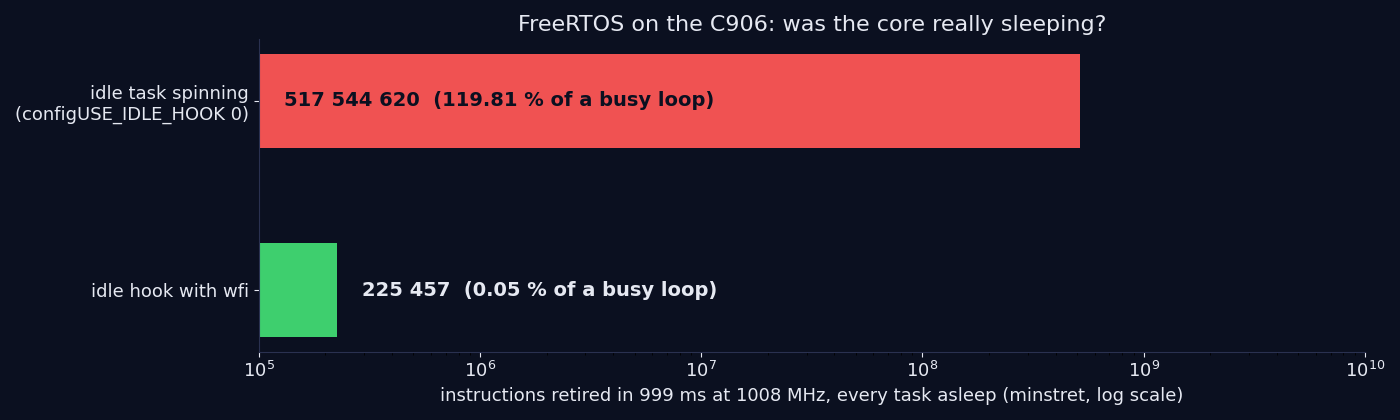 Same 999 ms, every task asleep: 517 million instructions with the idle task spinning, 225 thousand with
wfi. Log scale, or the green bar wouldn’t show.
(mcycle keeps counting through wfi on the C906, so it can’t show sleep. That’s why the first demo
lied.) The temperature sensor also read -10 C at first; it needed a trim value from the SID copied in.
Result
| Measurement | D-cache off | D-cache on | On, CPU + memory load |
|---|---|---|---|
| task switch | 19 907 cycles (19.7 us) | 734 cycles (0.71 us) | |
| tick wake-up, 10 000 samples | 14.96 / 15.58 / 18.04 us | 0.500 / 0.500 / 0.541 us | 0.92 / 2.92 / 5.29 us |
| wake-ups that slipped a tick | 0 | 0 | 0 |
So one bit in mhcr made the task switch 27x faster. Under load the worst wake-up is 5.3 us
and no tick is ever missed. Every d1_cli command gives the same result under the RTOS (DMA 1 MiB at
345 MB/s, 0 mismatches).
Idle in wfi retires 225 thousand instructions a second instead of 444 million. After 90 s idle
the die read 19.2 C with wfi against 21.6 C spinning (18.6 C at 24 MHz with the PLL, VE and
DSP off). Trends, not steady states.
What I’d do next
Measure current for real: temperature is a poor proxy, and I need a USB-C meter between supply and board. Then external-interrupt latency (a GPIO edge through the PLIC), which needs a source whose edge time I know, and a way to boot this 84 KB image from NAND.