A FreeRTOS shell on the boot cable, and the USB device that left after 170 ms
Back to the Pi Zero W hub · measured 2026-10-12
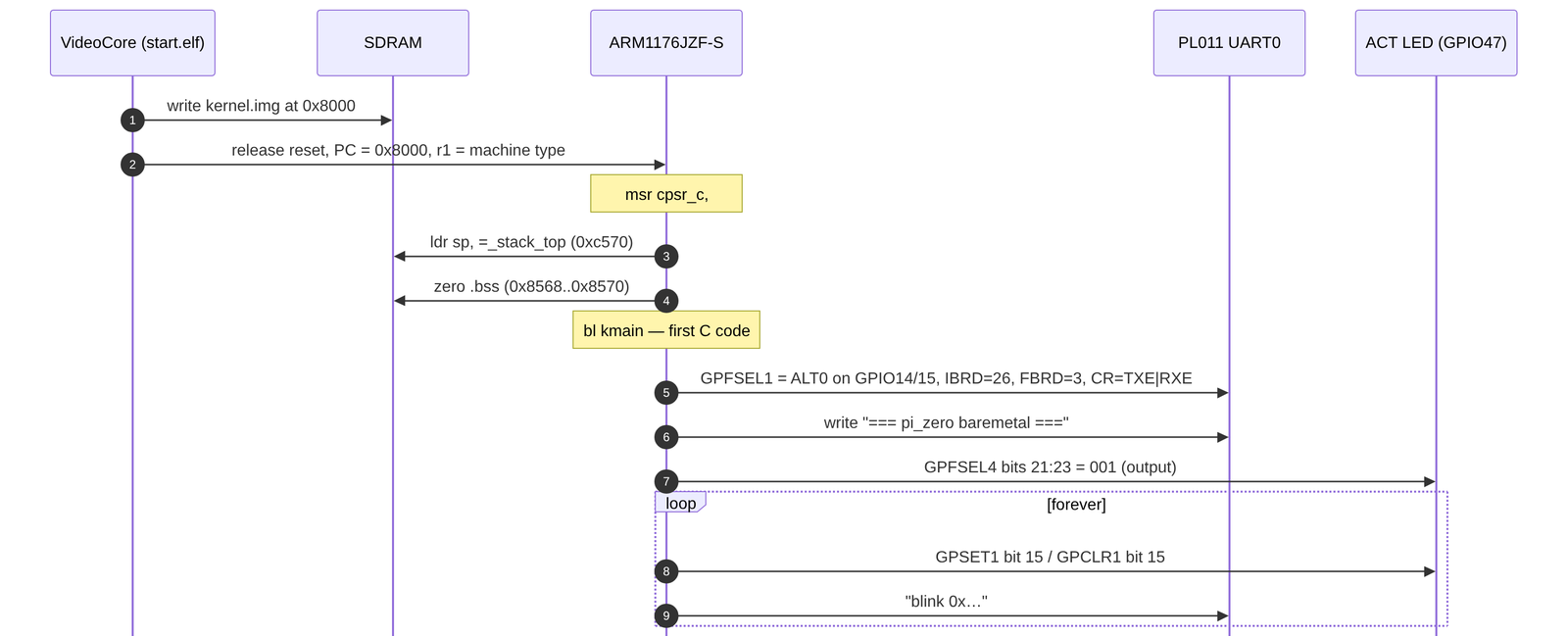
Situation
The USB boot worked, but my only output was an LED. No UART cable on my bench. I wanted a real shell on this board, on an RTOS, and the only wire I had was the micro-USB cable it boots through. So the console had to be USB CDC on that same port: rpiboot pushes the image, the ARM starts, and my code takes over the USB controller as a serial device.
Task
FreeRTOS on the ARM1176, TinyUSB as a CDC-ACM device on the DWC2 controller, a small shell. Then make it stable on the real board, where I can’t see anything until USB works.
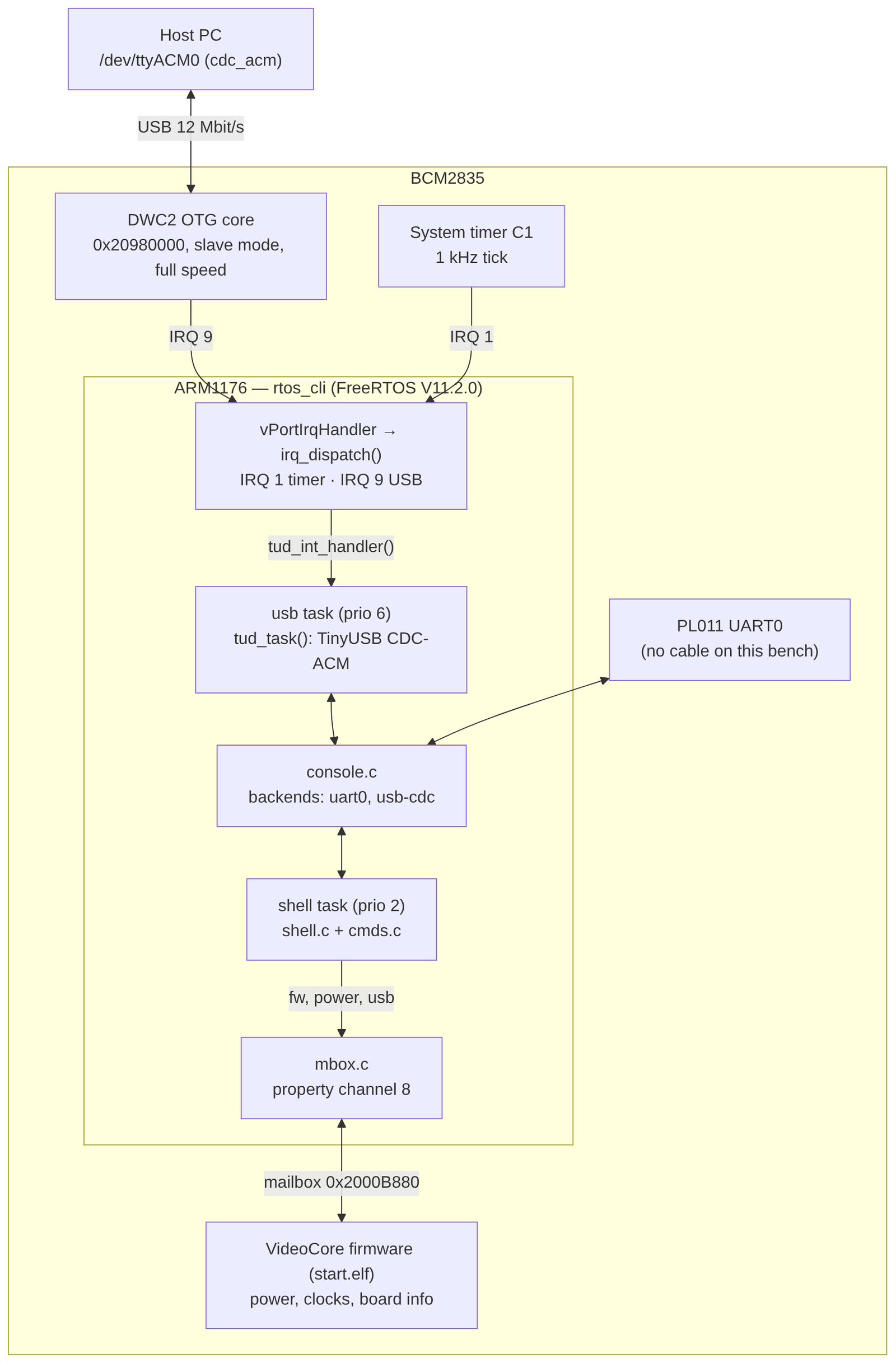 What I was building: timer IRQ 1 for the 1 kHz tick, DWC2 IRQ 9 into the TinyUSB task (prio 6), the shell task (prio 2), the mailbox to the firmware. The PL011 is drawn but has no cable on my side.
Action
Port choice. FreeRTOS V11.2.0 with the old ARM7_LPC2000 port as the base: ARMv6 in ARM state has
the same programmer’s model, so the stack frame and context save are code people have already
debugged. TinyUSB in slave mode (it has a BCM2835 port) so I didn’t have to think about DMA and cache
maintenance with the MMU off. First run on QEMU raspi0, where everything is visible:
pz> rt jitter 500
 vTaskDelay(1) x 500: min 842 us, avg 1000 us, max 1109 us
pz> rt switch 2000
 2000 round trips in 6097 us: 1524 ns per switch
Fine. On the board: nothing.
A one-bit debug channel. With no output at all, I used the USB pull-up as a signal. smoke(n) sets
DCTL bit 1 (soft disconnect) when the code reaches checkpoint n, and the PC sees the device leave.
Checkpoint 4 (blink task after 2 s of ticks) fired, so the scheduler was alive. Checkpoint 2 gave 0
and then disagreed with itself on a rerun. Noisy channel. That bit me again later.
Bug 1: my kernel wasn’t at 0x8000. Exceptions never reached my handler through VBAR. Instead of
staring at the vector code I tested the thing under it: a tiny kernel that drops the pull-up only if
its own PC is below a limit.
=== baremetal kmain PC < 0x8000 ? 1
=== without disable_commandline_tags: kmain PC < 0x8000 ? 0
=== without disable_commandline_tags: kmain PC < 0x9000 ? 1
disable_commandline_tags=1 in config.txt makes start.elf load the kernel at 0x0, not 0x8000.
I had copied that key into the bare-metal project too, and its LED had been happily blinking from the
wrong address the whole time (code linked at 0x8000 half-works at 0x0: the LED blinks, anything
using an absolute address is broken). Key removed, VBAR works.
Bug 2: the device that left. With TinyUSB in, the host got the CDC device, cdc_acm bound… and
then it was gone:
[108995.440988] usb 3-3.7: Product: Pi Zero W rtos_cli
[108995.451072] cdc_acm 3-3.7:1.0: ttyACM0: USB ACM device
[108995.620735] usb 3-3.7: USB disconnect, device number 51
About 170 ms, every time. No reset, no error, the D+ pull-up just vanished. I ruled things out one by one: the console backend, the host driver and ModemManager, the LED task, a USB power cycle before init, forcing B-valid, an IRQ storm, an ARM crash (the watchdog never fired).
Then I asked the board. A task snapshots 7 DWC2 registers after mount, waits 1 s for the first one to change, and fires the watchdog if the change is in a set I pick at build time. The boot ROM reappearing on USB means “yes”. One bit per boot:
=== which in mask 0x80 ? 0
=== which in mask 0x0F ? 1
=== which in mask 0x03 ? 0
=== which in mask 0x05 ? 0
Register 3: GUSBCFG. TinyUSB only writes it during init. Then the same game on its bits: FDMOD,
FHMOD, TRDT and PHYSEL all flipped. Someone rewrote the whole register into forced host mode, and a
host-mode core has no device pull-up. The only other writer is the VideoCore firmware.
The real cause was in my own code. At boot I ask the firmware (mailbox) to power USB on. Timed with a 5 s timeout instead of my 100 ms:
mailbox SET_POWER_STATE(usb, on): rc 8, state 00000001, 527230 us
527 ms. With the old timeout, TinyUSB enumerated inside that window, and the firmware’s last reset at the end of power-on knocked it off. Its late reply then matched my next mailbox call (same static buffer). Timeout raised to 2 s, init after the answer. No delay hacks needed.
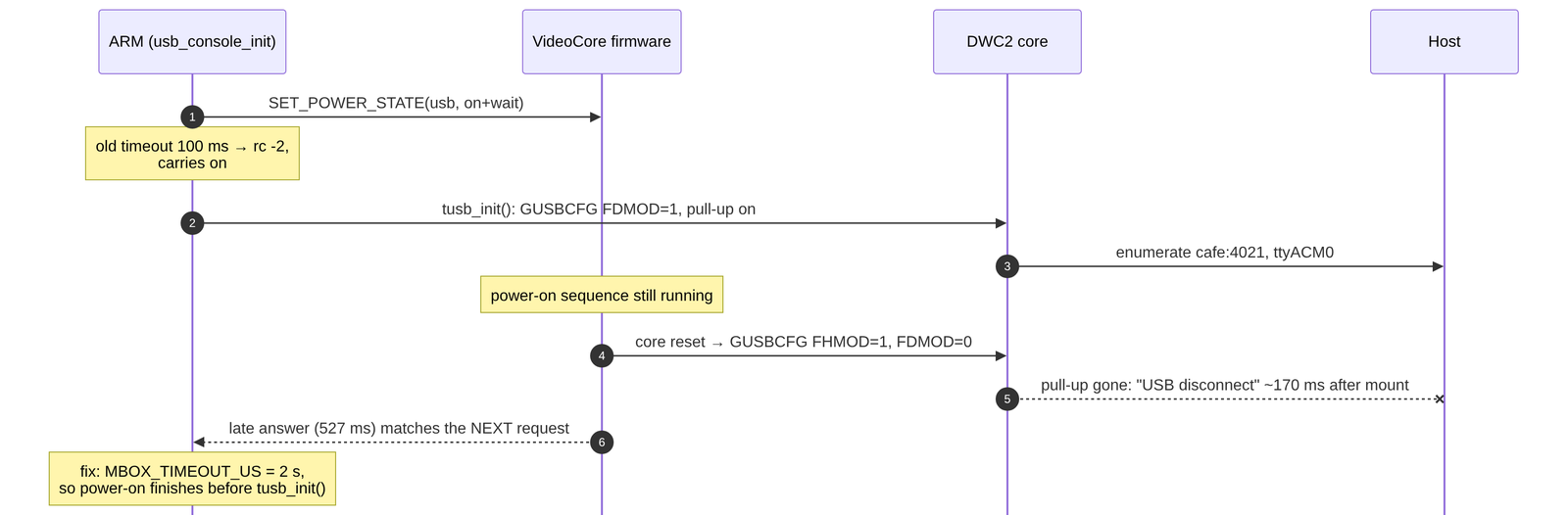 The drop, in order: my 100 ms mailbox timeout gives up, TinyUSB enumerates
cafe:4021, the firmware’s power-on finishes with a core reset into host mode, the pull-up goes, the PC logs “USB disconnect” about 170 ms after mount.
Bug 3: scrambled text. On the way there I had a build with a 3 s delay that stayed connected, and the shell answered like this:
upknonn: wlp e(tr heyp)lpz>
Typing one character every 50 ms showed the echo was right, so input was fine. In the output, bytes
3, 7, 11, 15 carried the byte from the previous word: “(tick 62558, other” came out as
“(ti k 6c5582 ot,er”. One byte lane, shifted by a word. That’s an unaligned LDR with SCTLR.U = 0,
and TinyUSB’s tu_unaligned_read32() is a plain *(uint32_t *)p. Setting SCTLR.U (bit 22) first
thing in start.S fixed it:
pz> cpu
 MIDR 410FB767 (implementer 41, part B76, rev 7)
 SCTLR 00450078 (MMU 0, D-cache 0, I-cache 0, high vectors 0)
 VBAR 00008020
So the firmware hands over 0x00050078, the ARM1176 reset value. (An earlier one-bit probe had told
me bit 16 was 0. Wrong. That was the noisy channel again.)
Clean-up. ps showed Tmr Svc at 14 % although it never runs: my run-time counter was the system
timer, which had already counted ~16 s of VideoCore boot before the scheduler started. Counting from
vTaskStartScheduler() fixed that. Then I turned the I-cache on (safe without the MMU).
Result
pz> ps
 task st prio stack cpu%
 shell * 2 7692 1.1
 IDLE R 0 920 98.8
pz> cpu
 SCTLR 00451078 (MMU 0, D-cache 0, I-cache 1, high vectors 0)
pz> rt switch
 1000 round trips in 22522 us: 11261 ns per switch
The shell is on /dev/ttyACM0 about 0.8 s after the firmware hands over, stable, and all
13 commands check out on the board. vTaskDelay(1) x 1000 on the board gives min 999, avg
1000, max 1001 us. A task switch went from 13.9 to 11.3 us with the I-cache on, and IDLE sits
at 98.8 %.
The lesson I keep: the USB power-on through the mailbox takes 527 ms, so initialise the DWC2 only after the reply. Eight days later I ran the same steps again and got the boot ROM after 5.69 s again and a task switch of 11247 ns against 11261.
What I’d do next
The D-cache and the MMU. 11 us per switch is slow for this core, and I’d bet most of it is uncached stack traffic (on the D1 the same kind of fix was worth 27x). And a place to keep a crash record that survives the watchdog reset, because DRAM doesn’t.