Lending core 3 of a running Linux to FreeRTOS (QEMU so far)
Back to the Pi 5 hub · QEMU runs 2026-10-30, board run not done
Situation
Linux is good at almost everything except promising a deadline. The usual trick is AMP: give one core to a small RTOS that only does the timed work, keep Linux on the rest. I’d done that on my ROCK 3A (RK3568) and measured 2.3 to 7.8 us wake-up latency for a 1 kHz task there. The Pi 5 has four A76 cores, so it’s the obvious next board.
But the usual way of doing AMP means changing the boot setup: reserved memory in the device tree,
maxcpus=, a reboot. My Pi 5 is running Linux for another project. I wasn’t going to touch its boot.
Task
Do AMP with no boot changes at all: take core 3 away from a Linux that’s already running, start
FreeRTOS on it, talk to it, give the core back. Everything from a loadable module, so rmmod leaves
the system as it was.
Action
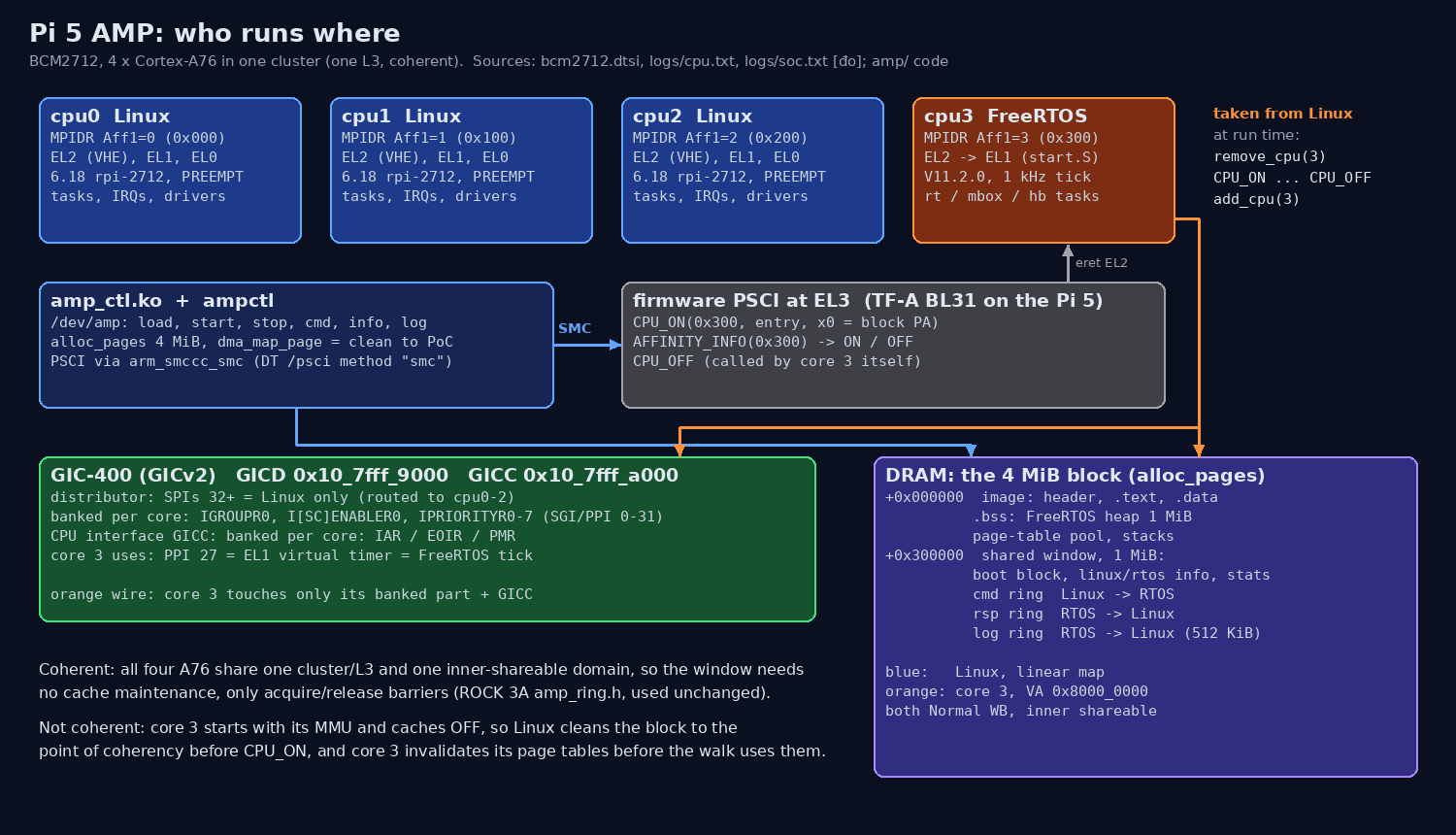
Design. amp_ctl.ko calls remove_cpu(3), allocates a 4 MiB block with alloc_pages (no
reserved memory needed), copies the RTOS image in, and starts core 3 there with PSCI CPU_ON. Linux
and the RTOS talk through rings in that shared block. To stop, the RTOS calls CPU_OFF on itself and
the module calls add_cpu(3). About half the code comes from my ROCK 3A AMP. FreeRTOS V11.2.0 uses
its GICv2 AArch64 port; core 3 sets up its own MMU and only touches its own banked GIC registers.
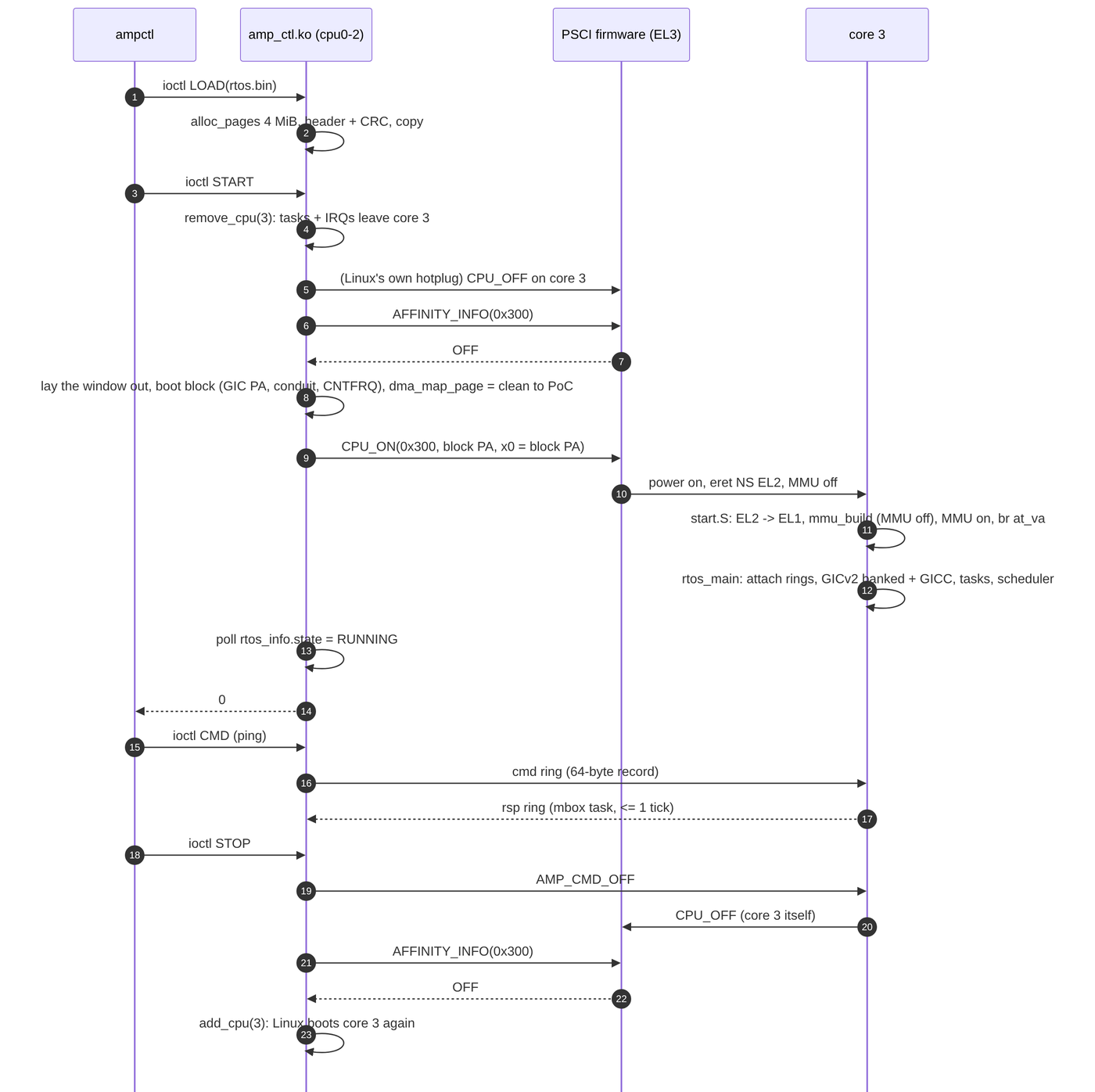 One full cycle as a sequence:
ampctl LOAD and START, remove_cpu(3), PSCI CPU_ON at the block’s physical address, the RTOS turning on its MMU, pings over the rings, then CPU_OFF on itself and add_cpu(3).
The Pi was offline. On 2026-10-30 I couldn’t reach the board at all (100 % ping loss), and I had
decided nothing gets written to it yet anyway. So: build on the PC against the Pi kernel at a pinned
commit (6.18.59), and test the whole cycle on QEMU’s virt machine with GICv2 and four A76s.
Bugs on the way. The first link failed: FreeRTOS’s port keeps a 32-bit absolute .word, so the
link address has to be under 4 GiB. I moved the RTOS virtual address from 0x40_0000_0000 to
0x8000_0000. Then, because I can’t debug core 3 before its MMU is on, a checker script walks every
instruction that runs before that point: 274 of them, no absolute address except the jump to the
virtual address. Page tables are walked in software for four layouts (Pi 5 x2, QEMU, VA = PA).
The first QEMU run said all PASS, and the log still had two real bugs in it. The second START
reused the first run’s .data (it came up still saying “rt 2000 us” from run one), so the image is
now copied fresh every time. And the first two log lines used a 54 MHz fallback, so time ran
backwards (3.543 s, then 3.086 s); CNTFRQ is now read first thing.
Result
The selftest on QEMU, a few of its verdict lines:
[ 3.013302] amp: '20261030-2354' RUNNING on cpu3 (MPIDR 0x80000003) 6880 us after CPU_ON, entered at EL2, runs at EL1
start: ok, 54.8 ms (remove_cpu + CPU_ON + boot)
[PASS] mailbox: 5 pings answered
[PASS] tick: ~1000 IRQs/s on core 3
stop: ok, 28.3 ms (CPU_OFF + add_cpu)
[PASS] after: the core is Linux's again
QEMU AMP TEST PASS
All 13/13 checks pass on QEMU, and a separate fault test works too: a data abort on core 3 ends
in CPU_OFF and the core goes back to Linux. Start takes 54.8 ms, stop 28.3 ms, and
CPU_ON to RUNNING is 1.2 to 6.9 ms under TCG. The RTOS image is 32 392 bytes and uses 1188 KiB
of the 3 MiB it’s allowed.
Latency on QEMU means nothing: three runs gave a worst wake-up of 1.7, 8.0 and 13.7 ms, because each vCPU is just a thread on my busy PC. The number this demo exists for is not measured yet.
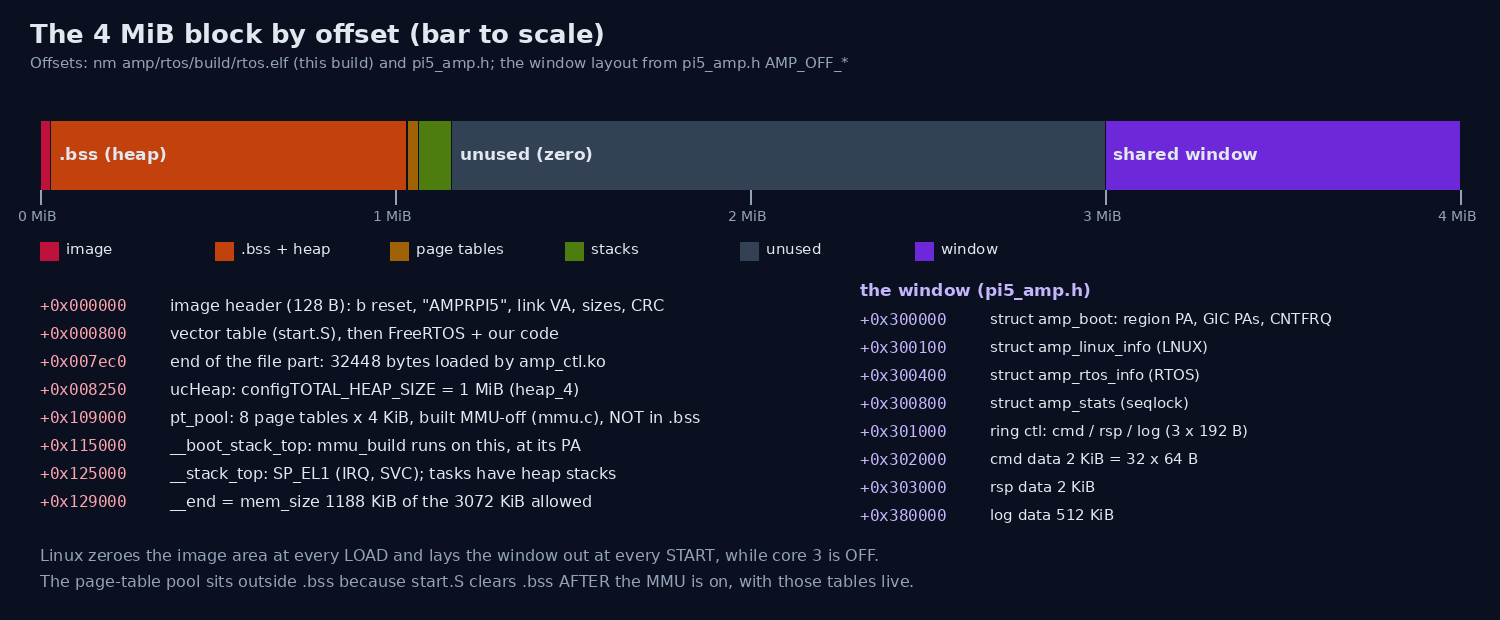 The 4 MiB block by offset, to scale: image header, code, the 1 MiB FreeRTOS heap in
.bss, page tables, stacks, and the shared window for the rings at the top.
What I’d do next
Run it on the Pi 5 the day I’m allowed to write to it: copy only our sources over, fetch FreeRTOS there,
build the module against the Pi’s own headers (it runs 6.18.50, I built against 6.18.59), then
insmod, ampctl selftest, rmmod. Things QEMU can’t prove: whether the firmware puts the timer PPI
in a group core 3 can use, and the cache maintenance (QEMU models no caches, so a missing clean would
still pass). Then the real wake-up latency, next to the ROCK 3A’s 2.3 to 7.8 us.