Raspberry Pi 5 (BCM2712 + RP1)
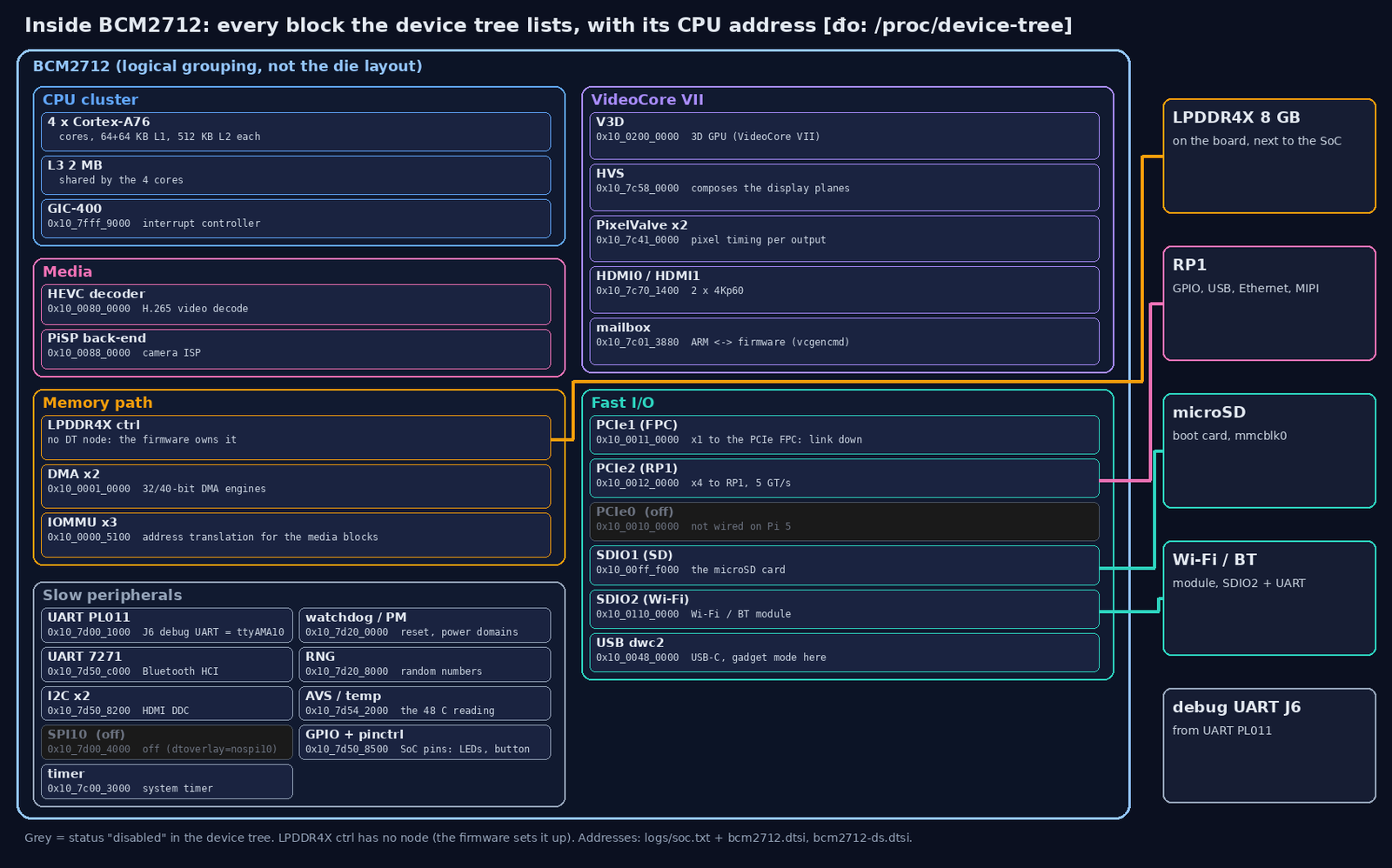
The Pi 5 is really two chips joined by PCIe. The BCM2712 has the four Cortex-A76 cores, the GPU, the memory controller and HDMI. The RP1, Raspberry Pi’s own chip, has almost everything you actually touch: the 40-pin header, USB, Ethernet, the camera and display connectors. Mine is the 8 GB Model B rev 1.0, running Debian 13 with kernel 6.18 from the SD card.
My Pi 5 with its active cooler on my desk, then its boot in 105 s: boot ROM, EEPROM bootloader, SDRAM, firmware from the SD card, the kernel (PCIe link up at 1.074 s, RP1 at 1.096 s), userspace at about 15 s. (Vietnamese on-screen text, no sound.)
This board is different from my other ones: it’s busy. It runs Linux for another project of mine, so I can’t just flash it or reboot it whenever I like. On 2026-10-30 I treated it like someone else’s server: everything over ssh, read-only, no sudo. That’s also why the RTOS work below is still waiting for its first run on the real board.
So far I got two things out of it. A read-only survey over ssh (buses, boot, power rails, pins, clocks, temperature), which is where I saw that a GPIO write is now a PCIe transaction. And an AMP demo: a kernel module lends core 3 to FreeRTOS and takes it back, 13/13 checks passing on QEMU.
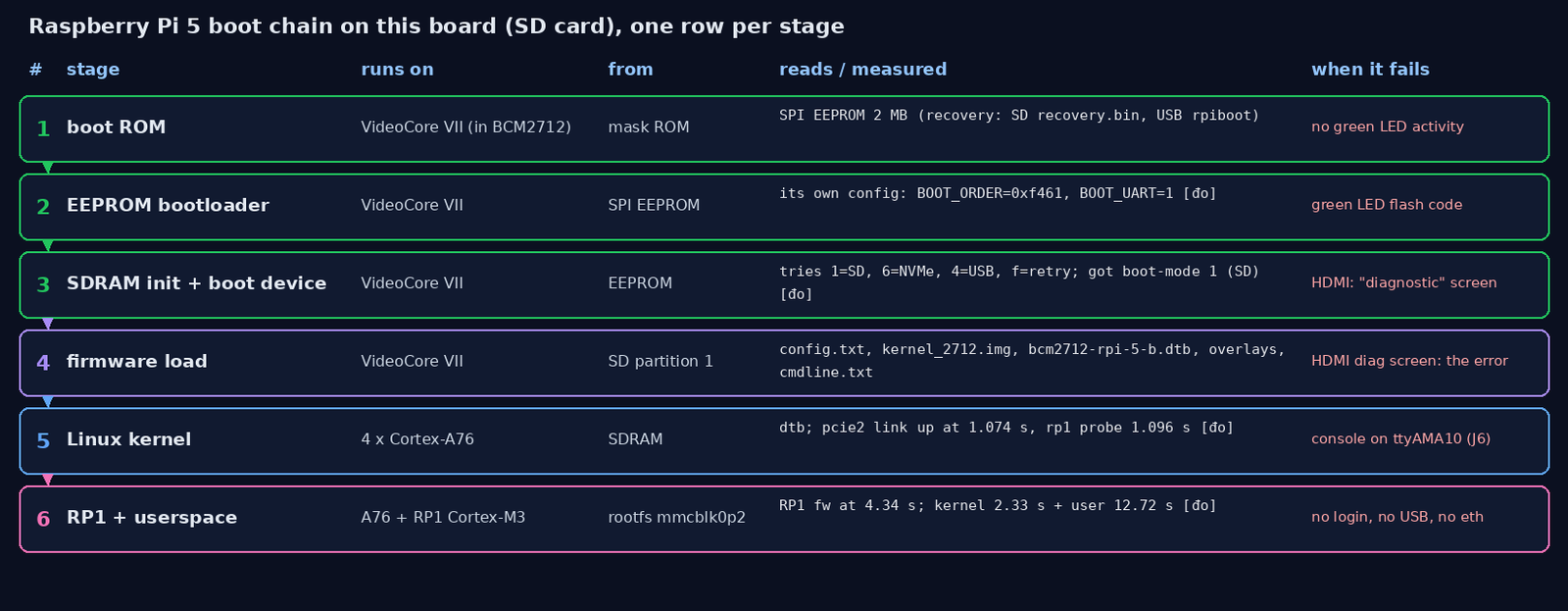 The same boot as one row per stage, read from my board’s logs:
BOOT_ORDER=0xf461, boot mode 1 (SD), kernel 2.33 s + userspace 12.72 s, and what the board shows when each stage fails.
The stories
| # | Story | Result | Status |
|---|---|---|---|
| 1 | A GPIO write on the Pi 5 is a PCIe transaction Surveying my Pi 5 read-only over ssh: where the header lives now, how it boots, what it draws at idle |
RP1 on PCIe x4 at 5 GT/s; idle 1.5 GHz, 47.7 C, fan off, ~1.93 W on the PMIC rails | Done |
| 2 | Lending core 3 of a running Linux to FreeRTOS (QEMU so far) A kernel module that unplugs one A76, starts FreeRTOS on it with PSCI, and gives it back, with no reboot |
QEMU: 13/13 selftest checks pass, start 54.8 ms, stop 28.3 ms; not run on the board yet | In Progress |
Still open
The AMP selftest on the real Pi 5. Until then I have no real latency number for it, only QEMU’s, which measures my PC’s scheduler, not the chip. I haven’t measured a GPIO toggle either: the board is shared, so I didn’t touch its pins. And the boot log on the 3-pin debug UART (J6) is still unseen, I don’t have a probe on it.