Two bugs in the DynamixelSDK Python package, found with no servo plugged in
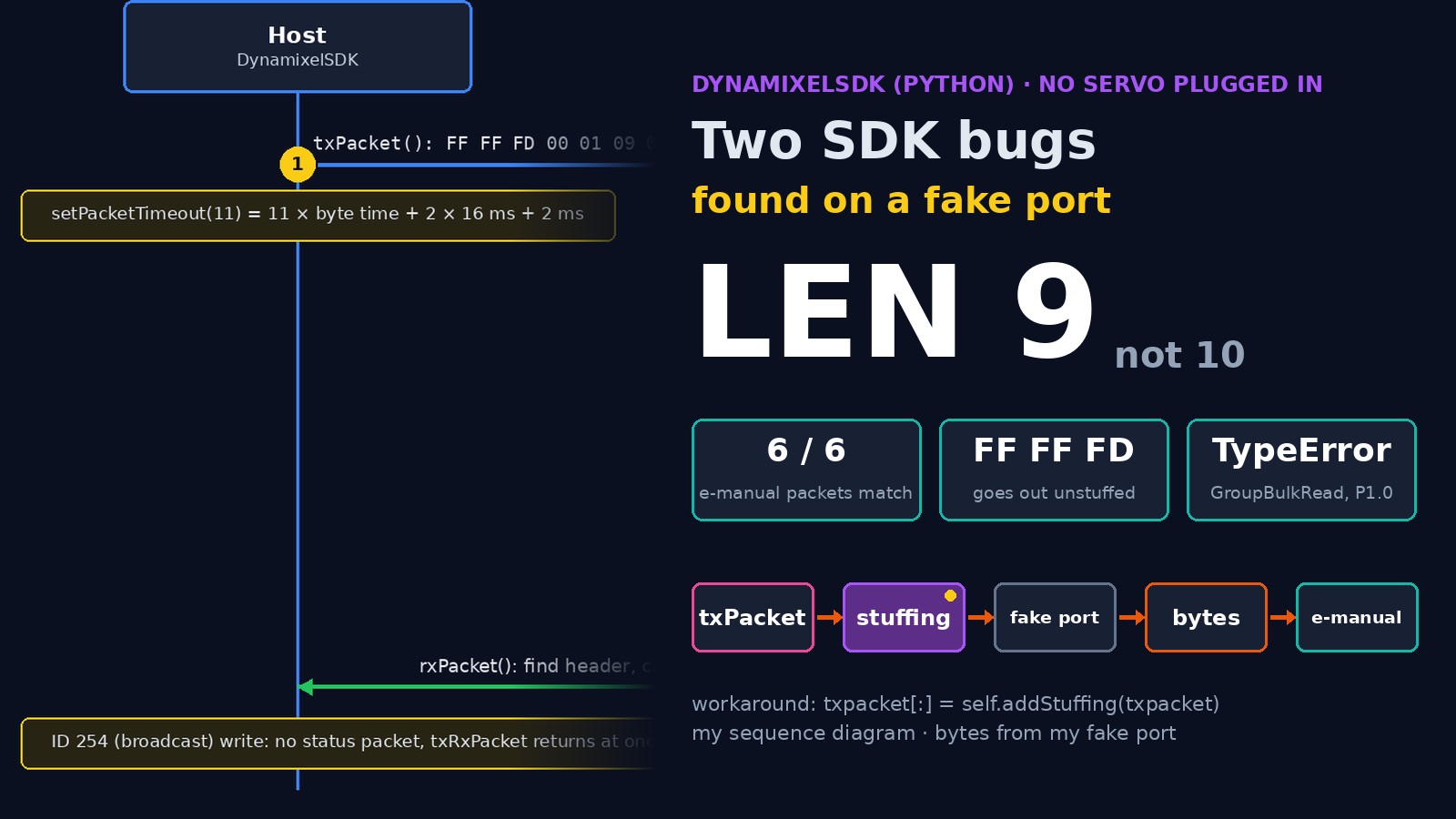 A write of FF FF FD goes out unstuffed (LEN 9, not 10), and GroupBulkRead on Protocol 1.0 raises TypeError.
Situation
I had servos and no adapter, and I wanted to know what the bus would carry before I spent evenings guessing at a scope. The ROBOTIS e-manual gives example packets for ping, read, write and sync write, so the SDK’s output can be checked against them without any hardware.
Later the humanoid walker needed to read ten servos every 20 ms, eight MX-28 and two AX-12A, all on Protocol 1.0. That’s a Bulk Read for the MX-28 and single reads for the AX-12A (Bulk Read isn’t supported on the AX).
Task
Run the real DynamixelSDK (pinned at commit a8d35d51, 2026-10-16) against a port that records what is written and plays back a scripted reply, print every byte, and compare with the e-manual.
Action
The fake port is the SDK’s own PortHandler with only the serial I/O replaced. Its timeout code
stays the SDK’s, unchanged, so the timing logic is tested too.
class FakePort(PortHandler):
    """The SDK's own PortHandler with only the serial I/O replaced: it captures
    what is written and plays back a scripted reply.  The timeout code
    (setPacketTimeout, isPacketTimeout) is the SDK's, unchanged."""
Every case with an e-manual reference came out MATCH: ping, read, write, sync write, and the
Protocol 1.0 checksum and ping. Then the case the e-manual doesn’t cover. Protocol 2.0 says that if
FF FF FD shows up inside a packet, the sender inserts an extra FD so the receiver doesn’t
take it for a new header. Goal Position 0x00FDFFFF has exactly those bytes:
$ python3 tools/dxl_wire_check.py stuffing
Write 0x00FDFFFF to 116 of ID 1: the data bytes are FF FF FD 00,
which looks like a header, so Protocol 2.0 says the sender must stuff a 0xFD
  addStuffing() return value: FF FF FD 00 01 0A 00 03 74 00 FF FF FD FD 00 00 00  (length field 10)
  what txPacket() wrote   : FF FF FD 00 01 09 00 03 74 00 FF FF FD 00 C9 07
  length field on the wire: 9, stuffed 0xFD present: False
addStuffing() builds the right packet. But when the length grows it rebinds its local packet
to a new list, and txPacket() calls it without using the return value. The caller’s list never
changes, and the unstuffed packet goes out. In Extended Position mode, −131073 is FF FF FD FF, so
this isn’t only a weird corner value. What I’d expect on a real bus is a “no status packet” or a CRC
error for a few specific positions only, which would be a nightmare to chase (I haven’t seen that
on hardware, it’s my guess). The one-line workaround is
txpacket[:] = self.addStuffing(txpacket). From reading the C++ SDK, it stuffs in place, so it
should be fine; I didn’t run it.
The second bug came from the humanoid’s bus code:
read_positions(): Bulk Read for 8 MX-28, then 2 single Reads for the AX-12
  FF FF FE 1B 92 00 02 01 24 02 02 24 02 03 24 02 04 24 02 0B 24 02 0C 24 02 0D 24 02 0E 24 E8
  ...
DynamixelSDK GroupBulkRead.txRxPacket() on Protocol 1.0:
  TypeError: Protocol1PacketHandler.bulkReadTx() takes 4 positional arguments but 5 were given
GroupBulkRead passes one argument too many to the Protocol 1.0 bulkReadTx(). So my walker
builds that Bulk Read packet itself; the line above is the packet it sends.
Result
Re-run today on the same pinned commit: all 6 reference cases match, the stuffing case still
writes LEN 9 with no extra FD, and GroupBulkRead on Protocol 1.0 still raises TypeError. On
the fake port, the walker’s command and read-back agree to within 0.042° (one encoder tick), and
the standing-pose command is one 38-byte Sync Write, 380 µs at 1 Mbps.
What I’d do next
Buy the U2D2, find out which protocol my MX-28s actually speak, and check that the bytes on a real bus look like these. And file both bugs with ROBOTIS, after checking whether a newer commit has fixed them.