PID: 108 s of windup, and gains from a relay
Back to the control library hub
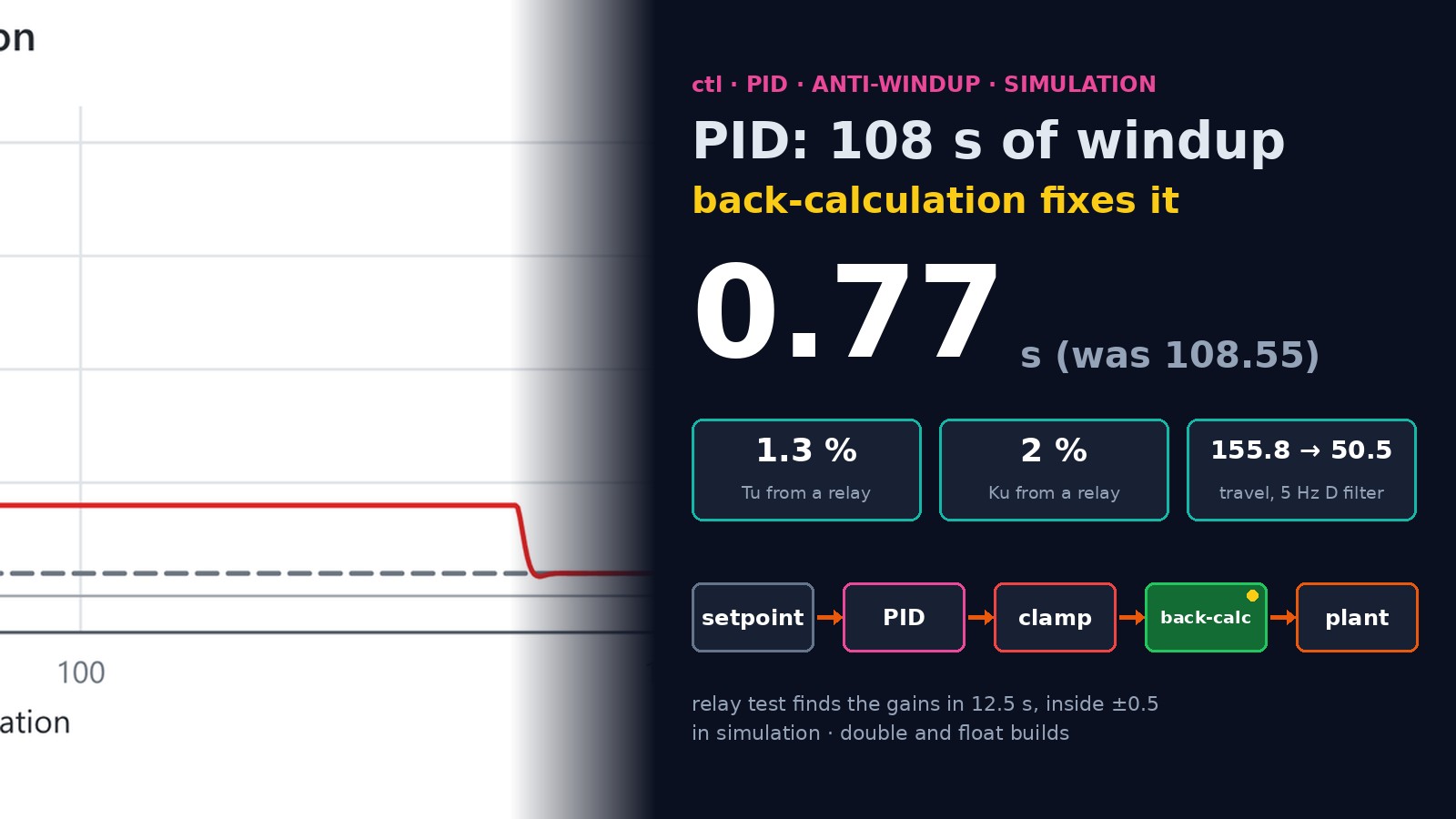 The result first: back-calculation brings the loop back from saturation in 0.77 s instead of 108.55 s, same gains, in simulation.
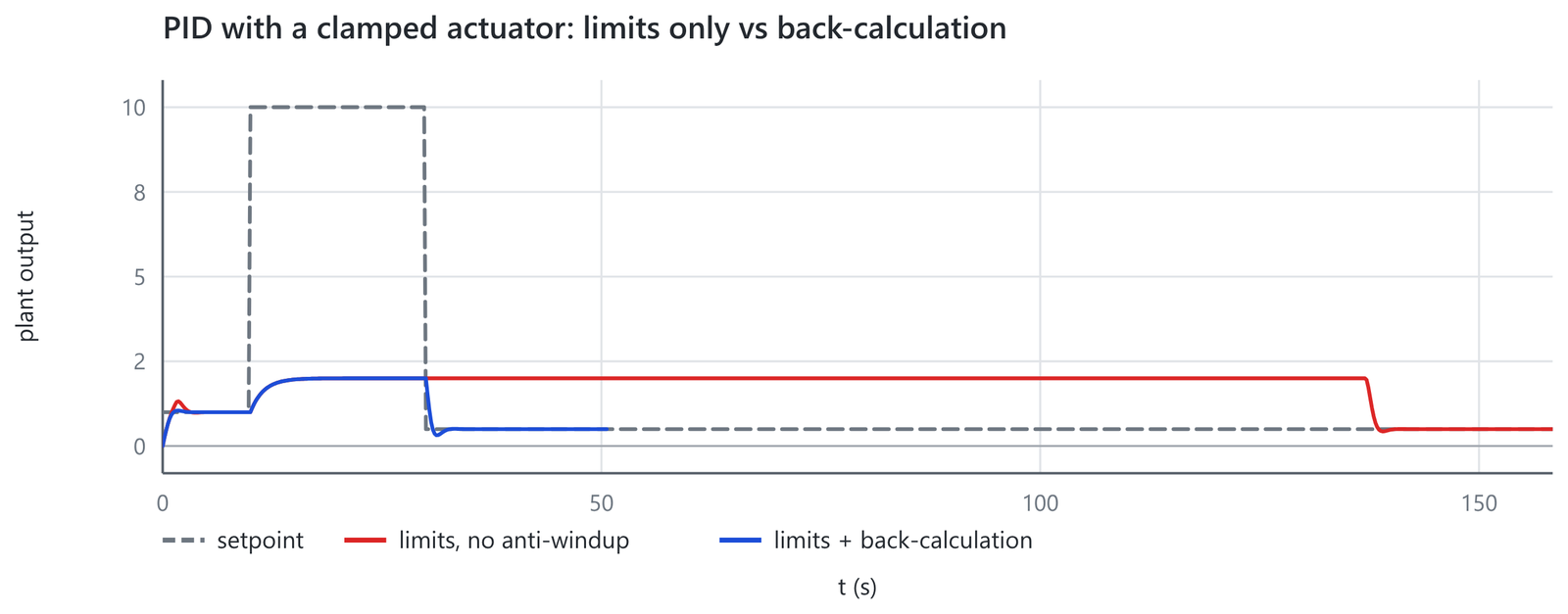
Situation
The PID I kept copying between projects had no output limit and no anti-windup. On a bench that’s invisible: the setpoints are reasonable and nothing saturates. Then one day you ask for something the actuator can’t deliver, the integrator keeps counting, and the loop is useless for a long time after you take the request back. I wanted to see how long “a long time” is, and I wanted gains I could measure rather than gains I’d tweaked until the plot looked fine.
Task
Two demos on the new ctl::Pid. First, one plant (first-order lag, K = 2, τ = 1.5 s, actuator clamped to
±1, loop at 100 Hz) driven to an unreachable setpoint of 10 for 20 s and then back to 0.5, with seven
PID configurations. Second, a relay-feedback autotune (Åström–Hägglund) on a plant whose answer I know
in closed form: three equal lags, K/(τs+1)³, where Tu = 2πτ/√3 and Ku = 8/K.
Action
The first build of basic_pid didn’t even compile:
basic_pid_demo.cpp:26:10: fatal error: demo_support.h: No such file or directory
The demo’s CMake still points at the old name of the product-demo folder, which I’d renamed and
forgotten about. I built it with an extra -I for now (the CMake fix is still on my list) and ran it:
  1. no limits, no anti-windup       overshoot  0.138   recovery    0.64 s   travel    66.4
  2. limits, no anti-windup          overshoot  0.324   recovery  108.55 s   travel     4.3
  3. limits + back-calculation       overshoot  0.048   recovery    0.77 s   travel     4.6
  5. unfiltered derivative           overshoot  0.039   recovery    0.78 s   travel   155.8
  6. derivative low-passed at 5 Hz   overshoot  0.046   recovery    0.77 s   travel    50.5
Row 1 looks the best and is a lie: it has no limits, so it commands 2.04 on an actuator that can do 1. Row 2 is what my old copy did once I gave it a clamp. Rows 5 and 6 add 2 % measurement noise, and “travel” (total actuator movement) is where the derivative filter pays: three times less wear for the same recovery.
Then the relay. It swings ±0.5 around a bias of 0.5, never leaves that range, and reads the period and amplitude of the limit cycle:
experiment took 12.51 s (12511 ticks), never commanded more than 1.000,
  measured Tu = 1.1020 s   (analytic 1.0883, error +1.3%)
  measured Ku = 3.9196     (analytic 4.0000, error -2.0%)
Ku is off more than Tu because the describing function keeps only the first harmonic of the square wave. I feed both into the seven published tuning rules and close the loop with each:
  Ziegler-Nichols PID    overshoot   50.8%  settle   2.91 s  IAE  0.651  travel    7.3
  no overshoot           overshoot   19.9%  settle   4.11 s  IAE  0.866  travel    1.3
  Tyreus-Luyben PID      overshoot    0.0%  settle   5.25 s  IAE  0.679  travel    4.0
The rule literally called “no overshoot” overshoots 20 %. Those rules were fitted to first-order-plus- dead-time processes, and this plant is third order. Only Tyreus-Luyben stayed under the setpoint, and it pays with roughly twice the settling time of Ziegler-Nichols.
Result
Back-calculation anti-windup cuts the recovery after saturation from 108.55 s to 0.77 s on the same gains, and a 5 Hz derivative filter cuts actuator travel under noise from 155.8 to 50.5. The relay experiment measures Tu within 1.3 % and Ku within 2 % of the closed-form answer in 12.5 s, without ever leaving its ±0.5 band. Same results in the float build.
What I’d do next
Run the relay on something with real dead time (a heater, see the hotend story on the plant models hub), where I expect Ku to be off by a lot more than 2 %. And fix that CMake include path.