Every TinyUSB device demo on the S3, checked from the PC side
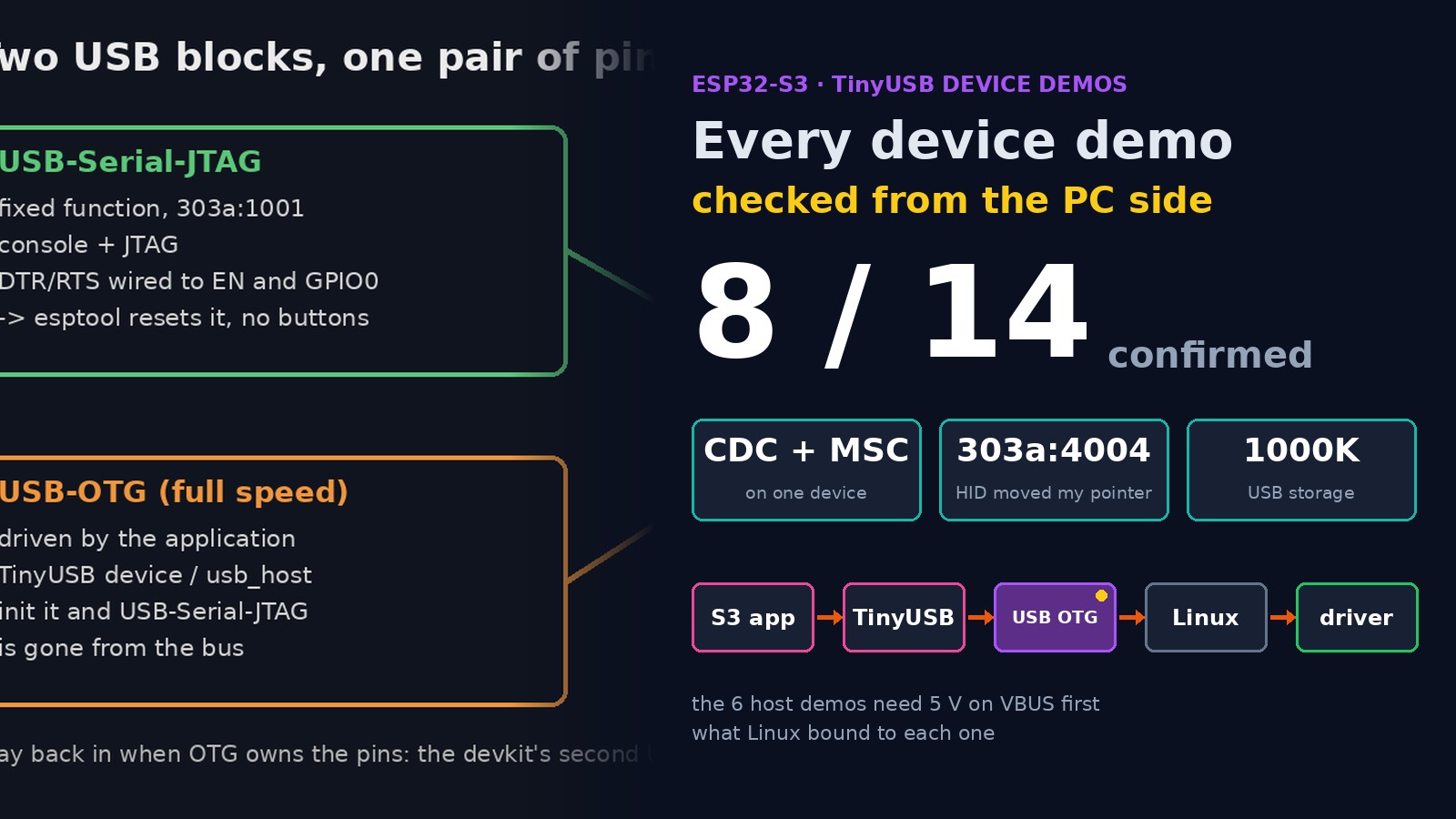 The result first: 8 of the 14 USB demos confirmed by what Linux bound to them: CDC, storage, NCM, MIDI, composite, HID.
Situation
Before writing my own USB device (the webcam), I wanted to know which of Espressif’s USB examples actually work on my S3, the 2 MB PSRAM devkit. ESP-IDF v5.2 ships fourteen: seven TinyUSB device demos, six host demos and one that echoes over the built-in USB-Serial-JTAG port.
Task
Build all fourteen for esp32s3 and run every one this board can run. “It worked” has to mean what
the PC ended up with (a new tty, a disk, a network interface), not that idf.py flash exited 0.
Action
All fourteen built clean, from 205 KB (the echo) to 667 KB (tusb_ncm, which drags in the whole
Wi-Fi stack). The only change I made to Espressif’s code was four project() names that didn’t match
their directory, because my build script finds the image by that name.
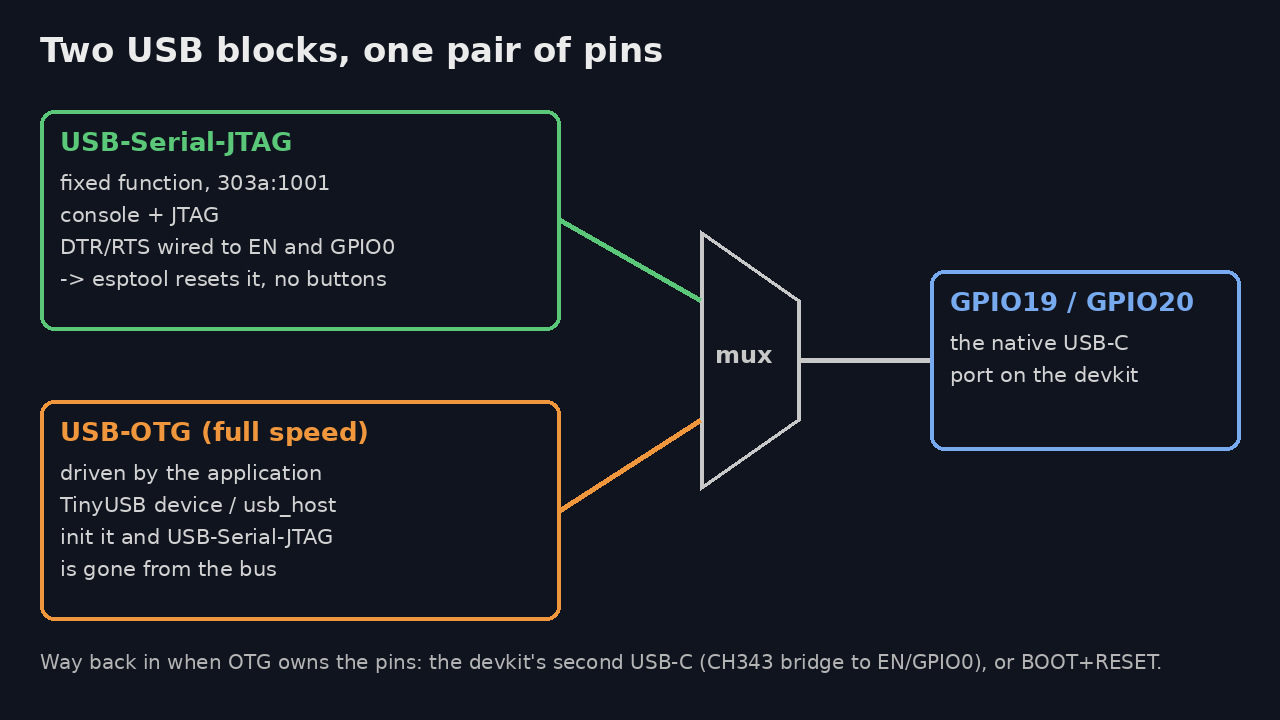
The thing to know about the S3 is in the picture above. soc_caps.h says it has both
SOC_USB_OTG_SUPPORTED and SOC_USB_SERIAL_JTAG_SUPPORTED, but they share GPIO19/20 through a mux.
The moment an app starts the OTG controller, 303a:1001 disappears, and with it the DTR/RTS lines
that let esptool reset the chip into the loader. I flashed tusb_serial_device over the native port,
and then couldn’t get back in:
$ esptool.py -p /dev/ttyACM0 --before usb_reset chip_id
A fatal error occurred: Failed to connect to Espressif device:
Serial data stream stopped: Possible serial noise or corruption.
default_reset fails the same way. esp_tinyusb doesn’t implement a reboot-to-bootloader on the
CDC line state, so the 1200-baud trick from Arduino boards does nothing. The fix was boring: the
devkit’s other USB-C port goes to a CH343 bridge wired to EN and GPIO0 directly, so I flashed
everything else through that and left the native port free to be the thing under test. BOOT+RESET
also works, one press per flash.
Then the board stopped running anything. tusb_msc flashed fine, but the PC saw 303a:1001 instead
of a disk, and every later flash failed with No serial data received. UART0 showed why:
ESP-ROM:esp32s3-20210327
rst:0x1 (POWERON),boot:0x0 (DOWNLOAD(USB/UART0))
waiting for download
boot:0x0 means GPIO0 was low when the chip latched its straps. A watchdog reset (which the ROM
reports as POWERON) didn’t clear it, and holding all four DTR/RTS combinations on the bridge didn’t
change it either. Pulling both cables did: the tusb_msc image already in flash started on its own and
/dev/sda appeared. My guess is the bridge’s auto-reset transistor stayed on after the flasher exited,
so my flash script now deasserts DTR/RTS after every flash. The last five demos went in one after
another with no trouble after that.
Result
Eight demos, each recorded by what Linux bound to it:
| Demo | VID:PID | What the PC did |
|---|---|---|
usb_serial_jtag_echo |
303a:1001 | marker string on ttyACM0 came back byte for byte |
tusb_serial_device |
303a:4001 | cdc_acm, new ttyACM, same echo |
tusb_console |
303a:4001 | cdc_acm, log output over USB |
tusb_msc |
303a:4002 | usb-storage, /dev/sda 1000K, “TEST MSC Storage” |
tusb_ncm |
303a:4000 | cdc_ncm, an enx… interface named after the chip’s MAC |
tusb_midi |
303a:4008 | snd-usb-audio, audio control + MIDI streaming |
tusb_composite_msc_serialdevice |
303a:4001 | cdc_acm and usb-storage on one device |
tusb_hid |
303a:4004 | usbhid, keyboard + mouse, and it moved my pointer |
That’s every descriptor shape TinyUSB ships, working on this silicon. I left the board on
usb_serial_jtag_echo, the one state where it can still be reflashed over its own native port.
What I’d do next
The six host demos (usb_host_lib, CDC-ACM, the CP210x/FTDI/CH34x VCP, HID, MSC, UVC) need 5 V on VBUS
and a USB-A socket on the OTG pins, and the devkit wires both its USB-C ports as devices. A small
breakout and a second S3 running tusb_serial_device would give cdc_acm_host something to talk to.
A reboot-to-bootloader hook on the CDC line state would also be nice, but it only helps demos that
have a CDC port.