Commissioning from a datasheet that’s 50 % wrong
Back to the DC motor drive hub
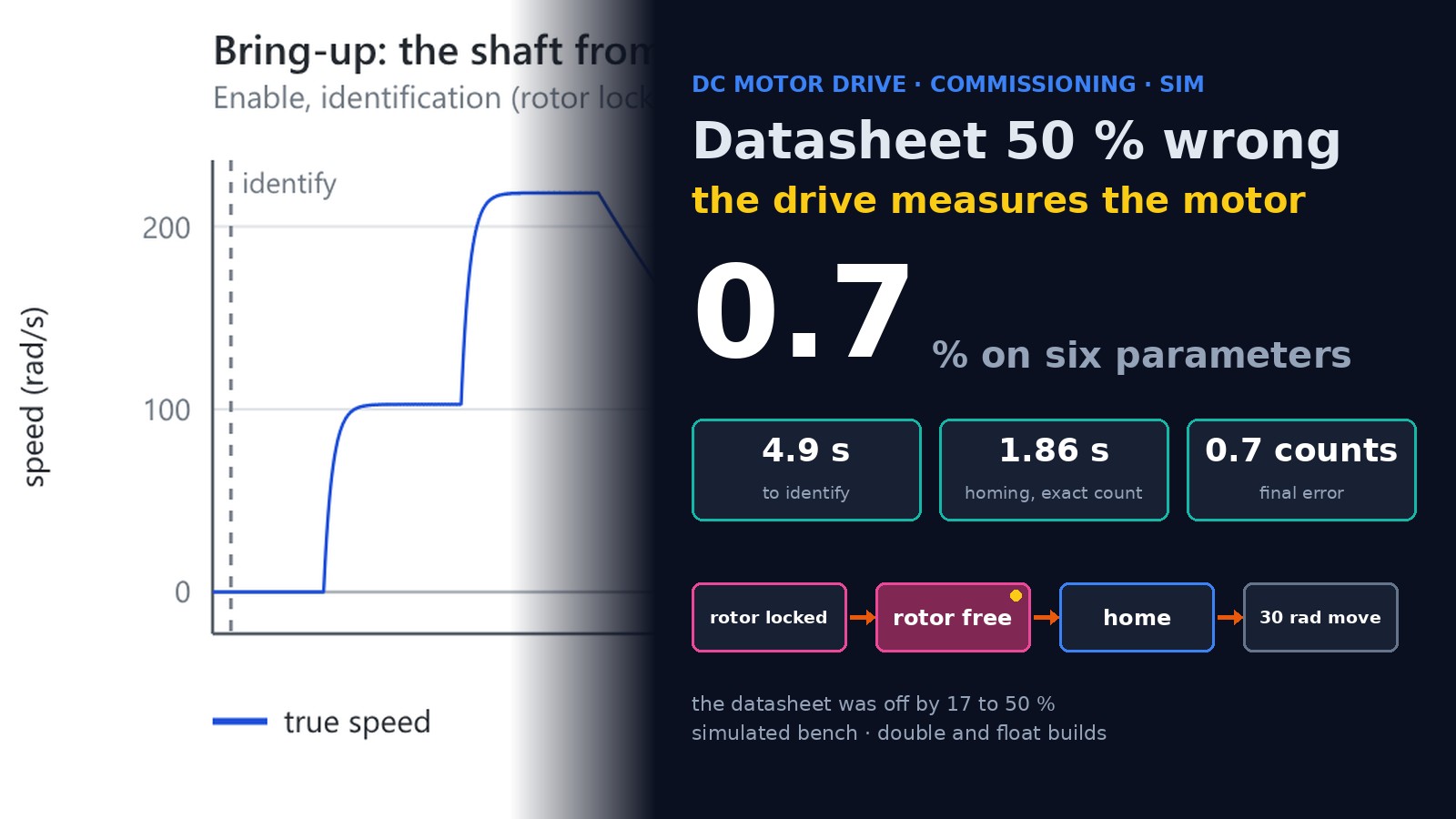 The result first: all six motor parameters within 0.7 % in 4.9 s, from a datasheet that was off by up to 50 %.
Situation
Every drive I’ve tuned started from the datasheet and ended with hand-tweaking, because the datasheet describes a motor, not the one on my bench with its coupling and its load. In the simulated plant I made that explicit: the datasheet the drive starts from has R 17 % low, L 30 % high, Kt 10 % low and the inertia 50 % low.
Task
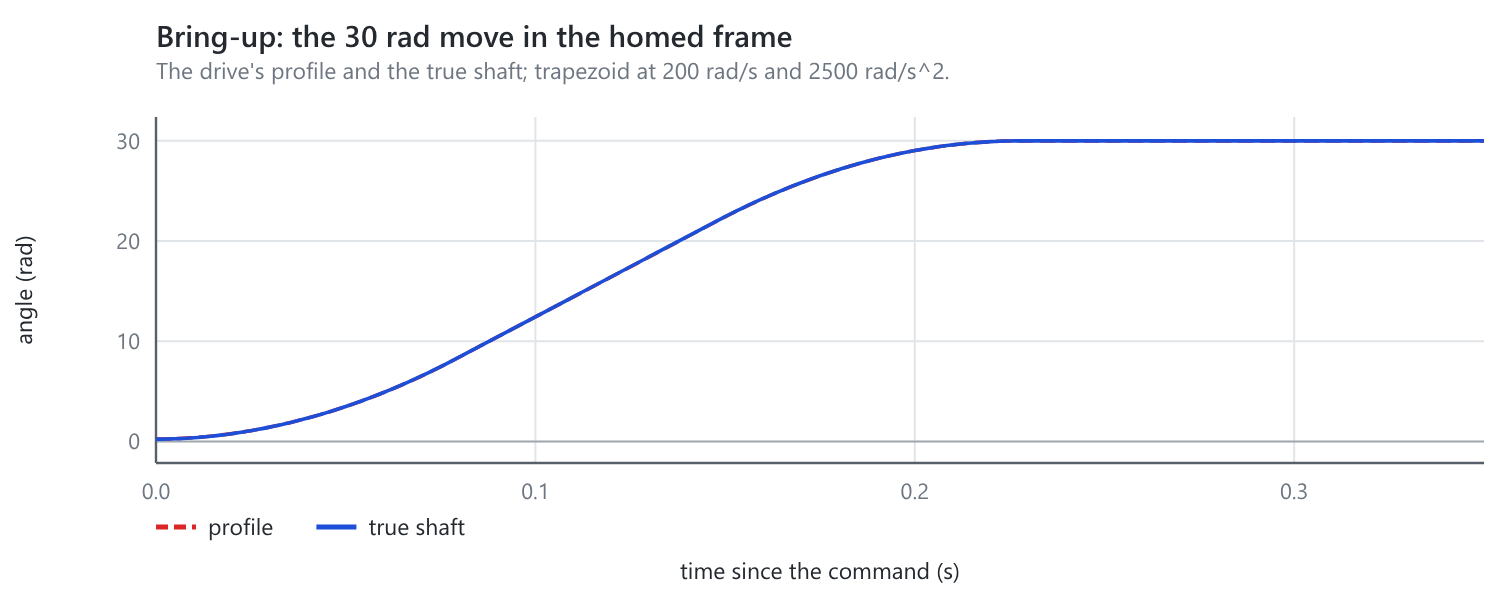
Bring the drive up the way it would happen on a real machine, with every check against the plant’s true parameters: CiA 402 to OperationEnabled, identify the motor on the drive itself (R and L with the rotor held, Kt, J, b and Coulomb friction with it free), re-tune the servo and the protection from what was identified, find the origin on a hard stop 2 rad behind the shaft, then run a 30 rad trapezoid at 200 rad/s and 2500 rad/s².
Action
$ ./build/dc_motor/dc-motor bringup
  CiA 402: NotReadyToSwitchOn -> SwitchOnDisabled (0x0240) -> ReadyToSwitchOn (0x0221) -> SwitchedOn (0x0233) -> OperationEnabled (0x0637)
  identification time                              4.9061 s
  parameter     datasheet identified       true     error
  R  (ohm)         0.9960     1.2039     1.2000    +0.32%
  L  (mH)          0.7800     0.6029     0.6000    +0.48%
  Kt (mN m/A)     22.5000    25.0018    25.0000    +0.01%
  J  (g cm^2)    100.0000   199.3802   200.0000    -0.31%
  b  (uN m s)     20.0000    10.0682    10.0000    +0.68%
  Fc (mN m)        1.0000     1.9939     2.0000    -0.31%
The identifier pauses between the locked and the free steps (AwaitFreeRotor): it waits for someone to
release the rotor, just like on a fixture. After that the drive disables, configures the servo gains from the
identified model, puts protection on the identified R and back-EMF constant, and enables again. Nothing
after this point ever sees the plant’s true parameters.
Homing seeks at −5 rad/s with the current limited to 0.5 A until it hits the stop, backs off, and takes the count at the stop as the origin. The origin has to be applied to the encoder counter and to the speed estimator in the same step. I’ve had the version where only the counter got it, and the compiler doesn’t care, so the glue now does both together and a drift test pins the order.
  homing time                                      1.8600 s
  origin - true stop                               0.0000 counts   ok
  move: settled within 2 counts after              0.2277 s        ok
  move: worst following error                      0.0157 rad      ok
  move: final error (true shaft)                  -0.7048 counts   ok
Result
From a datasheet off by 17 to 50 %, the drive identifies all six parameters to within 0.7 % (worst: viscous friction, +0.68 %) in 4.9 s, homes to the exact count in 1.86 s, and finishes the 30 rad move 0.7 counts from target with a worst following error of 0.016 rad. The float build agrees to within a few hundredths of a percent (J −0.33 %, final error −0.60 counts).
What I’d do next
The identifier needs the rotor held for R and L. On a real machine that’s a fixture or a brake, and I don’t have either yet. I’d like a version that does R and L with short pulses too fast to turn the shaft.