When it goes wrong: chip fault, a hot winding, a dead encoder
Back to the DC motor drive hub
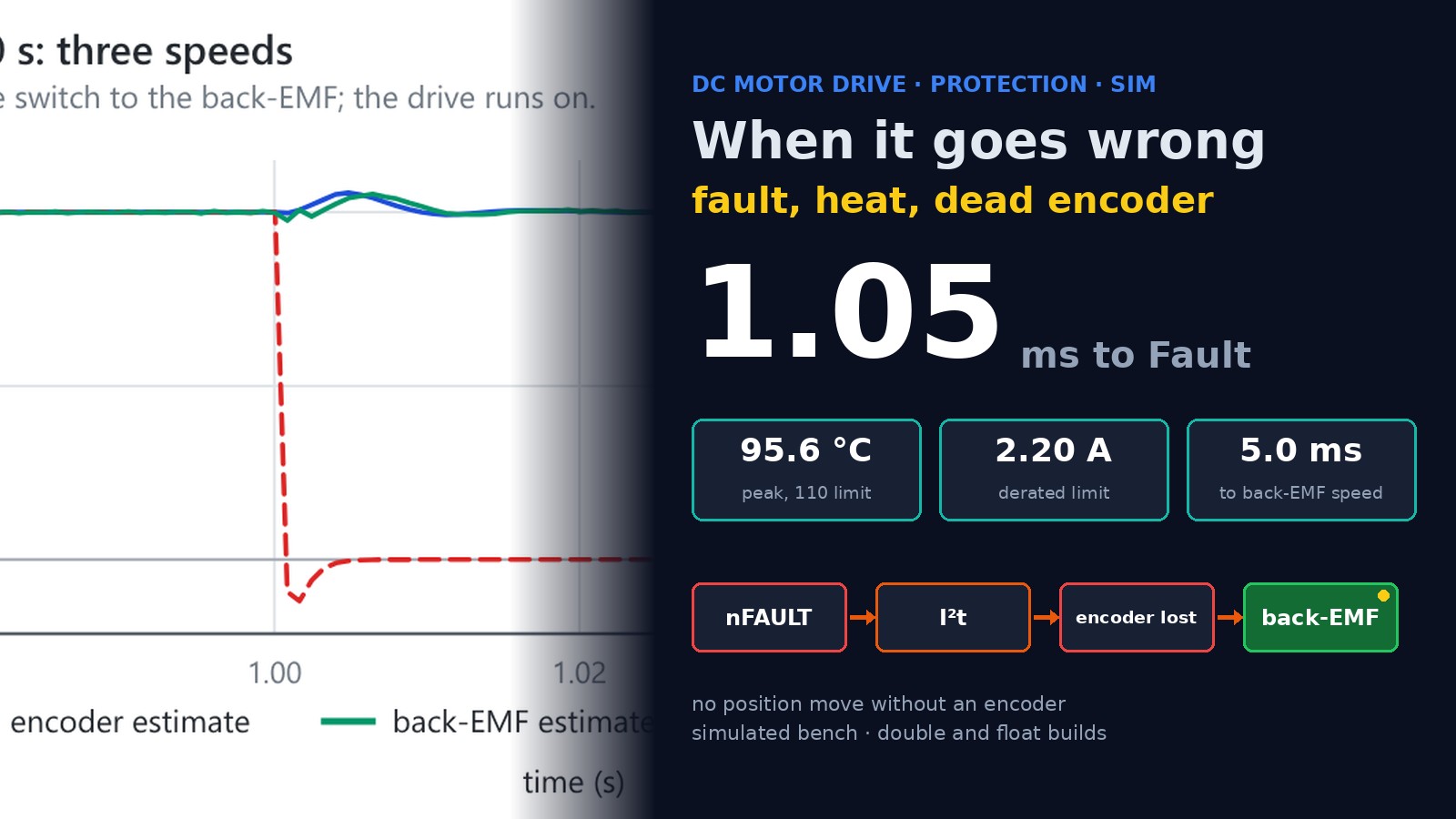 The result first: Fault in 1.05 ms, the winding peaks at 95.6 °C under a 110 °C limit, and a dead encoder hands over to back-EMF speed in 5.0 ms.
Situation
The happy path of a drive is maybe a third of the code. The rest is what happens when the bridge pulls its fault pin mid-move, when the load is heavier than the motor’s rating for minutes at a time, or when a connector shakes loose. On a bench you find those by breaking things. In the simulator I can break them on purpose, at the same tick, every run.
Task
Three scenarios, all on the commissioned model. (c) The bridge asserts nFAULT for 100 ms during a 40 rad move: go to Fault, refuse a reset while the fault is held, recover, finish the move. (d) A pump load that needs about 2.6 A at 280 rad/s on a motor rated 1.5 A, four cycles of 25 s pumping and 5 s stopped: the winding must not reach 110 °C and nothing should trip. (e) The encoder line dies at 200 rad/s: keep running on the back-EMF speed, and refuse any position command, because without an encoder there is no angle.
Action
Fault first. Protection maps the chip fault to “coast now”, and the state machine walks to Fault:
   0.1000 s  nFAULT asserted at 200.2 rad/s
   0.1001 s  OperationEnabled    -> FaultReactionActive
   0.1011 s  FaultReactionActive -> Fault
  failed resets while asserted                          1
   0.2310 s  Fault               -> SwitchOnDisabled
  shaft speed when enabled again                 162.8830 rad/s
  brought to rest under control in                 0.0433 s        ok
The interesting line is the speed when enabled again: the shaft is still coasting at 163 rad/s. The servo has to come up idle (torque mode, 0 A), not resume the old move, then stop the shaft under control and only then take the new position command.
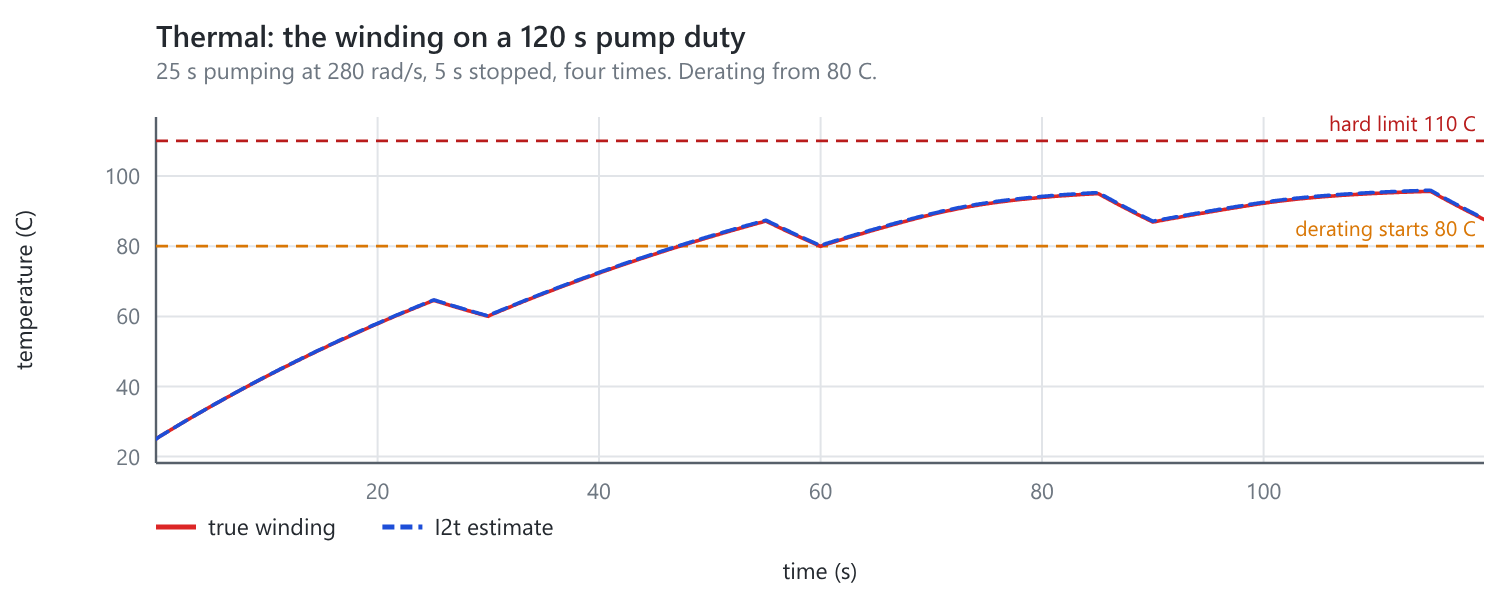
Thermal: from 80 °C the protection derates the current limit towards 1.5 A at 110 °C. The speed loop then runs into its limit and the pump just gets slower, which is the right thing to give up:
  first derating (estimate at 80 C) at            47.0911 s
  peak true winding temperature                   95.6319 C
  lowest derated limit                             2.2038 A
  speed at the end of the last pumping phase     259.4872 rad/s
  estimate above the truth by at most              0.2931 K
The I²t estimate runs slightly high (by the identified R’s error), which is the safe side.
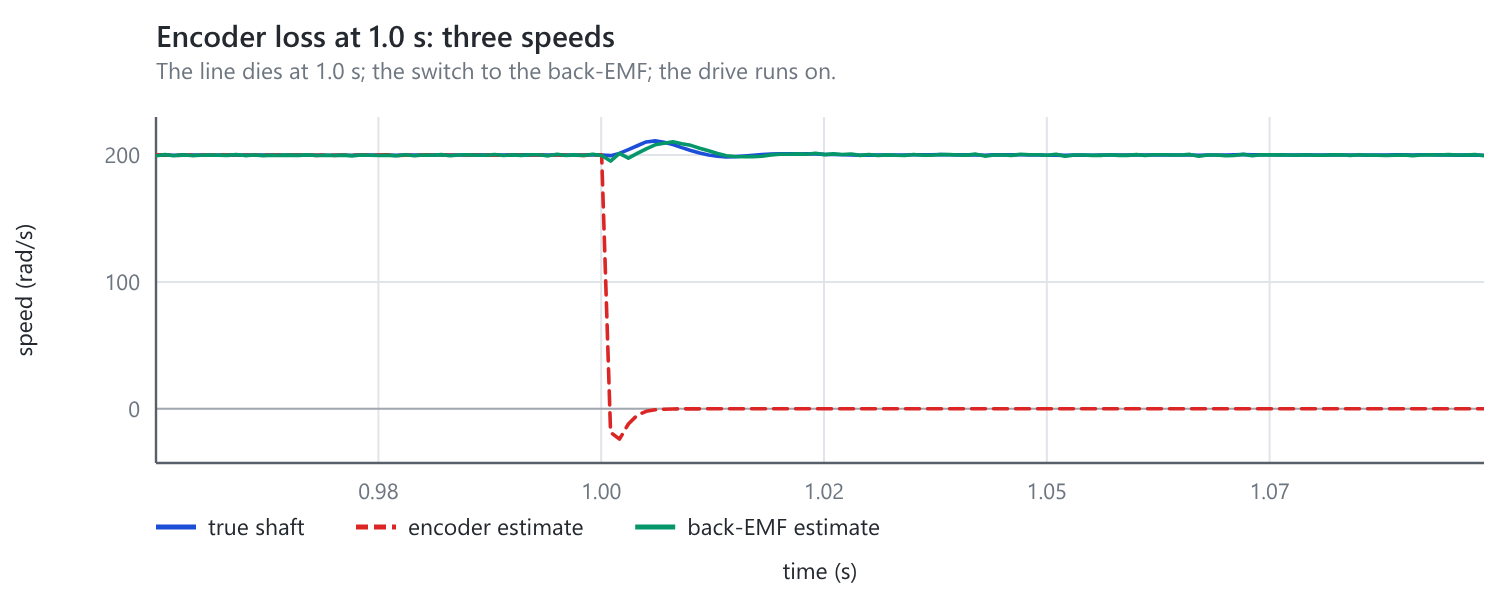
Encoder loss: the cross-check between encoder speed and back-EMF speed has to disagree for 5 ms before it switches, so a single glitch doesn’t do it.
  line dead to the switch                          5.0000 ms       ok
  worst |w - 200| in the 200 ms after             11.2217 rad/s    ok
  still OperationEnabled, Warning set                 yes          ok
  position refused: PositionWithoutEncoder            yes          ok
Result
The chip fault reaches Fault in 1.05 ms, a reset is refused while nFAULT is held, and after recovery the move
finishes 0.18 counts from target. Under the pump duty the winding peaks at 95.6 °C (hard limit 110 °C) with the
limit derated to 2.20 A and nothing latched; the pump drops to 259 rad/s instead. With a dead encoder the drive
switches to back-EMF speed in 5.0 ms, stays within 11.2 rad/s of 200, and refuses the position move with
PositionWithoutEncoder, then ramps down and faults. The float build passes the same checks (peak 95.633 °C, switch at 5.0 ms).
What I’d do next
The back-EMF speed depends on Ke, and a real motor’s Ke drops as its magnets warm up. On the simulator that never happens. That’s the first thing I’d measure on a real motor, together with the thermal time constant (here it’s a model value, 40 s).