A load step, a disturbance observer, and a current sensor that can’t tell direction
Back to the DC motor drive hub
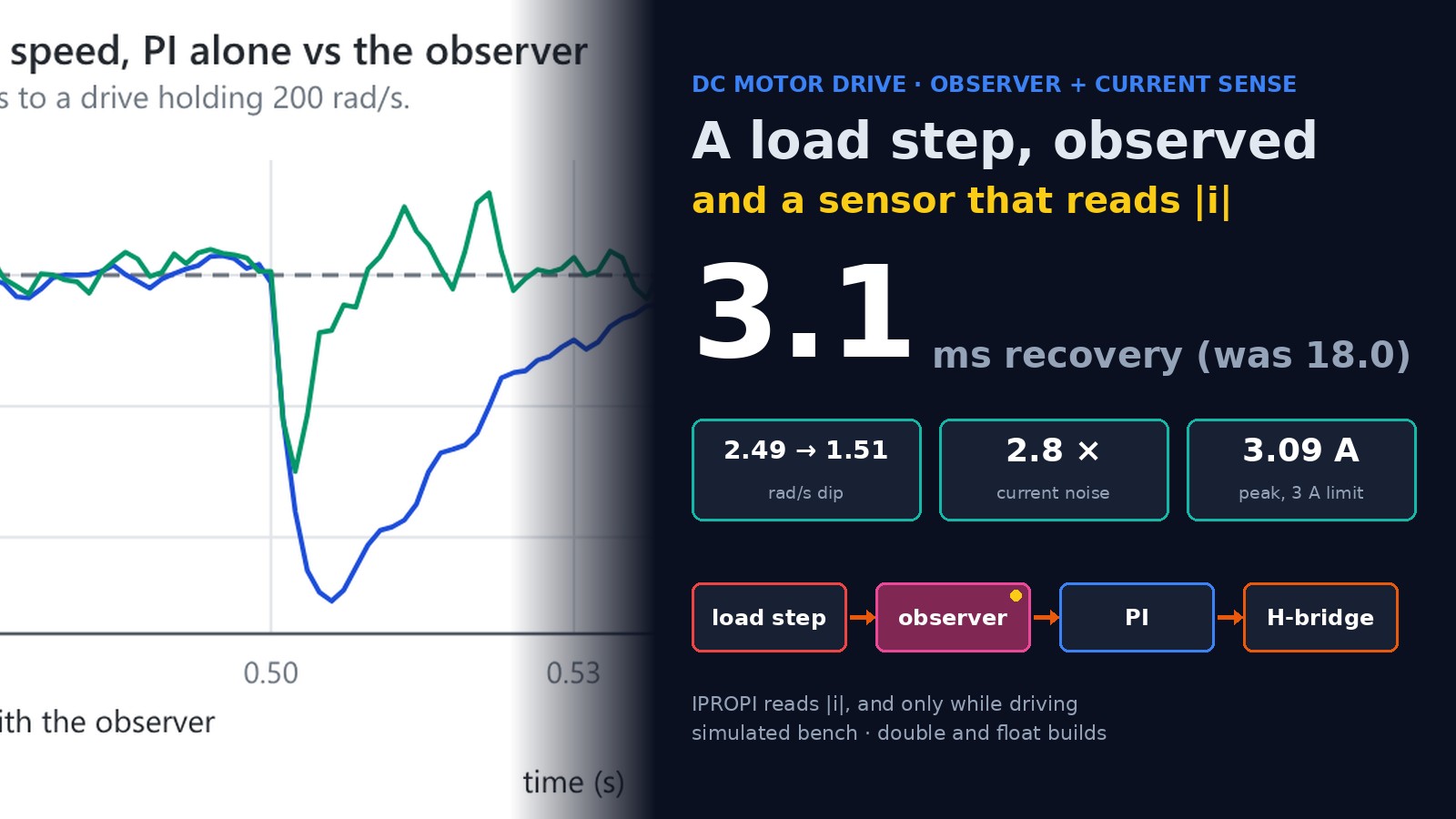 The result first: with the observer the load step costs 1.51 rad/s instead of 2.49 and recovers in 3.1 ms instead of 18.0.
Situation
Two things I couldn’t answer from the block diagram. A disturbance observer is supposed to reject load torque faster than the integrator, but it differentiates the encoder speed (J·dω/dt), so it must be noisier; by how much? And the cheap integrated H-bridges report current through a mirror pin that gives |i| only, and only while the bridge is driving. Without a sign you can’t close a current PI. Is the drive still usable?
Task
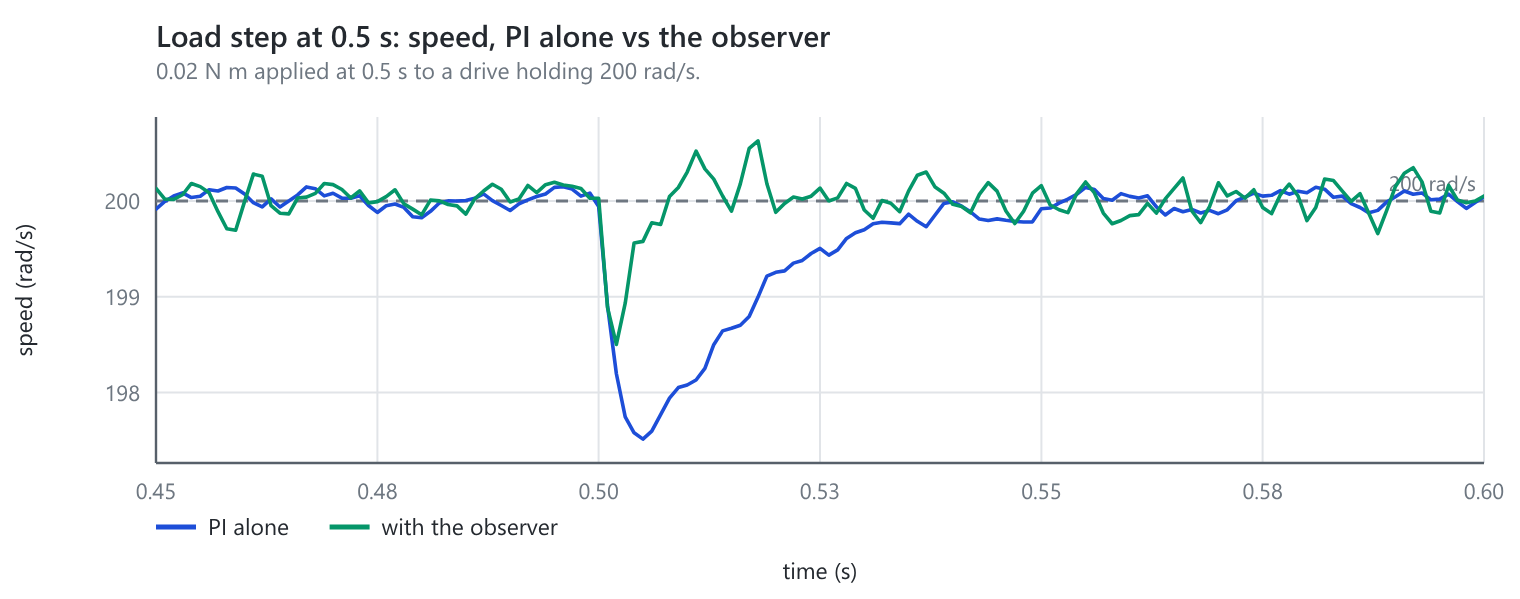
Run two identical drives on the commissioned model from the bring-up story. First pair: hold 200 rad/s, drop 0.02 N·m on both at 0.5 s (0.8 A worth of torque), one with the observer, one without. Second pair: step 0 → 150 → −150 → 0 rad/s with a load from 0.3 s, one with a signed shunt, one with magnitude-only sensing, which makes the library run the inner loop in voltage mode and use |i| only to limit.
Action
$ ./build/dc_motor/dc-motor loadstep
                                         PI alone     observer
  speed dip after the step                  2.488        1.506 rad/s
  back within 1 rad/s after                  18.0          3.1 ms
  reference noise before the step          0.0433       0.1234 A rms
  load compensation at the end             0.0000       0.8270 A
The observer’s feed-forward ends at 0.827 A, which is the load divided by Kt, so it estimated the torque itself and not just “something”. The price is right there: before the step its current reference is 2.85× noisier than the PI’s.
The reversal from +150 to −150 rad/s regenerates, which is exactly where a sign-blind current sensor could get confused.
$ ./build/dc_motor/dc-motor currentsense
                                             signed    magnitude
  0 -> 135 rad/s (90 %) after                  40.4         45.7 ms
  speed rms around 150, 0.2-0.3 s            0.0435       0.0974 rad/s
  reversal to -135 rad/s after                 71.1         75.3 ms
  peak |i| in the reversal                    3.020        3.091 A
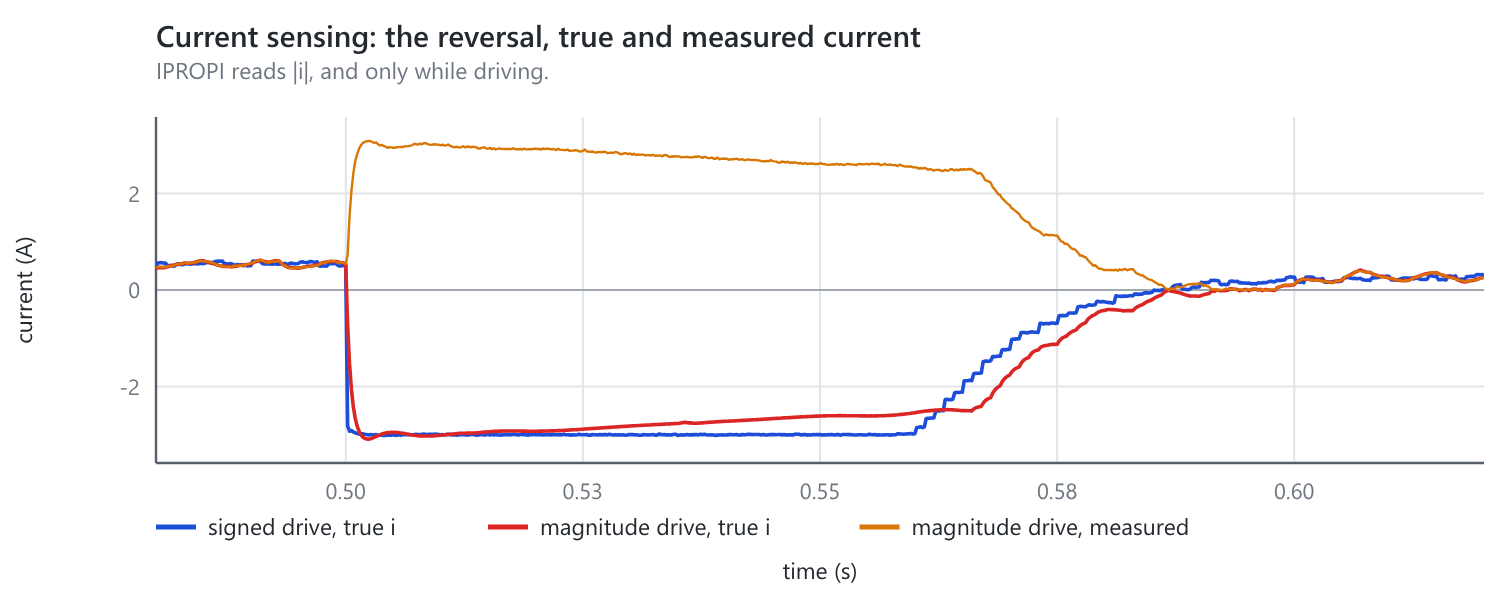
The magnitude sensor (orange in the plot) reads a positive 3 A while the true current is −3 A, and it still holds the limit, because the limit only needs |i|. What you lose is the current loop’s stiffness: voltage mode is about twice as noisy at speed.
Result
With the observer, the dip under the load step drops from 2.49 to 1.51 rad/s and recovery from 18.0 to 3.1 ms, at 2.85× the current-reference noise. Magnitude-only sensing reaches and holds every speed and keeps the peak current at 3.09 A against a 3 A limit through the regenerating reversal; its speed is 2.2× noisier (2.0× in the float build) and its 90 % rise is 5 ms slower.
What I’d do next
The observer’s bandwidth is the knob between those two columns. I only ran one value. A sweep of dip vs noise would show where it stops being worth it.