Complementary filter at 0.0044 rad, once I stopped trusting the gyro for 0.5 s
Back to the control library hub
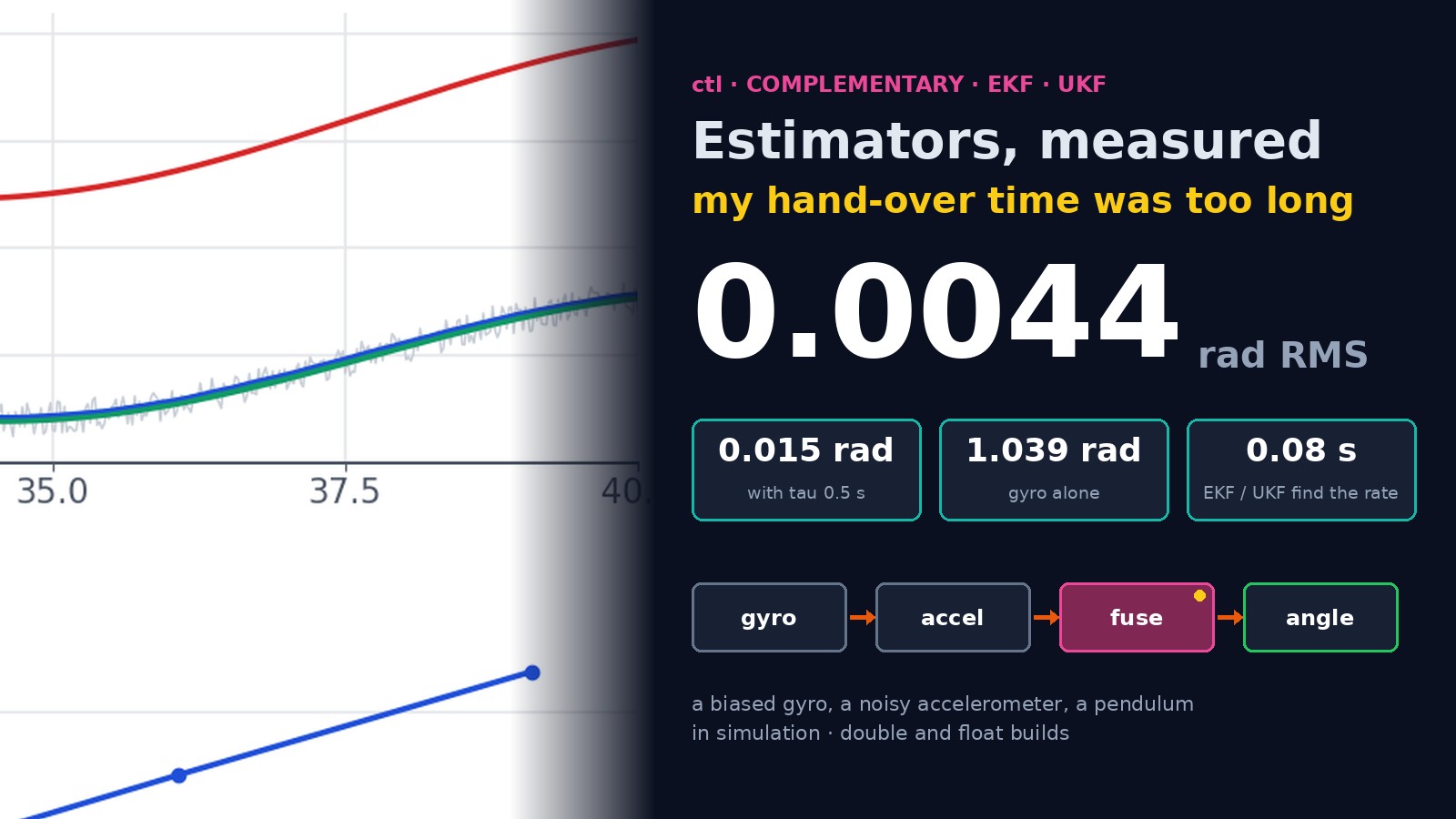 The result first: the same complementary filter, hand-over time 0.1 s instead of 0.5 s, tracks the angle to 0.0044 rad RMS instead of 0.0151. In simulation.
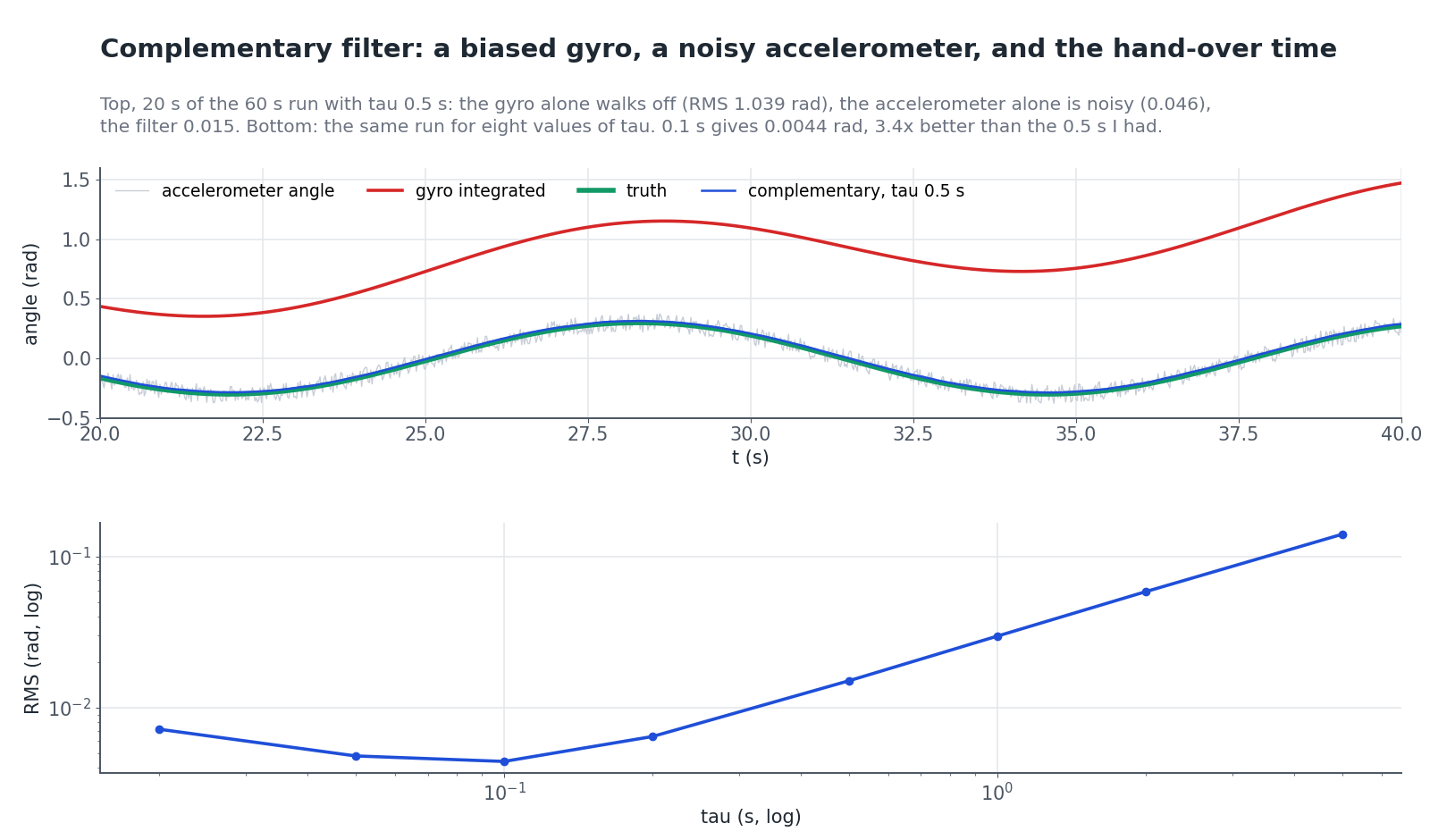 Top: the gyro alone walks away, the accelerometer alone is noise, the filter sits on the truth. Bottom: the error against tau, best at 0.1 s.
Situation
Every control law in the library assumes it knows the state, and a real board measures less than that. The library has three answers: a complementary filter for the IMU case, and an EKF and a UKF for anything with a model. My controller gallery ran the complementary filter once, on a synthetic IMU (true angle 0.3·sin(0.5t) rad, a gyro with a 0.03 rad/s bias, an accelerometer angle with ±0.08 rad of noise), and printed 0.0151 rad RMS against 1.039 for the gyro alone and 0.046 for the accelerometer alone. Better than either input, so I’d left it there. The hand-over time, 0.5 s, was a number I’d picked because it looked reasonable.
Task
Sweep the filter’s single parameter, tau, from 0.02 to 5 s on the same 60 s run and see whether 0.5 s was any good. Then run the EKF and the UKF side by side on the pendulum from the unit tests: angle measured with ±0.01 rad of noise at 100 Hz, rate never measured, both filters starting with the angle wrong and no idea of the rate. Once released from 1.0 rad, once from 2.5 rad, where sin θ is far from θ and an EKF’s linearisation is supposed to hurt.
Action
Both runs are in controller_traces, the measurement demo next to the gallery, built in double and
float. The sweep:
tau sweep, fused RMS: 0.02:0.0072 0.05:0.0048 0.10:0.0044 0.20:0.0064 0.50:0.0151 1.00:0.0298 2.00:0.0588 5.00:0.1410
From 0.5 s up the error doubles every time tau doubles, and the numbers are almost exactly 0.03 × tau: 0.015, 0.030, 0.060, 0.150 by that rule, 0.0151, 0.0298, 0.0588, 0.1410 measured. That’s the gyro bias coming through. A complementary filter integrates the gyro over a window of about tau, so a constant bias b leaves an angle error of about b·tau. Below 0.1 s the bias term is small and the accelerometer’s noise takes over, because the filter now trusts it more. The best of the eight is 0.1 s at 0.0044 rad, 3.4× better than the 0.5 s I had. The optimum moves with the bias and the noise, so on a real IMU I’d measure both first and set tau from them, not from this run.
The Kalman filters were the opposite of exciting:
from 1.0 rad: rate error < 0.1 rad/s after EKF 0.08 s, UKF 0.08 s; RMS 10..20 s EKF 0.0046, UKF 0.0046 rad/s
from 2.5 rad: rate error < 0.1 rad/s after EKF 0.08 s, UKF 0.08 s; RMS 10..20 s EKF 0.0051, UKF 0.0051 rad/s
Both find a rate they never see in 0.08 s, eight samples, and track it to about 0.005 rad/s. From 2.5 rad, where I expected the EKF’s first-order Jacobian to fall behind the UKF’s sigma points, they agree to four digits. With an angle measured directly and 100 Hz updates, each prediction step is short enough that the linearisation error stays tiny. I couldn’t make them differ on this plant, and that’s the result: here the UKF’s extra cost (5 sigma points through the model each step) buys nothing.
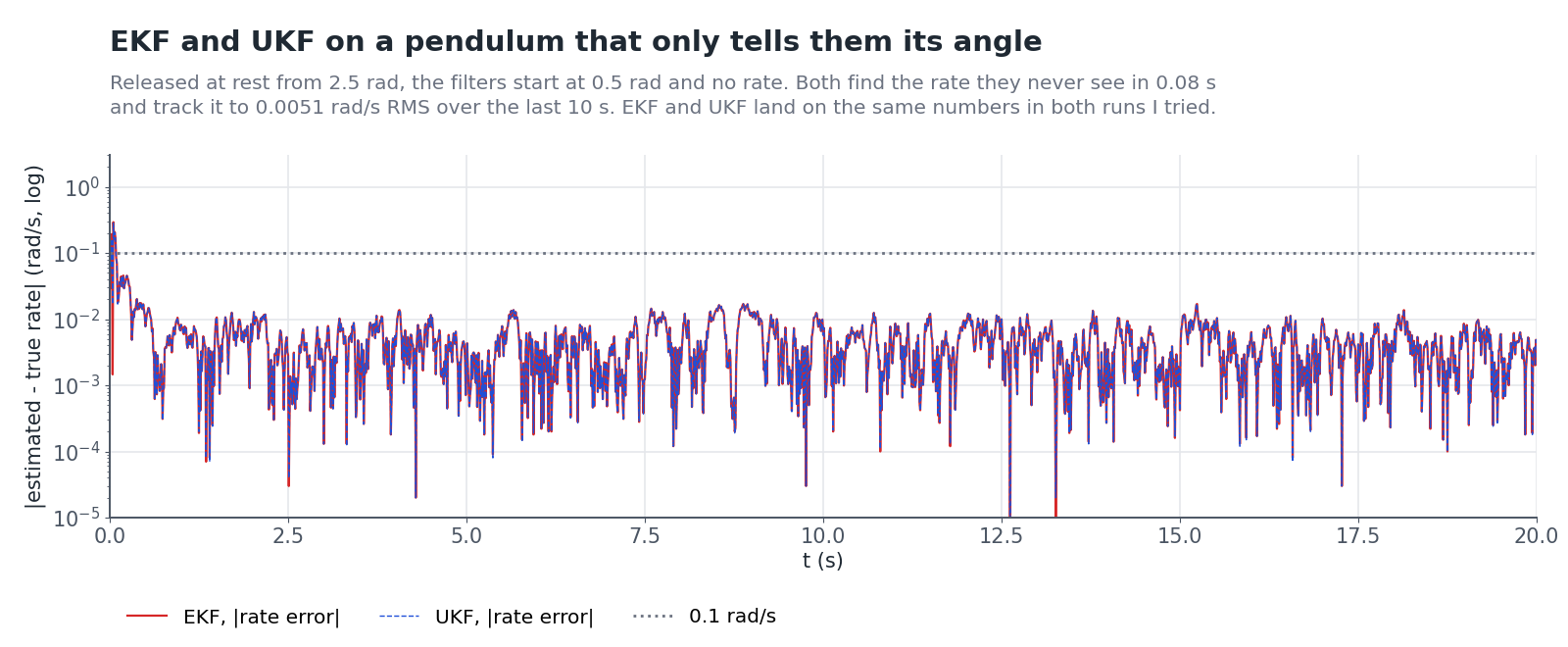 Released from 2.5 rad: both errors drop under 0.1 rad/s in 0.08 s and lie on top of each other for the rest of the run.
Result
With tau 0.1 s instead of 0.5 s the complementary filter’s error drops from 0.0151 to 0.0044 rad RMS, against 1.039 rad for the gyro alone and 0.046 for the accelerometer alone; above 0.1 s the error tracks the bias times tau almost exactly. The EKF and the UKF both recover an unmeasured pendulum rate in 0.08 s and hold it to 0.0046 rad/s RMS from 1.0 rad and 0.0051 from 2.5 rad, with identical numbers. Same results in the float build. All in simulation, on a synthetic IMU with uniform noise and a constant bias.
What I’d do next
Give the EKF/UKF a case where they should differ: a range-and-bearing measurement, or a slow update rate where one prediction step spans a big part of the swing. And put the complementary filter on a real MPU6050 from the driver library, where the bias isn’t constant.