Motion profile and feedforward: 0.30 m to 1.5 mm by moving the derivative
Back to the control library hub
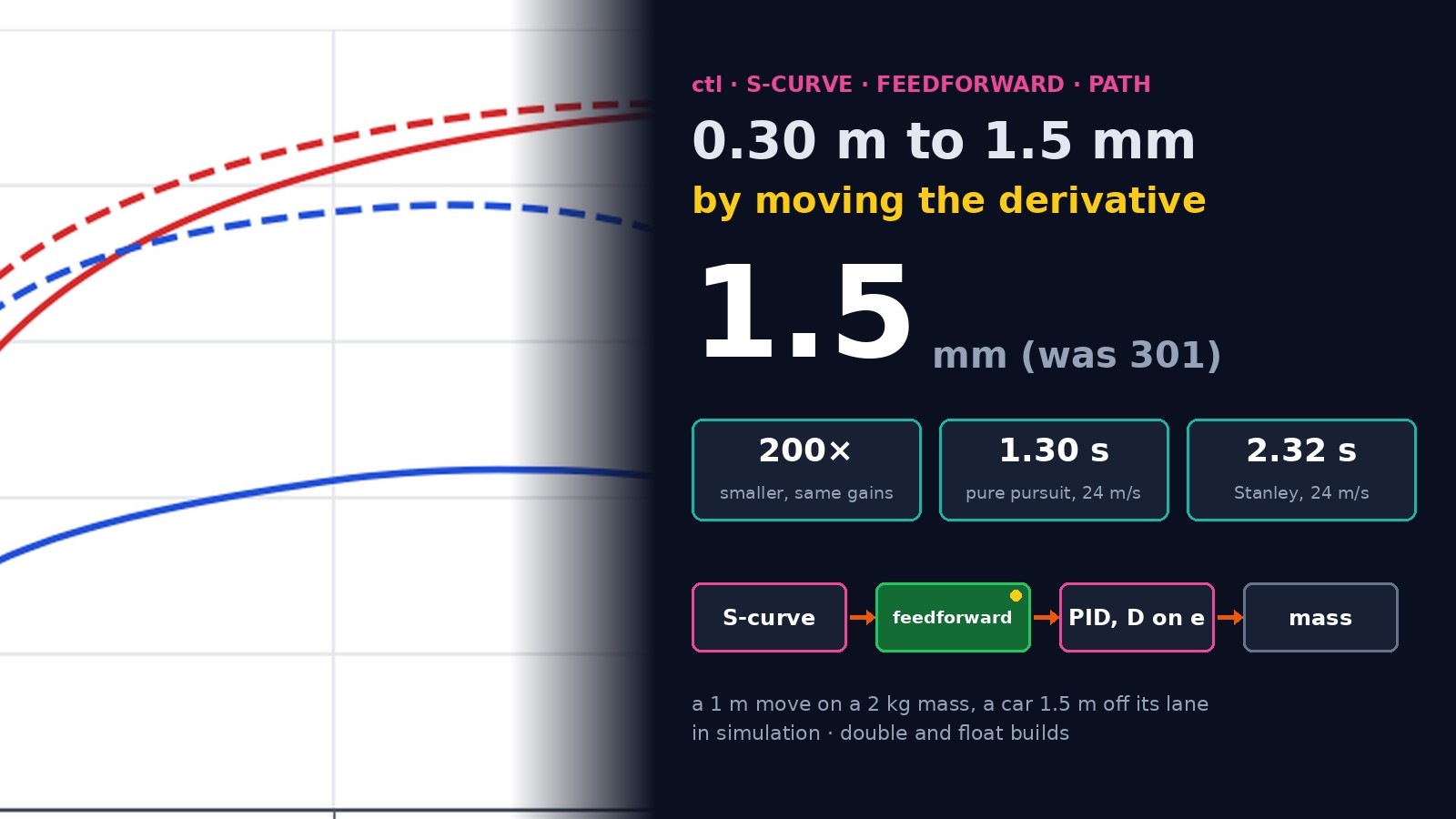 The result first: the same PID and the same feedforward follow a 1 m S-curve to 1.5 mm instead of 301 mm, once the derivative looks at the error. In simulation.
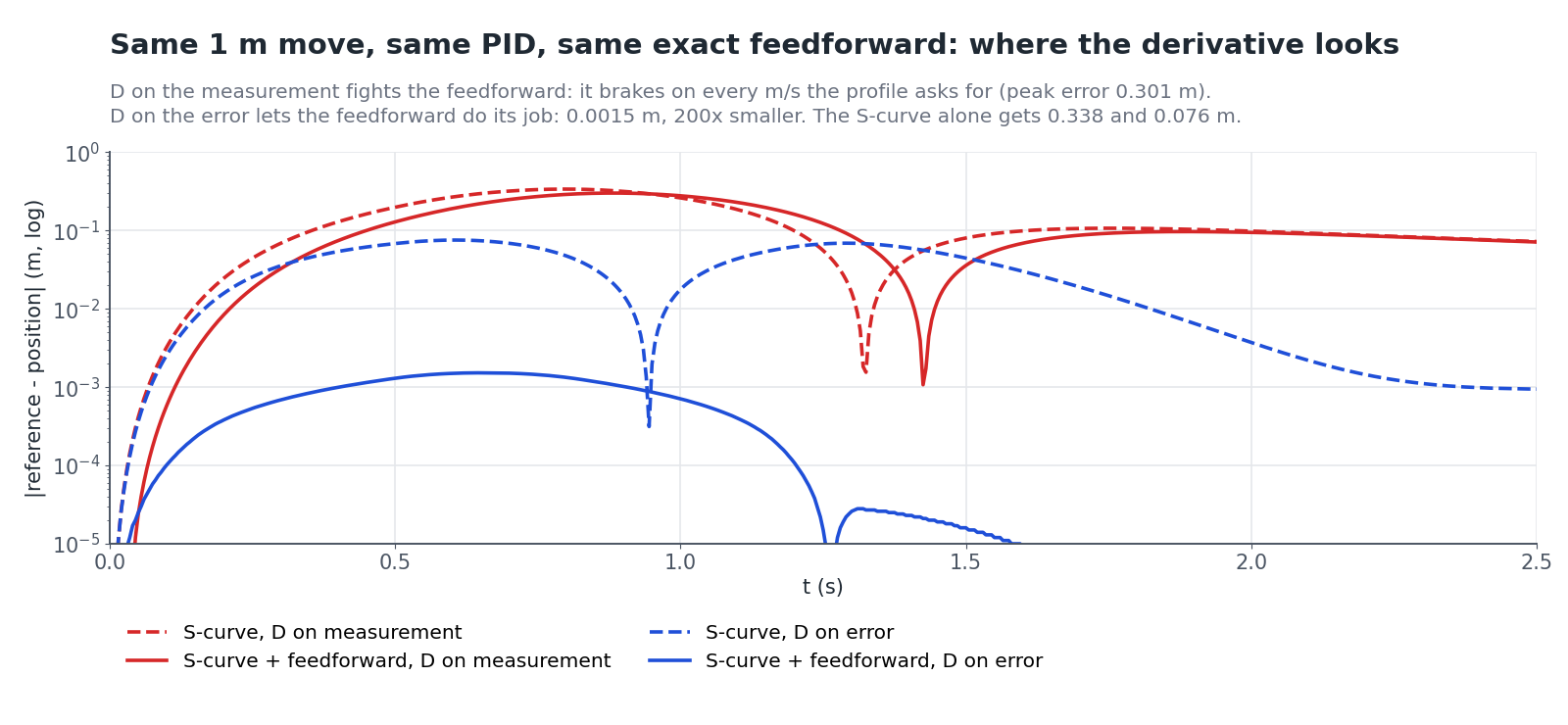 Red: derivative on the measurement, with and without feedforward, both near 0.3 m. Solid blue: derivative on the error plus feedforward, 0.0015 m at worst.
Situation
My controller gallery demo moves a 2 kg mass with 1.5 N·s/m of drag by 1 m, three ways: a bare step, an S-curve profile (1.5 m/s, 3 m/s², 20 m/s³), and the profile plus feedforward of its own velocity and acceleration. The feedforward gains are the exact mass and drag, so in theory the PID has almost nothing left to do. The gallery printed peak errors of 1.00, 0.34 and 0.30 m, and its README read that as “the machine actually following a trajectory it can execute”. 0.30 m of error on a 1 m move with a perfect model is not following anything. Something was fighting the feedforward.
Task
Find what, using the gallery’s own numbers as the baseline, without touching the gains or the plant. Then, since path tracking sits in the same header family, compare the library’s two lateral controllers on the gallery’s car: a kinematic bicycle with a 2.7 m wheelbase starting 1.5 m off its lane, nose turned 0.2 rad away, at 6, 12 and 24 m/s.
Action
The PID in the gallery is set up with setpointWeightD = 0: the derivative acts on the measurement only.
That’s the right habit for steps, because a derivative on the error kicks hard when the setpoint jumps.
On a profiled move it’s the wrong one. The derivative term becomes -Kd·v, a brake on every m/s the profile
asks for, and with Kd = 20 at the profile’s 1.5 m/s that term alone is 30 N, against a feedforward that never
needs more than about 8 N. The feedforward drives, the derivative brakes, and the P and I terms only
push back once there’s enough position error to do it with. That error is the 0.30 m.
I reran the move in controller_traces (the measurement demo next to the gallery) with the derivative
on the error, setpointWeightD = 1, nothing else changed:
step command                   peak tracking error 0.99997 m
S-curve, D on measurement      peak tracking error 0.33843 m
S-curve + ff, D on measurement peak tracking error 0.30113 m
S-curve, D on error            peak tracking error 0.07562 m
S-curve + ff, D on error       peak tracking error 0.00152 m
With the derivative on the error the profile alone already gets to 0.076 m, and with the feedforward the error is 0.0015 m, 200× smaller than the gallery’s best row. In that run the feedback part of the command never exceeds 0.003 N; the feedforward does the whole move. There’s no derivative kick to worry about either: an S-curve’s position reference is smooth, and its velocity starts at zero. The CNC axis story on the plant models hub does the same thing on a full servo axis with a resonance, where it takes the error down to 1.48 µm.
The path trackers are less dramatic and more interesting. Pure pursuit steers toward a point a speed- dependent distance ahead (3 m + 0.4 s × v); Stanley steers on the cross-track error at the front axle (k = 1.2):
| speed | pure pursuit: inside 10 cm after | peak steer | Stanley: inside 10 cm after | peak steer |
|---|---|---|---|---|
| 6 m/s | 2.10 s | 0.412 rad | 2.06 s | 0.470 rad |
| 12 m/s | 1.55 s | 0.253 rad | 2.12 s | 0.343 rad |
| 24 m/s | 1.30 s | 0.132 rad | 2.32 s | 0.273 rad |
At walking pace they’re even. As the speed goes up, pure pursuit’s lookahead grows with it, so it steers less and still gets back sooner. Stanley’s gain is on the error divided by the speed, so it gets softer as the car gets faster and its tail drags out. Pure pursuit isn’t free though: at 24 m/s it swings out to about 2.0 m before turning back and crosses the line by 9 cm, where Stanley peaks at 1.78 m and never crosses. Both end on the line at 15 s.
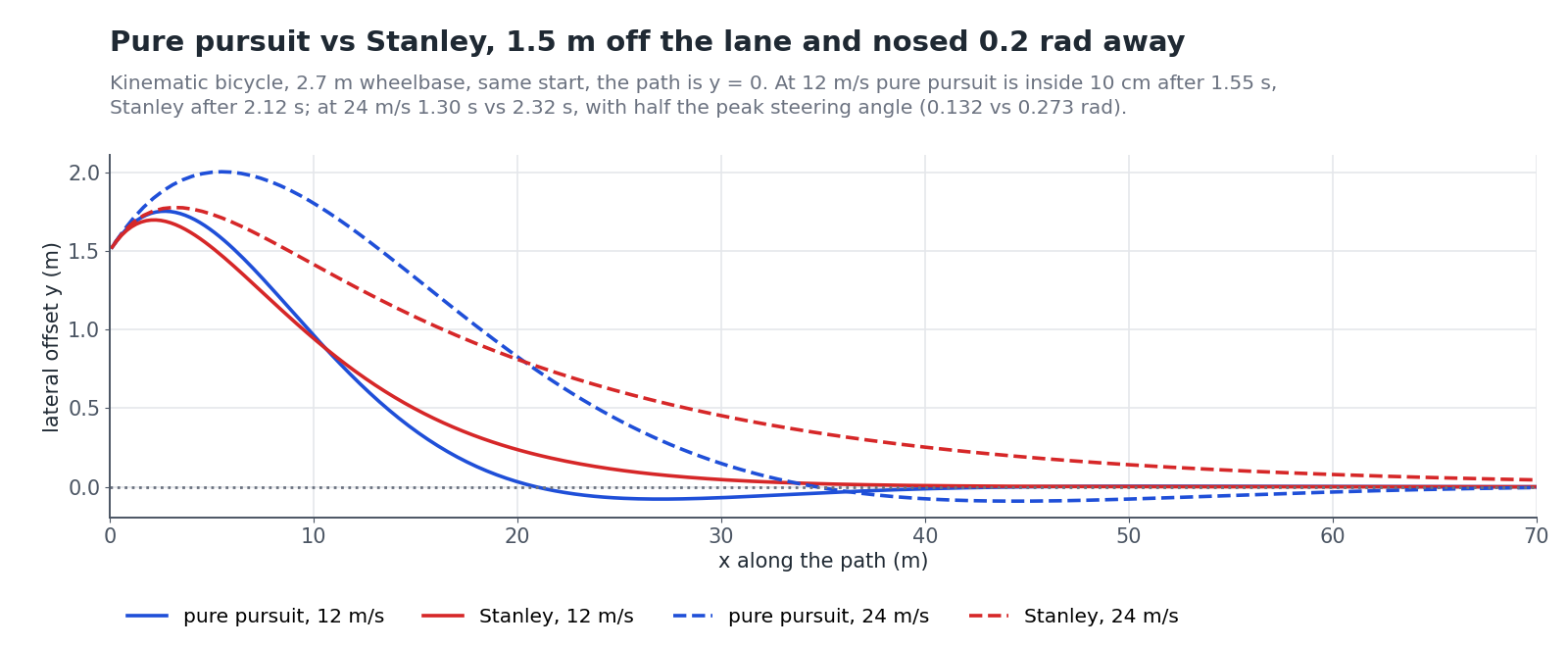 Blue, pure pursuit: back on the lane sooner, with a wider first swing and a small overshoot. Red, Stanley: no overshoot, a long tail at 24 m/s.
Result
Same gains, same exact feedforward: moving the PID’s derivative from the measurement to the error takes the peak tracking error of the 1 m S-curve from 0.301 m to 0.0015 m. On path tracking, pure pursuit gets within 10 cm of the lane after 1.30 s at 24 m/s with a peak steering angle of 0.132 rad, Stanley after 2.32 s with 0.273 rad; at 6 m/s they’re within 0.04 s of each other. Same numbers in the float build. All in simulation, on a kinematic car with no tyre slip.
What I’d do next
Fix the gallery itself so its printed line stops underselling feedforward, and give ctl::Pid a comment
next to setpointWeightD saying when 0 is wrong. Then run both path trackers on a curved path with a
dynamic tyre model, where Stanley is supposed to earn its keep.