Cart-pole swing-up: energy pump, then a hand-over to LQR
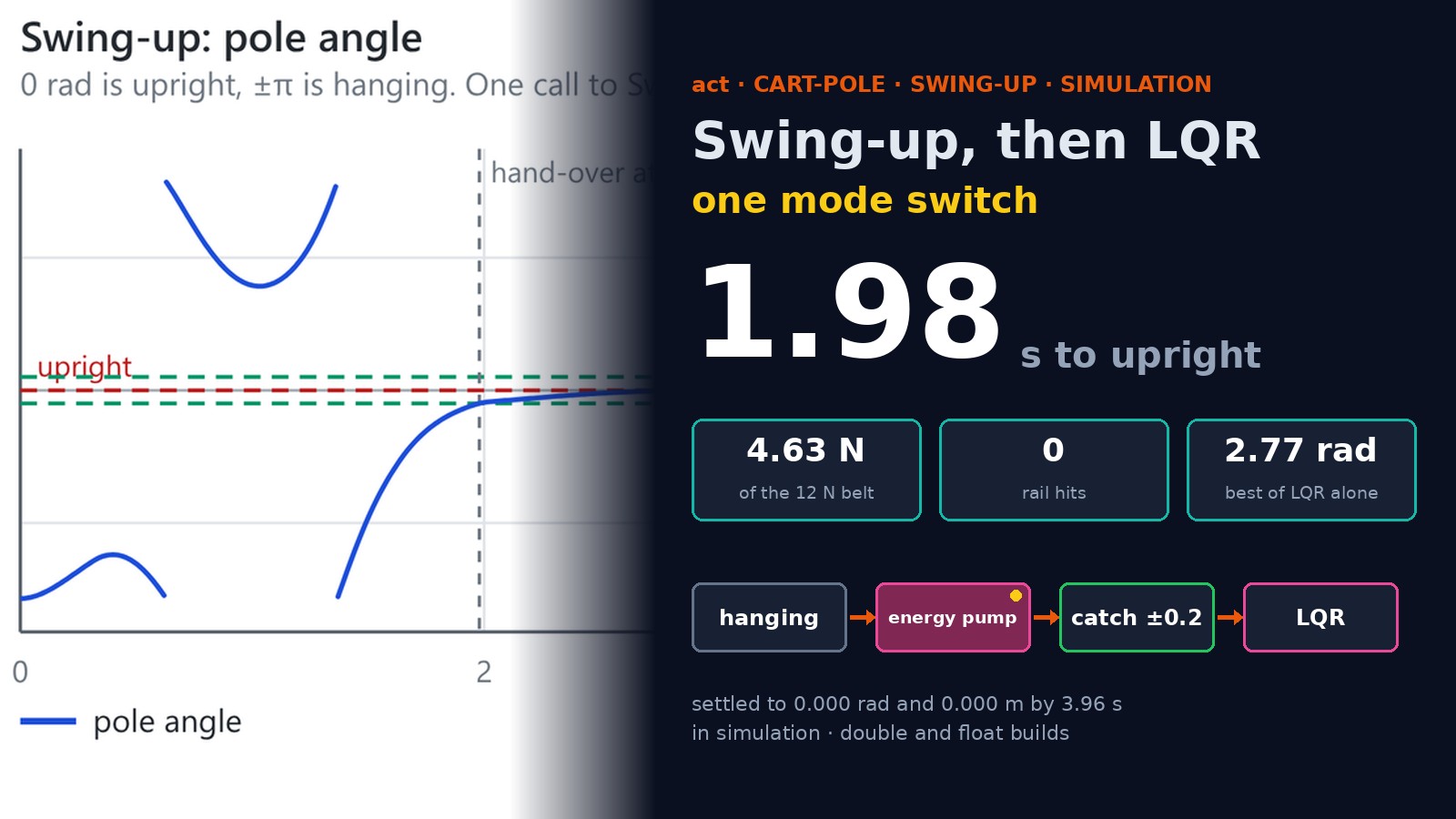 The result first: upright 1.98 s after release with 4.63 N of the 12 N belt; LQR alone never gets closer than 2.77 rad.
Situation
The classic teaching rig: a cart on a 1.2 m rail, belt-driven with a 12 N force limit, a 0.6 m pole on a free bearing. Balancing it upright with an LQR is the easy demo. Getting it up there from hanging is the one I actually wanted, because the same structure (a nonlinear law to reach the region where a linear law works, then a switch) shows up in a lot of real machines.
Task
Start hanging, end upright and centred, without ever hitting the rail end-stops or exceeding the belt. And show what happens if you skip the swing-up and just turn on the LQR.
Action
The pump regulates one number, the pole’s energy, defined as zero upright and still (−1.18 J hanging). It’s bang-bang on sign(ω·cos θ), limited to an acceleration far below what the belt can do: at full authority the cart would travel metres before the pole was up, and the track is 1.2 m.
The balancer is a discrete LQR on the four-state linearisation about upright (cart position, cart velocity, angle, rate). Q = diag(25, 5, 60, 2), R = 0.05. The cart-position weight is the one that matters: with it near zero the pole balances beautifully while the cart drifts off the end of the rail.
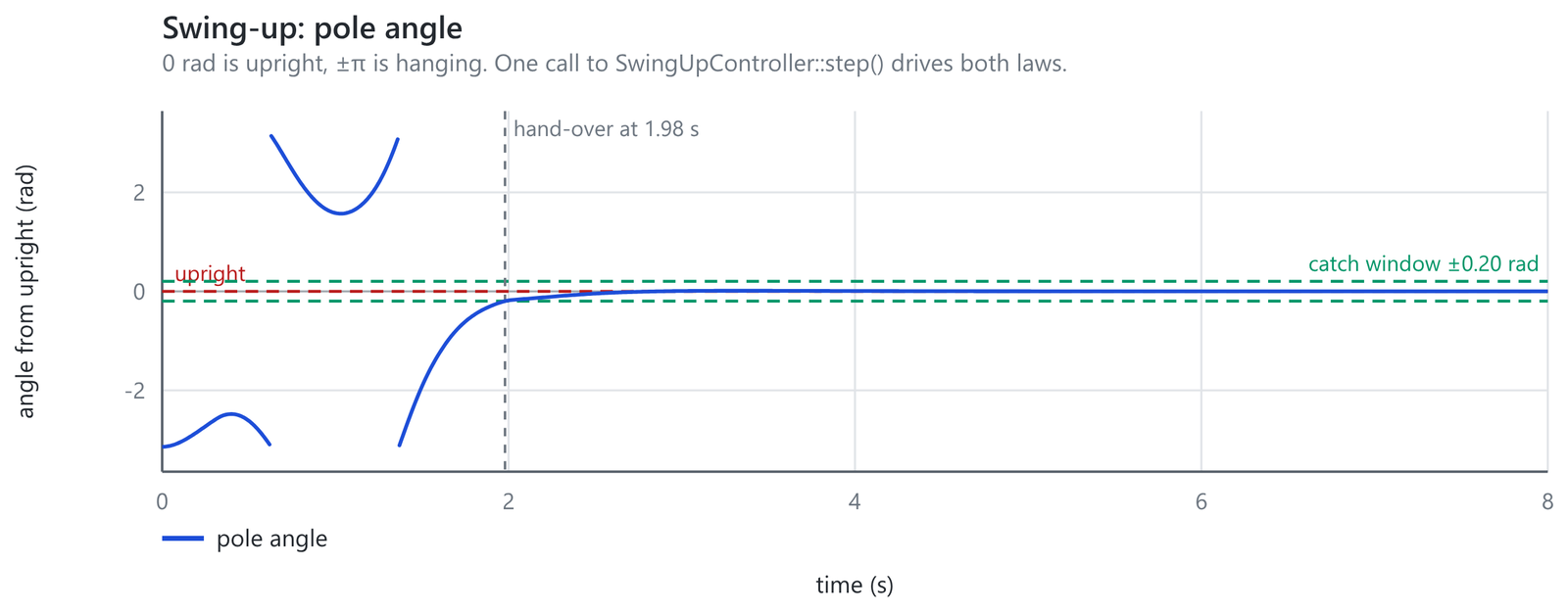
The hand-over condition is |θ| < 0.20 rad and |ω| < 1.1 rad/s. The rate part is easy to forget. A pole sweeping through upright at 5 rad/s is momentarily at zero angle, and catching it there hands the LQR angular momentum that no bounded cart force can absorb in a few degrees. The cart then chases the pole into the end stop.
$ ./build/products/pendulum_swingup
  gain on pole angle                             -91.8068 N/rad
  time to first catch                              1.9800 s        ok
  mode switches                                         1
  peak cart excursion                              0.5130 m
  peak force actually applied                      4.6270 N
  final |angle|                                    0.0000 rad      ok
  rail end-stop hits                               0.0000          ok
  closest the pole ever came to upright            2.7742 rad
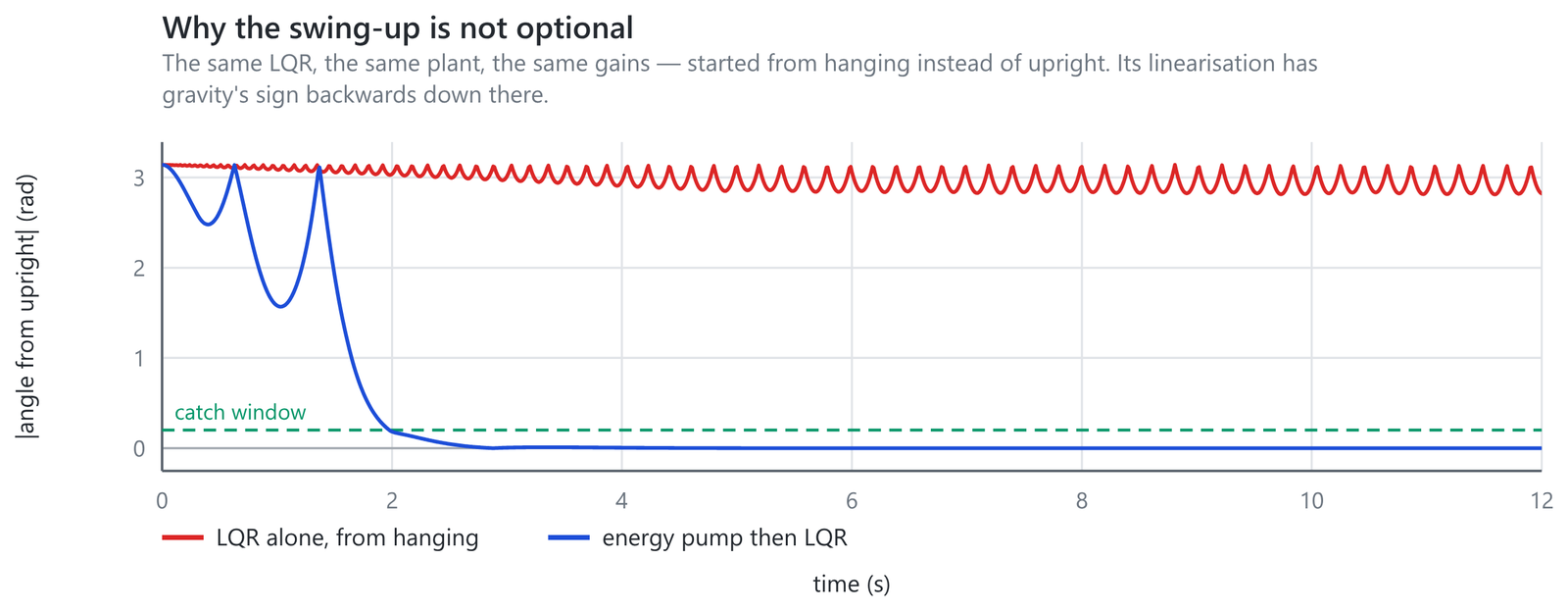
That last line is the LQR alone from hanging. At θ = π the linearised model thinks gravity restores rather than topples, the feedback sign is effectively inverted, and the controller pushes the pole away from upright for the whole run.
Result
Swing-up reaches the catch window 1.98 s after release with one mode switch, settles to 0.000 rad and 0.000 m by 3.96 s, uses 4.63 N of the 12 N belt and never touches the rail ends (peak excursion 0.51 m). The LQR alone never gets closer than 2.77 rad to upright. Same in the float build.
What I’d do next
Run it with the act backlash and encoder quantisation switched on. A real belt has both, and I suspect the
catch window needs to shrink.