Piezo stage: learning control vs an inverse model, and the answer I didn’t expect
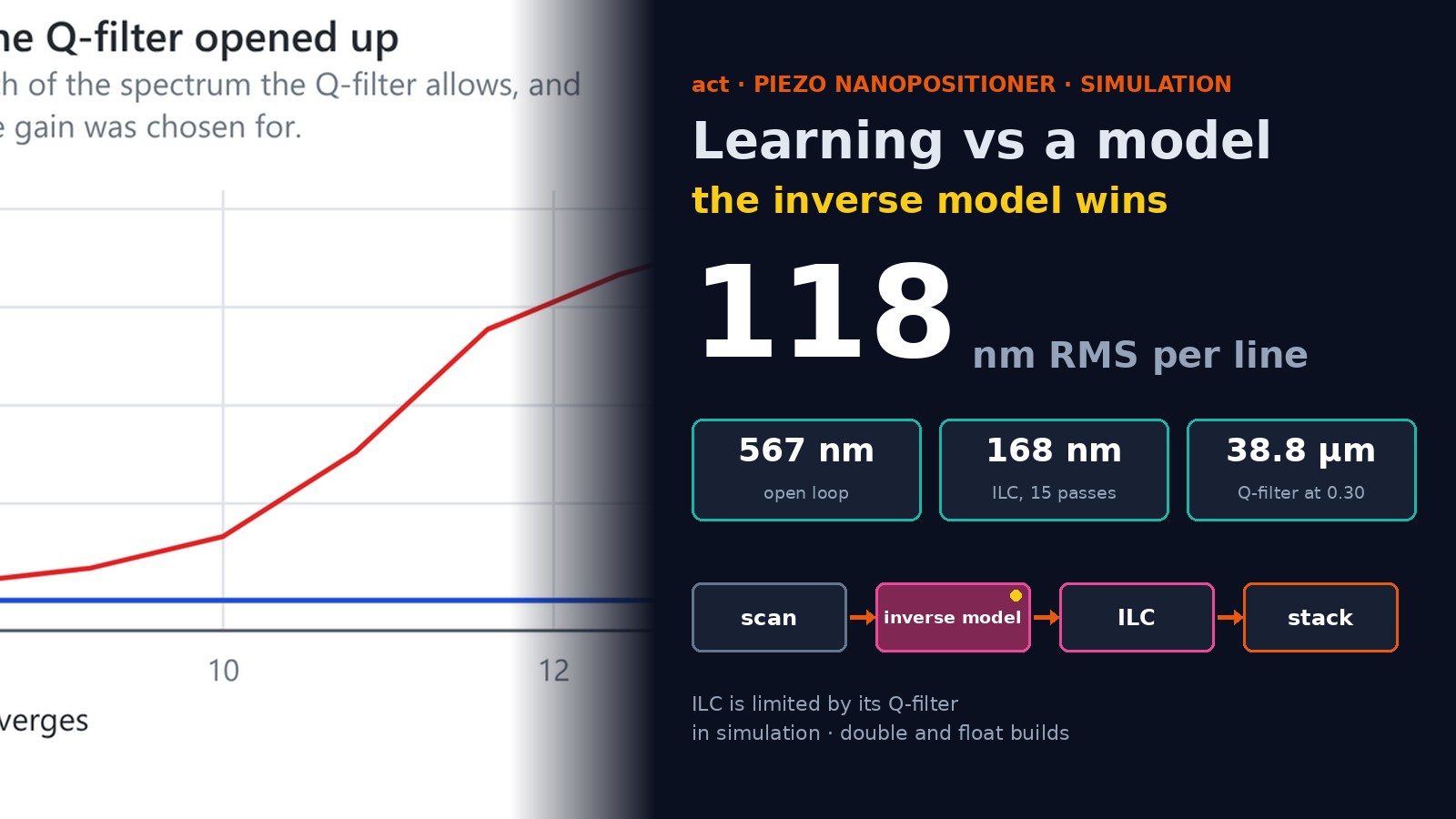 The result first: 118 nm RMS per scan line with the inverse model, 168 nm with learning, 567 nm open loop.
Situation
A piezo stack resolves sub-nanometre steps and has 13 % hysteresis, which on a 15 µm scan is about 2 µm of error on an actuator sold for its resolution. The scanning stage of a microscope runs the same raster line over and over, so the error isn’t noise, it repeats. I wrote this demo expecting iterative learning control (ILC) to win: it learns the repeating error with no model at all.
Task
One 40 ms raster line on a 20 µm stage (resonance at 4 kHz, ζ = 0.012). Compare open loop, a feedforward inverse of the hysteresis (Prandtl-Ishlinskii, closed form), ILC from the nominal command, and ILC on top of the inverse.
Action
The scan is a raised cosine, not a triangle: a triangle’s corners have energy at the 4 kHz resonance, where the gain is forty times its DC value, and the ringing would swamp every number after it.
1: open loop, nominal gain only
  RMS tracking error                             566.7650 nm
  forward-versus-reverse offset                  940.4163 nm
2: feedforward hysteresis inversion
  RMS tracking error                             118.0219 nm
3a: learning from the nominal command, no hysteresis model
  pass  1   RMS error     566.77 nm
  pass  2   RMS error     409.40 nm
  pass 15   RMS error     168.35 nm
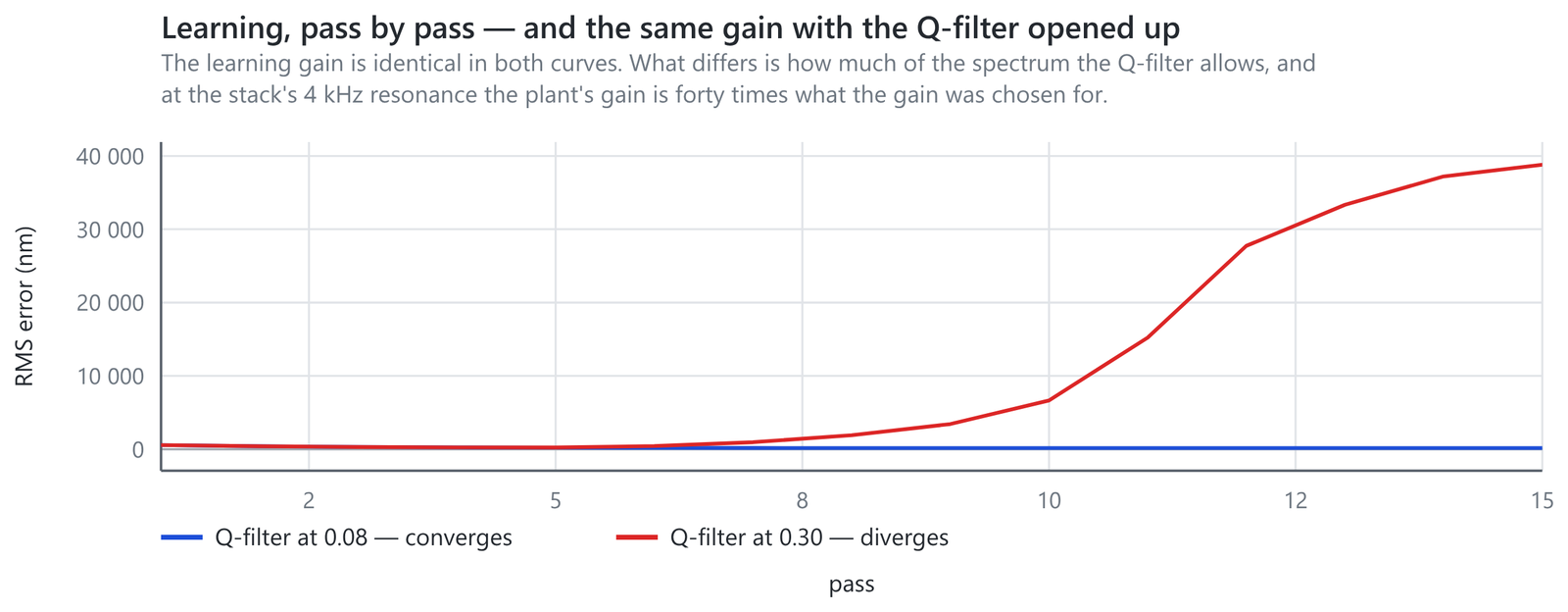
ILC gets most of the way, but its floor is set by the Q-filter, which has to throw away enough spectrum to stay stable against that lightly damped resonance. Opening the Q-filter (0.08 → 0.30) with the same learning gain makes it blow up instead:
3b: the same gain with the Q-filter opened up
  pass 15   RMS error   38808.17 nm
And learning on top of the inverse doesn’t help either. It starts at 118 nm, goes up to 179 nm on pass 2, and ends at 169 nm, i.e. back at the learning-only floor.
Result
RMS error per scan line: 567 nm open loop, 168 nm after 15 passes of ILC with no model, 118 nm with the closed-form hysteresis inverse. The inverse wins here because the dominant error is a memoryless nonlinearity that a model captures exactly, while ILC is limited by its Q-filter. With the Q-filter opened to 0.30 the same ILC diverges to 38.8 µm. Same verdict in the float build.
What I’d do next
I think the result is generous to the model: the inverse was written for the hysteresis I simulated, so it fits it well. With a hysteresis shape the inverse doesn’t match, and creep (1.5 % per decade in the model) over a longer run, I’d expect ILC to catch up. Not run yet.