3D printer hotend: one step test, SIMC gains, and the thermistor that falls out
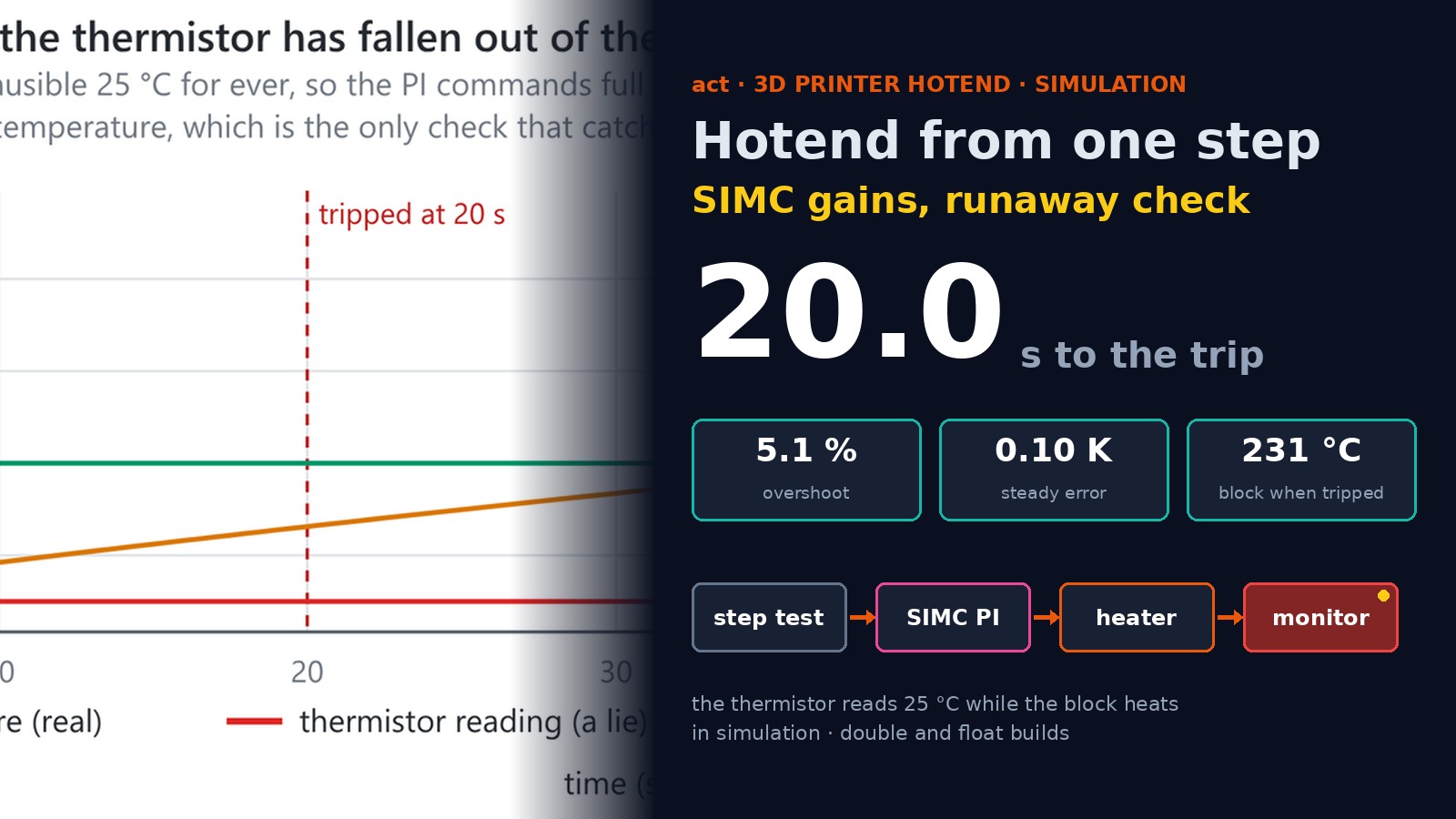 The result first: 5.1 % overshoot from one step test, and the fallen-out thermistor is caught in 20.0 s at 231 °C.
Situation
A desktop printer’s hotend: a 40 W cartridge heater in an aluminium block, a thermistor in a well next to it, a MOSFET switching at a few hertz, and a part-cooling fan that takes heat away the moment a print starts. The plant is so slow that a trial-and-error tuning round costs half an hour. And the failure that matters is not a bad tuning, it’s a thermistor that comes loose and reads room temperature while the heater runs flat out.
Task
Fit a first-order-plus-dead-time model from a single step of heater power, compute PI gains with Skogestad’s SIMC rules, check it against a fan coming on at 300 s, then pull the thermistor out of the block and make sure something notices.
Action
The step test (0.4 duty) gives three numbers. The model in the simulator is actually two thermal nodes with radiation, so the fit is an approximation on purpose:
  fitted gain                                    272.0954 K per unit duty
  fitted time constant                           118.5462 s
  fitted dead time                                 3.8357 s
  controllability ratio (theta/tau)                0.0324
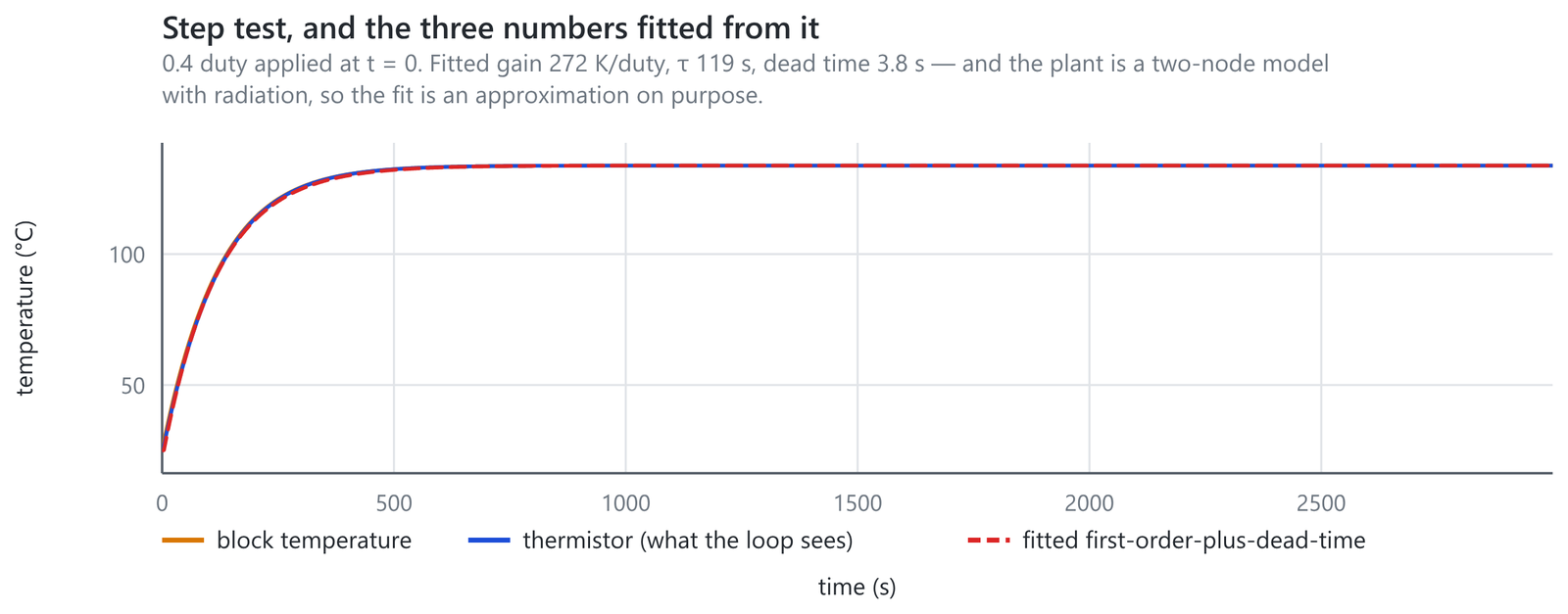
θ/τ = 0.03 means lag-dominant, so a PI is enough. SIMC gives Kp = 0.057 duty/K and an integral time of 30.7 s, plus a feedforward duty of 0.51 for the setpoint:
  overshoot                                        5.1365 %
  settling time (2% band)                        203.3500 s
  steady-state error                               0.0967 K
  worst dip when the fan starts                    2.0602 K
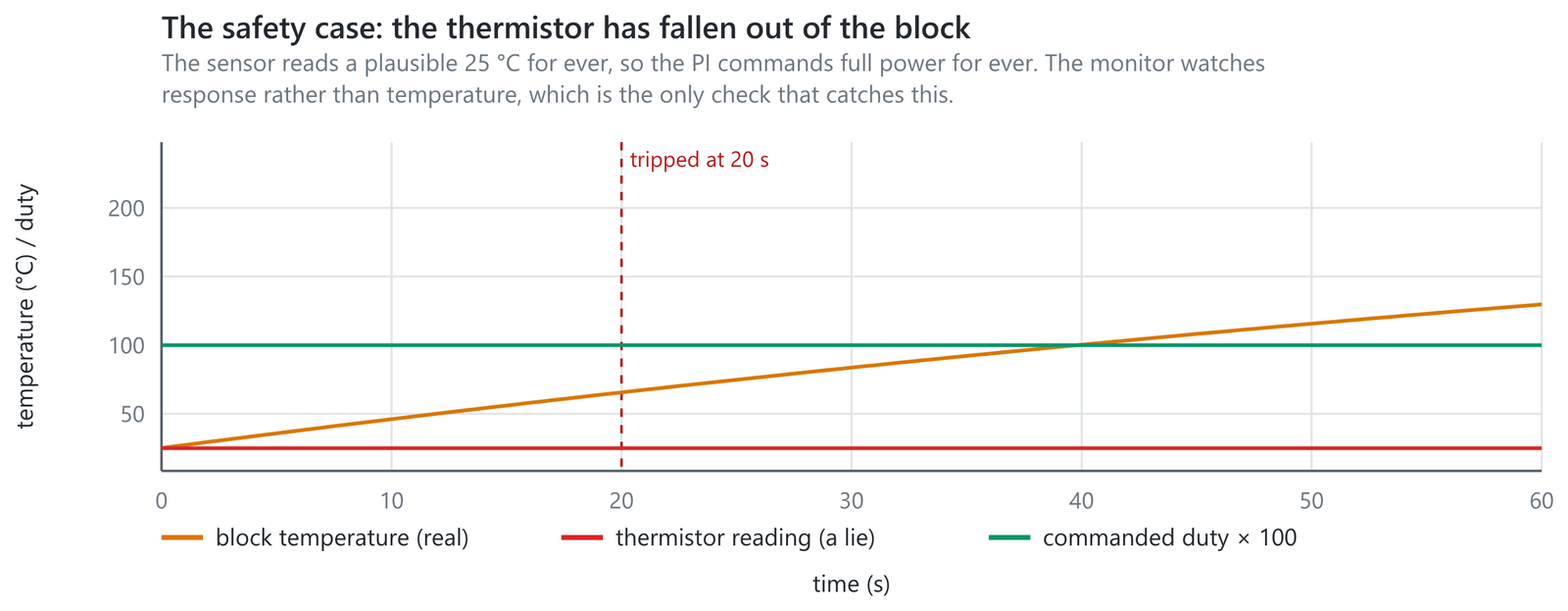
For runaway, an absolute temperature limit is useless here: the loose thermistor reads a believable 25 °C, so the loop commands full power forever and the limit never sees anything. The check that works watches response: full power must produce a rise within 20 s. If it doesn’t, it doesn’t matter whether the sensor, the heater or the mechanics failed, the safe action is the same.
Thermal runaway: the thermistor falls out of the block
  block temperature when the trip fired          231.4713 C
  time to trip                                    20.0000 s
Result
From one step test the SIMC PI reaches the setpoint with 5.1 % overshoot, settles in 203 s, holds 0.10 K steady error and dips only 2.1 K when the fan starts. When the thermistor falls out, the response check trips in 20.0 s with the block at 231 °C, a case no absolute limit would have caught. Same in the float build.
What I’d do next
231 °C in 20 s is fast enough to scorch PLA. The trip window could depend on the commanded duty, so a full-power command gets a shorter window. I’d also like to rerun the step fit with heater power ±10 %, since cheap cartridges vary.